




Large industrial projects are not built overnight, nor are they advanced by a single announcement. They evolve through a structured process in which engineering, commercial development, financing and systematic de-risking progressively reinforce one another. With each milestone, uncertainty is reduced and confidence in the project’s long-term viability continues to grow.
Institutional project finance generally enters the picture only after a project has reached a level of technical maturity that allows lenders to conduct independent due diligence and, if satisfied, provide the long-term capital required for construction.
Banks rarely finance ideas. They finance projects that have progressed far enough to withstand independent technical, commercial and financial scrutiny.
Against that backdrop, Homerun Resources’ announcement of a signed Letter of Intent (LOI) from a leading European project finance bank for a proposed financing facility of up to 170 million EUR may represent an important milestone in the company’s transition from engineering to institutional financing.
The timing appears consistent with the recent completion of the company’s Bankable Feasibility Study (BFS), which established the technical and economic foundation for discussions with long-term project finance institutions.
Today’s announcement should not be interpreted as secured financing. Homerun appropriately notes that any future financing remains subject to comprehensive technical, commercial, legal and financial due diligence, together with syndication and final credit approvals. These are standard elements of institutional project finance and reflect the rigorous process through which large industrial projects are evaluated before financing commitments are made.
Another noteworthy aspect of today’s announcement is the financing amount itself: The proposed facility of up to 170 million EUR appears closely aligned with the project’s engineering and may offer an early indication of how the financing strategy is taking shape.
Viewed alongside Homerun’s recent milestones (including completion of the BFS, inclusion in Bahia’s Programa Desenvolve industrial incentive program and the appointment of Benchmark and StoneX to support broader financing initiatives), today’s announcement represents another step in a broader financing strategy.
This report explores why that may matter, how large industrial projects are typically financed and why the BFS may have marked an important turning point in Homerun’s transition toward institutional project finance, including how institutional lenders typically evaluate industrial projects before committing long-term construction capital.
WHEN ENGINEERING BECOMES FINANCEABLE
Project financing is often perceived as a single event: Financing is announced, construction begins and the project moves forward. Industrial projects approaching 400 million USD, however, are typically financed through a carefully assembled combination of debt, equity, government support and strategic partnerships.
Engineering therefore comes first. Financing follows. This progression helps explain the sequence of Homerun’s announcements over the past year. The company’s earlier efforts focused primarily on reducing technical uncertainty:
- Exploration confirmed an exceptionally pure low-iron silica resource in Bahia.
- Metallurgical work demonstrated purification pathways.
- Engineering studies evaluated manufacturing configurations, process flows, capital requirements and operating assumptions.
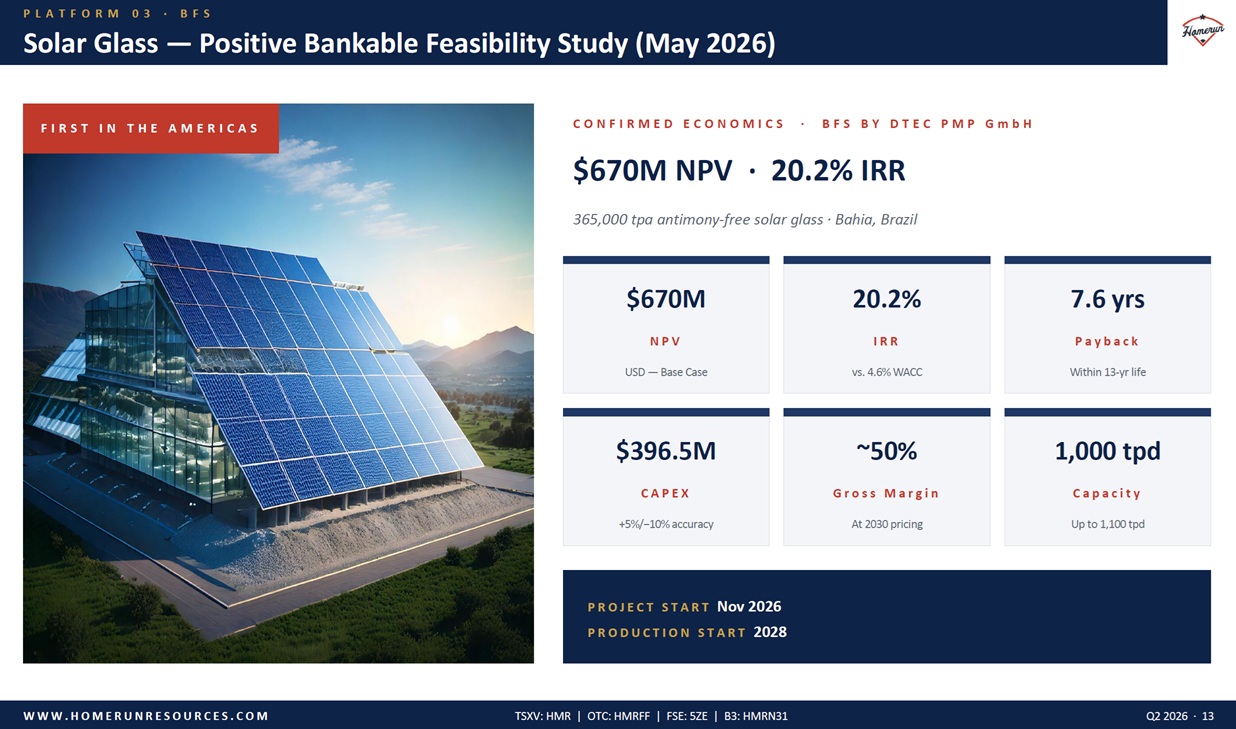
Those efforts culminated in the publication of the company’s BFS, outlining a proposed 1,000 tonne/day solar glass manufacturing facility with estimated CAPEX of ~396.5 million USD.
Since the completion of the BFS, the company’s announcements have increasingly shifted toward commercial execution and financing. The question is no longer whether the project can be engineered, but increasingly how it may ultimately be funded.
That transition reflects an important shift in how the project is evaluated. Large institutional lenders rarely finance concepts. They typically become involved only after a project has reached a stage where its engineering, economics and commercial foundations are sufficiently advanced to support independent institutional review.
Whether Homerun ultimately secures the financing currently under discussion remains uncertain. What has already changed, however, is the framework within which the project is now being evaluated. Following completion of the BFS, the Solar Glass Project appears to have entered the institutional project finance process, where engineering gives way to lender due diligence and financing evaluation
WHERE ENGINEERING MEETS FINANCE
For many retail investors, a BFS marks the finish line of a project’s technical development. For institutional lenders, however, it marks the beginning of a much more rigorous review process.
This helps explain why Homerun’s latest financing announcement follows naturally after the publication of its BFS. Unlike preliminary economic assessments or conceptual studies, a BFS is intended to provide the level of engineering detail necessary for financiers, strategic partners and independent technical advisors to evaluate a project in depth and begin a formal institutional review.
A completed BFS transforms an industrial concept into a project that is ready for institutional due diligence. It establishes the technical foundation upon which lenders can determine whether the project is capable of supporting long-term project financing.
From that point onward, institutional lenders typically conduct their own comprehensive technical, legal, environmental and financial due diligence before making any financing decision.
Homerun’s CEO, Brian Leeners, framed the announcement in a way that captures the broader significance of the LOI. Rather than focusing solely on the proposed financing amount, he emphasized what the engagement may represent in terms of the project’s institutional readiness:
“This letter of intent from a leading European project finance bank is a strong validation of the work we have done to structure the Solar Glass Project as a bankable asset. We are honoured by this indication of interest and encouraged by the calibre of institutions now engaging with us as we advance project financing toward completion.”
The phrase “bankable asset” is particularly noteworthy because it reflects the language of institutional project finance rather than that of early-stage project development. Rather than emphasizing geology, engineering or resource quality, it points toward the process of demonstrating that a completed industrial facility may satisfy the requirements necessary to attract long-term institutional capital. While the announced LOI does not constitute financing, the terminology itself suggests that discussions are increasingly taking place within that institutional framework.
CONNECTING TECHNOLOGY AND CAPITAL
Some investors may naturally ask why a European financial institution would become involved in financing a manufacturing facility located in Brazil.
Large solar glass facilities rely heavily on specialized European equipment. In such cases, financing often follows the equipment, with European project finance institutions and export credit agencies frequently supporting overseas industrial projects.
Although Homerun has not disclosed the identity of the financial institution involved, the financing structure described in the news-release appears broadly consistent with internationally recognized project finance practices.
FINANCING BY DESIGN
One detail within Homerun’s latest announcement deserves closer examination: The proposed financing facility of up to 170 million EUR.
The figure does not appear arbitrary.
It closely corresponds to the equipment package identified in the BFS, suggesting that financing discussions are increasingly being structured around specific engineering work packages rather than a single headline capital requirement.
That approach is entirely consistent with the way many large industrial projects are financed. Different portions of the overall CAPEX are frequently matched with different funding sources. Equipment packages may qualify for export credit-supported financing. Construction costs may be financed separately. Working capital often requires dedicated facilities. Strategic investors may contribute equity. Government incentives may improve cash flow and reduce financing requirements.
Large industrial projects are rarely financed by a single institution. Project owners typically assemble multiple complementary funding sources that collectively fund construction.
Viewed from this perspective, the proposed 170 million EUR facility appears less like financing for an entire project and more like one component of a broader capital structure in which different sources of funding are matched to different project requirements.
BANKS THINK DIFFERENTLY THAN THE STOCK MARKET
Understanding today’s announcement ultimately requires recognizing that institutional project finance lenders evaluate industrial projects through a fundamentally different lens than public equity markets.
Public markets often react to newsflow, financing announcements and short-term share price movements. Institutional lenders generally do not. Their primary concern is whether a completed facility can reliably generate sufficient cash flow to service long-term debt over many years.
As a result, lenders devote far more attention to questions such as:
- Engineering quality and technical design
- Construction execution and completion risk
- Operating costs and projected margins
- Equipment selection and long-term reliability
- Raw material supply and logistics
- Customer contracts and revenue visibility
- Long-term market demand
These are the factors that ultimately determine whether a project can support institutional financing.
The milestones that matter most to institutional lenders are therefore not always the same milestones that receive immediate attention in the stock market.
That difference in perspective may also help explain why Homerrun’s recent announcements have increasingly focused on engineering progress, financing initiatives, government incentives and systematic project de-risking as the company advances toward potential project financing.
RISK REDUCTION DRIVES BANKABILITY
Institutional financing is rarely secured through a single announcement. Large industrial projects generally become financeable through the systematic reduction of technical, economic, financial, commercial and execution risks over time: A process commonly referred to as de-risking.
Each milestone helps reduce uncertainty, strengthens lender confidence and expands the body of independently verifiable information available for institutional due diligence, thereby progressively strengthening the project’s overall bankability.
Viewed through this lens, Homerun’s recent announcements appear less like isolated corporate updates and more like a systematic effort to address each category of risk in turn.
Technical Risk: Can the project be built?
The project is now supported by detailed engineering, defined process flows, equipment specifications, capital cost estimates and operating models. Institutional lenders do not expect industrial projects to be risk-free. They expect risks to be identified, measured and managed.
Economic Risk: Can the project generate attractive returns?
A project must also demonstrate the potential to generate sufficient economic returns over its operating life. Homerun’s BFS estimated a post-tax Net Present Value (NPV) of ~670 million USD, an Internal Rate of Return (IRR) of 20.2% and a projected payback period of ~7.6 years.
Institutional lenders nevertheless stress-test construction costs, operating expenses, energy prices and product pricing before committing capital. Bankability depends not only on projected profitability but also on the ability to withstand uncertainty.
Financial Risk: Can the project be financed?
Raising construction capital remains one of the largest challenges for any major industrial project. For Homerun, recent announcements suggest that financing efforts are progressing on multiple fronts simultaneously.
- The inclusion of the project within Bahia’s Programa Desenvolve industrial incentive program has the potential to improve cash flow efficiency by deferring eligible ICMS obligations, thereby strengthening the project’s overall financial framework.
- The appointment of Benchmark and StoneX broadened the company’s access to institutional capital markets and financing expertise.
- Today’s announced LOI from a leading European project finance bank extends those efforts into the area of long-term project debt.
Each initiative addresses a different component of the financing strategy. Together, they suggest that financing is being approached as a structured process rather than a single transaction.
Commercial Risk: Can the product be sold?
Commercial readiness represents another important component of bankability.
For a solar glass project of this scale, lenders will ultimately need confidence that the planned production can be sold into a sufficiently large and durable market at prices capable of supporting the project’s operating and financing obligations. That confidence may be demonstrated through customer relationships, commercial agreements or other evidence of market demand.
Projects are financed not only because they can manufacture products, but because those products are expected to generate sustainable revenues over the life of the debt.
Execution Risk: Can the project be successfully delivered?
Execution risk never disappears, it evolves. As projects mature, geological and technical uncertainty gradually gives way to financing, procurement, construction and operational execution.
Institutional lenders seek evidence that these evolving risks have been identified, measured and can be effectively managed.
THE EMERGING PATTERN
Looking across Homerun’s recent announcements, a broader pattern begins to emerge. Each milestone appears to strengthen the project’s readiness for institutional financing by progressively reducing the technical, commercial and financial uncertainties that lenders typically evaluate.
Commercial development continues alongside these initiatives, adding another important dimension to the project’s advancement. No single announcement determines whether the Solar Glass Project will ultimately be constructed. Viewed within the broader context of the project’s development, however, the announcements resemble the progression commonly observed as large industrial projects advance toward financial close.
For retail investors, this broader perspective may be more informative than viewing each announcement independently. Project success rarely depends on any single milestone. It is reflected in the gradual accumulation of engineering, commercial and financing progress that strengthens institutional confidence: A process that ultimately determines whether a project becomes financeable.
THE ROLE OF SYNDICATION
One aspect of Homerrun’s announcement that may receive relatively little attention from retail investors is the reference to syndication.
In project finance, a single institution does not always retain the entire financing exposure. The arranging bank often structures the transaction before inviting additional financial institutions to participate. This distributes risk among multiple lenders while allowing larger financing packages to be assembled than any one institution might provide independently.
Accordingly, today’s announced LOI contemplates not only arranging the financing, but also structuring and syndicating it: A process commonly associated with the financing of large-scale industrial projects requiring substantial amounts of long-term capital.
AN EVOLVING INVESTMENT STORY
Beyond the financing itself, today’s announcement may also reflect a broader evolution taking place within Homerun.
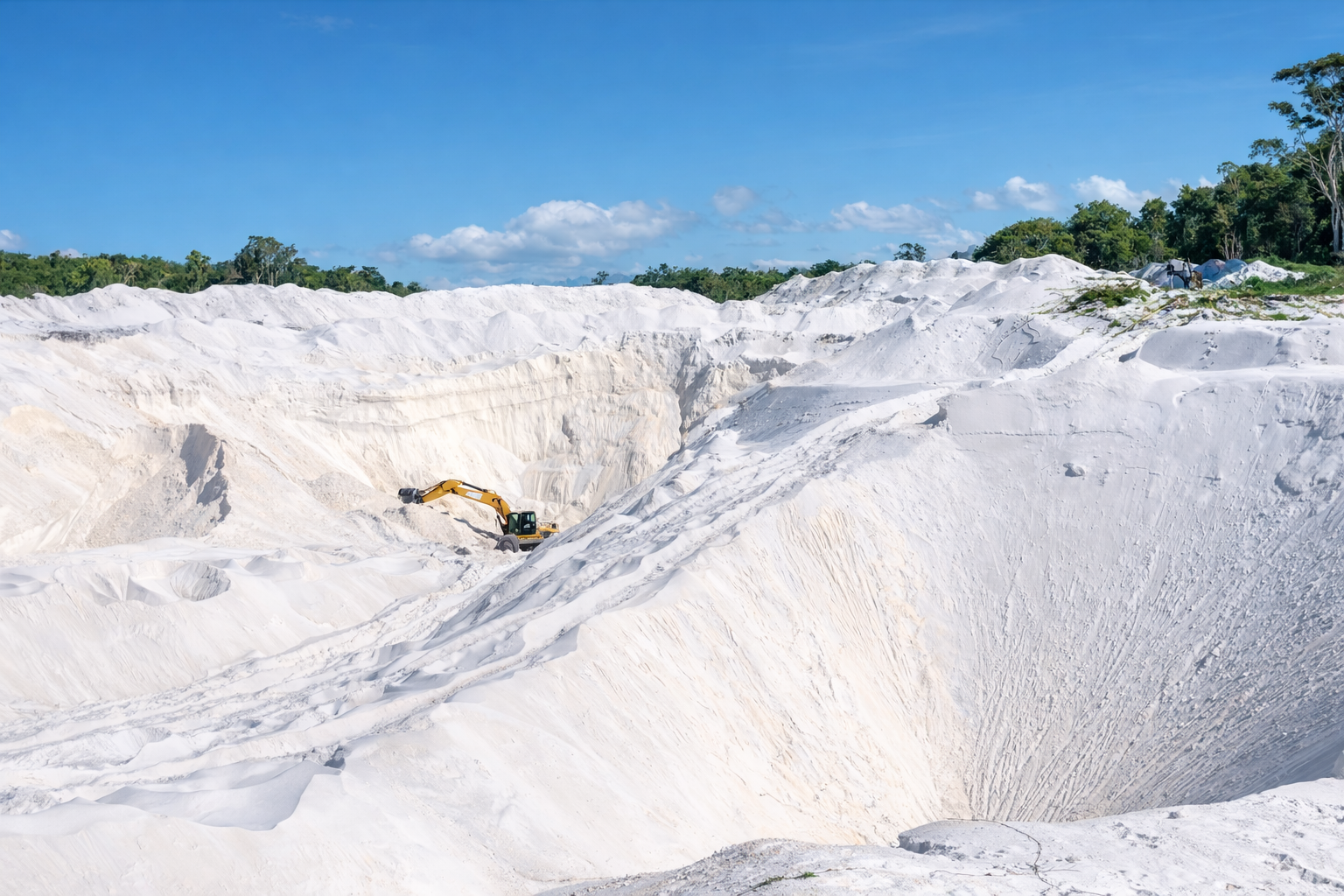
Historically, many investors viewed Homerun primarily as a resource developer, with the investment thesis centred on its exceptionally high-purity silica deposit in Bahia and the strategic value of that resource.
Increasingly, however, the company’s announcements point toward something different: The development of an integrated manufacturing platform designed to convert that resource into substantially higher-value industrial products.
Rather than simply extracting and selling silica sand, Homerun aims to manufacture ultra-clear solar glass while also advancing initiatives involving high-purity silica and advanced silica materials.
This approach aligns with a broader industrial trend in which resource-rich countries seek to capture more value through domestic processing and manufacturing rather than exporting raw materials. Brazil has publicly expressed similar ambitions through initiatives designed to encourage industrial development and local value creation.
This evolution also changes the framework through which the company may increasingly be evaluated. Early-stage resource companies are often assessed primarily on exploration success, resource growth and geological potential. Integrated industrial projects, by contrast, are evaluated more heavily on engineering execution, financing strategy, commercial development, manufacturing economics and long-term cash-flow generation. Homerun’s recent announcements increasingly reflect this shift in emphasis.
As projects mature, the profile of potential investors often evolves as well. Beyond traditional resource investors, advanced industrial projects may begin attracting infrastructure investors, industrial specialists, strategic corporate partners and project finance lenders that evaluate opportunities through a different lens. Rather than focusing primarily on the underlying resource, these investors assess whether a completed industrial asset can generate predictable long-term returns.
Taken together, Homerun’s latest announcements suggest that the investment story is gradually evolving from one centred primarily on a strategic silica resource toward one increasingly focused on the creation of an integrated industrial manufacturing platform. If that transition continues, the company’s long-term valuation may increasingly depend not only on the quality of its resource, but on its ability to successfully finance, construct and operate high-value industrial assets.
BOTTOM LINE
During the earliest stages of a project, investors ask whether the resource exists. Engineering studies then seek to determine whether that resource can be transformed into a commercially viable product.
A BFS addresses perhaps the most fundamental technical question: Can the project be designed and constructed on an economically attractive basis?
Once that question has largely been answered, attention naturally shifts toward financing, commercial execution, procurement and ultimately construction.
In many respects, today’s news appears to reflect exactly that transition. The signed LOI is not significant because it guarantees financing. It does not. Nor is its significance derived solely from the proposed financing amount of up to 170 million EUR. Its broader importance lies in what it may indicate about the stage the project has reached within the institutional financing process.
Large project finance institutions generally become involved only after engineering has produced a project capable of independent technical, commercial and financial evaluation. By that stage, the central question is no longer simply whether a project can be engineered, but whether it has matured sufficiently to justify long-term institutional capital.
While substantial work still lies ahead, including comprehensive due diligence, syndication and final credit approvals, today’s announcement suggests that Homerun’s Solar Glass Project is increasingly being assessed within the framework of institutional project finance rather than as an early-stage industrial concept.
Industrial projects rarely advance through a single defining event. Progress is typically achieved through a sequence of interconnected milestones, each addressing a different category of technical, commercial, financial or execution risk while gradually strengthening the overall investment case.
Viewed in that context, the most important aspect of today’s announcement may not be the proposed 170 million EUR financing itself, but what it may indicate about the project’s evolution.
The central question is no longer “Can this project be engineered?” but increasingly “Can this project support the institutional financing required for construction?”
Those are fundamentally different questions. The first is answered through geology, metallurgy and engineering. The second is answered through commercial development, financial structuring, lender due diligence and institutional confidence. The completion of the BFS established the project’s technical foundation. Today’s announced LOI suggests that the next phase may now be unfolding.
Whether Homerun ultimately secures the financing currently under discussion remains uncertain. Regardless of the eventual outcome, one conclusion already appears increasingly evident: The investment story is gradually shifting from demonstrating that the Solar Glass Project can be built to demonstrating that it may become financeable.
For long-term investors, that may represent the more important development. It reflects not simply another corporate milestone, but the possibility that the project is progressing along the same institutional pathway as large industrial projects toward financial close and, ultimately, construction.

Company Details

Homerun Resources Inc.
#2110 – 650 West Georgia Street
Vancouver, BC, V6B 4N7 Canada
Phone: +1 844 727 5631
Email: info@homerunresources.com
www.homerunresources.com
ISIN: CA43758P1080 / CUSIP: 43758P
Shares Issued & Outstanding: 77,333,285
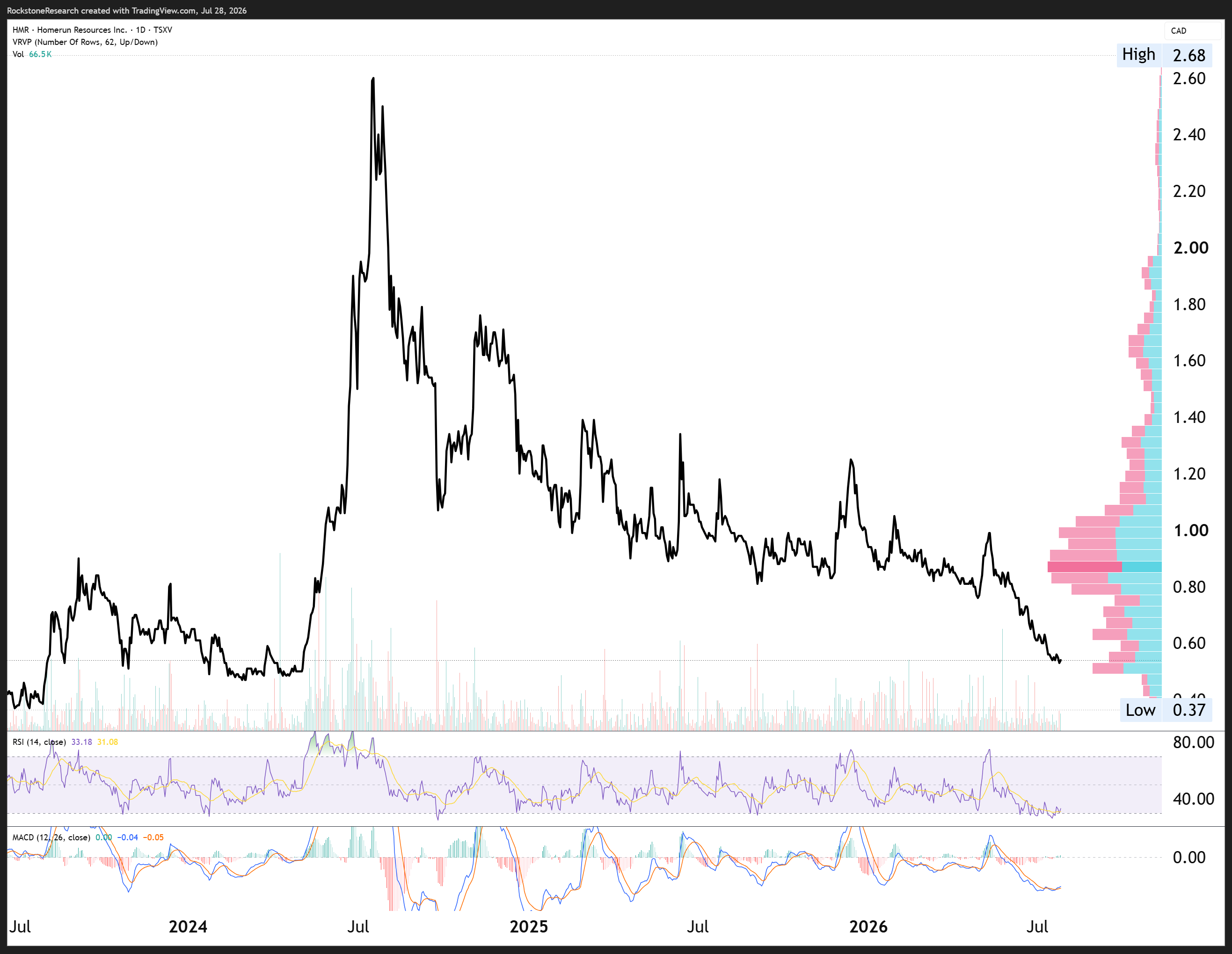
Canada Symbol (TSX.V): HMR
Current Price: 0.54 CAD (07/27/2026)
Market Capitalization: 42 Million CAD
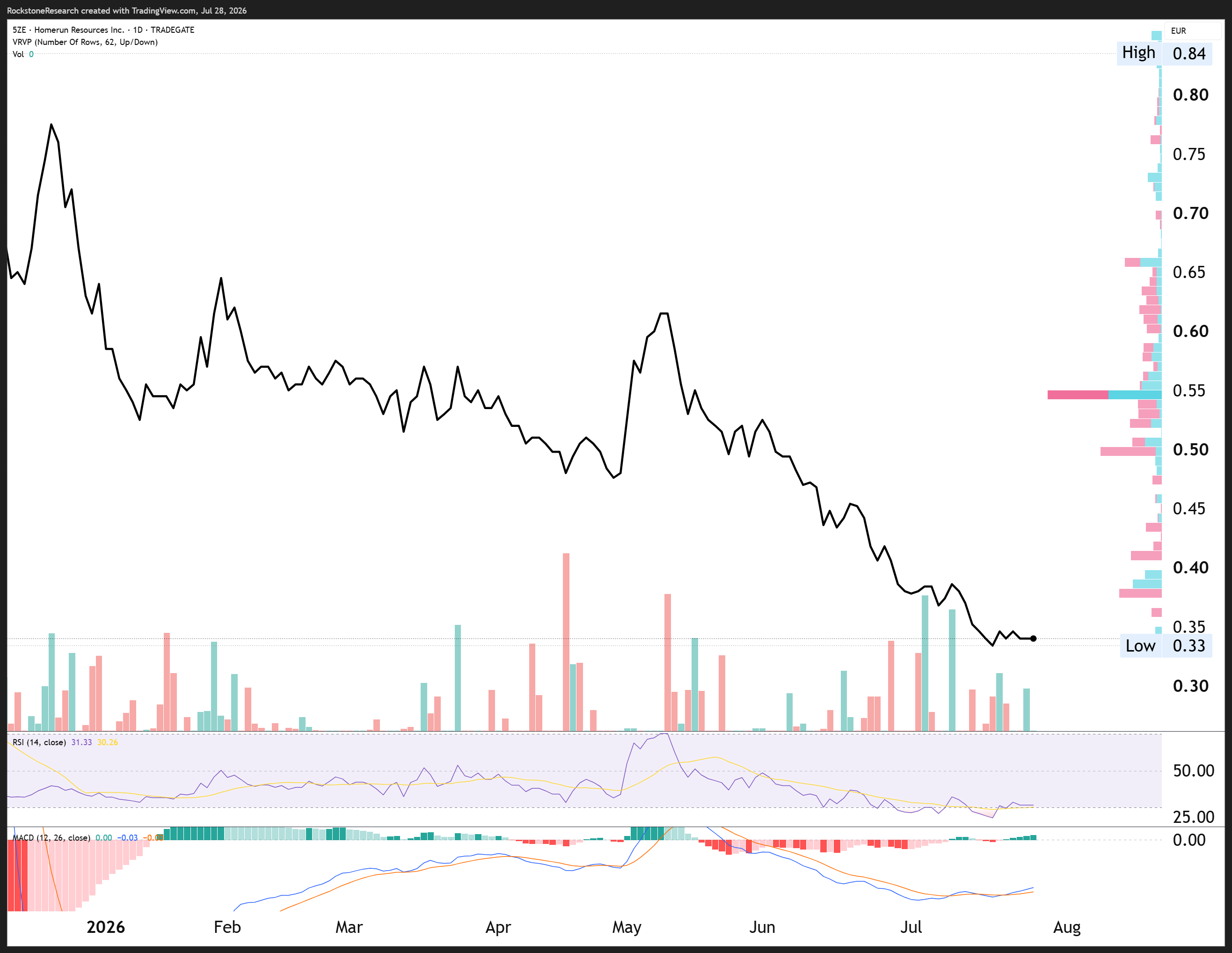
Germany Ticker / WKN: 5ZE / A3CYRW
Current Price: 0.34 EUR (07/27/2026)
Market Capitalization: 26 Million EUR

Stephan Bogner
Contact
Rockstone News & Research
Stephan Bogner (Dipl. Kfm., FH)
Müligässli 1, 8598 Bottighofen
Switzerland
Phone: +41-71-5896911
Email: info@rockstone-news.com
Disclaimer and Information on Forward Looking Statements: Rockstone and Homerun Resources Inc. (“Homerun“) caution investors that any forward-looking information provided herein is not a guarantee of future results or performance, and that actual results may differ materially from those in forward-looking information as a result of various factors. The reader is referred to Homerun’s public filings for a more complete discussion of such risk factors and their potential effects, which may be accessed through its documents filed on SEDAR+ at www.sedarplus.ca. All statements in this report, other than statements of historical fact, should be considered forward-looking statements. Much of this report is comprised of statements of projection, interpretation and strategic analysis. Such statements involve known and unknown risks, uncertainties and other factors that may cause actual results, developments or events to differ materially from those anticipated in these forward-looking statements. There can be no assurance that such statements will prove to be accurate, as actual results and future events could differ materially from those anticipated in such statements. Forward-looking statements in this report include statements, interpretations, conclusions, strategic observations and analytical opinions regarding Homerun’s Solar Glass Project in Bahia, Brazil, the Bankable Feasibility Study (BFS), the announced Letter of Intent (LOI) with a leading European project finance bank, the Company’s financing strategy, institutional project finance, project bankability, syndication, due diligence, the State of Bahia’s Programa Desenvolve industrial incentive program, project economics, construction plans, engineering assumptions, commercial development, vertically integrated silica strategy, manufacturing objectives and broader industrial development initiatives. Forward-looking statements include, without limitation, expectations regarding the significance of the announced LOI, the Company’s ability to successfully complete technical, commercial, legal, environmental and financial due diligence, satisfy customary conditions precedent, arrange syndicated project financing, negotiate definitive financing documentation, obtain final credit approvals, secure debt, equity, strategic investment or other capital, achieve financial close, construct and commission the Solar Glass Project, execute its vertically integrated manufacturing strategy, develop commercial customer relationships, qualify products with customers, generate long-term revenues and cash flows, benefit from government incentives and successfully transition from project development to commercial operations. Forward-looking statements also include expectations regarding the potential financial benefits associated with Programa Desenvolve, including the deferral of ICMS (state value-added tax), improvements to working capital management, financial flexibility and project economics, as well as statements regarding institutional financing, project de-risking, commercial validation, strategic positioning, industrial policy, long-term manufacturing objectives and the Company’s broader investment thesis. Such statements are based on current management expectations, publicly available information and the author’s independent analysis and remain subject to numerous risks, uncertainties and assumptions. Letter of Intent and Financing Risks: The announced LOI does not constitute a binding financing commitment. Any potential financing remains subject to comprehensive technical, commercial, legal, environmental and financial due diligence, syndication, negotiation of definitive documentation, satisfaction of customary conditions precedent and final internal credit approvals. There can be no assurance that the proposed financing will proceed, that financing will become available on acceptable terms or at all, or that the Company will successfully secure sufficient debt, equity, strategic investment or other capital required to develop the Solar Glass Project. Syndication and Institutional Financing Risks: Large-scale project financings commonly involve multiple financial institutions participating through syndication. There can be no assurance that additional lenders will participate, that acceptable financing terms will be achieved, or that market conditions will support successful syndication. Changes in interest rates, credit markets, lender risk appetite or macroeconomic conditions could materially affect financing availability, timing or cost. Bankability and Due Diligence Risks: Completion of a BFS does not guarantee that a project will be considered bankable or financeable by institutional lenders. Independent lenders may reach different technical, commercial, legal, environmental or financial conclusions during their due diligence process. Additional engineering work, commercial agreements, permitting, environmental studies, contractual arrangements or project modifications may be required before financing can proceed. Construction and Execution Risks: The Solar Glass Project remains subject to engineering, procurement, permitting, environmental, construction, commissioning and operational risks. Capital costs, operating costs, equipment availability, contractor performance, labour availability, infrastructure development, supply chain disruptions, foreign exchange movements, inflation, energy costs and project scheduling may differ materially from current assumptions. There can be no assurance that construction will proceed on schedule, within budget or in accordance with current plans. Technical and Engineering Risks: The economic projections contained within the BFS are based upon engineering assumptions, technical studies, operating parameters and economic models that may change over time. Actual construction costs, operating performance, plant recoveries, equipment performance, production rates, maintenance requirements, utility costs and operating efficiencies may differ materially from those currently estimated. Commercial and Market Risks: Statements regarding future demand for solar glass, customer qualification, commercial agreements, product pricing, market penetration, vertically integrated silica processing and advanced silica products are forward-looking. Commercial success will depend upon customer acceptance, successful qualification processes, competitive market conditions, technological developments, photovoltaic industry growth, international trade policies, energy markets, supply chain conditions and broader economic factors. Government Incentive and Regulatory Risks: Statements regarding Programa Desenvolve and other government incentives are based on current legislation, regulatory frameworks and management expectations. Continued eligibility, government approvals, regulatory interpretation, tax legislation, environmental regulation and industrial policy may change over time. There can be no assurance that the anticipated financial benefits or incentives will be realized to the extent currently expected. Commodity, Energy and Macroeconomic Risks: Project economics may be materially affected by changes in inflation, interest rates, foreign exchange rates, energy prices, transportation costs, raw material costs, global economic conditions, geopolitical developments, international trade policies and broader financial market conditions. Forward-looking Analytical Opinions: This report contains the author’s independent analysis and interpretation of publicly available information. Statements regarding project bankability, institutional financing, project de-risking, the significance of the announced LOI, the potential implications of syndication, the evolution of the investment thesis, the Company’s strategic positioning and the stage of project development represent analytical opinions rather than statements of fact. Such opinions are inherently subjective and should not be interpreted as guarantees of future financing, project completion, commercial success, shareholder value creation or future market performance. Accordingly, readers should not place undue reliance on forward-looking information. Actual results may differ materially from those expressed or implied in the forward-looking statements contained in this report. Rockstone and the author of this report do not undertake any obligation to update any statements made herein except as required by applicable law. Past performance, comparisons to other companies, projects, commodities, technologies, jurisdictions, feasibility studies, capital-market events or industry trends are provided for illustrative purposes only and should not be considered indicative of future results.
Disclosure of Interest and Advisory Cautions: Nothing in this report should be construed as a solicitation to buy or sell any securities mentioned. Rockstone, its owners and the author of this report are not registered broker-dealers or financial advisors. Before investing in any securities, you should consult with your financial advisor and a registered broker-dealer. Never make an investment based solely on what you read in an online or printed report, including Rockstone’s report, especially if the investment involves a small, thinly-traded company that isn’t well known. The author of this report, Stephan Bogner, is paid by Homerun Resources Inc. On September 8, 2025, Homerun announced that the company “entered into an agreement with Rockstone Research to provide marketing services to the company”, and that “Rockstone Research is an arm’s-length marketing firm and has been engaged for an initial three-month term for total consideration of $25,000, which is payable up front. The company does not propose to issue any securities to Rockstone in consideration for the services to be provided to the company.” The marketing services agreement has since been extended and remains in effect as of the date of this report. The author owns equity of Homerun and thus will profit from volume and price appreciation of the stock. This also represents a significant conflict of interest that may affect the objectivity of this reporting. The author may buy or sell securities of Homerun (or comparable companies) at any time without notice, which may give rise to additional conflicts of interest. Overall, multiple conflicts of interests exist. Therefore, the information provided in this report should not be construed as a financial analysis or recommendation but as an advertisement. This report should be understood as a promotional publication and does not replace individual investment advice. Rockstone’s and the author’s views and opinions regarding the companies that are featured in the reports are the author‘s own views and are based on information that was received or found in the public domain, which is assumed to be reliable. Rockstone and the author have not undertaken independent due diligence of the information received or found in the public domain. Rockstone and the author of this report do not guarantee the accuracy, completeness, or usefulness of any content of this report, nor its fitness for any particular purpose. Lastly, Rockstone and the author do not guarantee that any of the companies mentioned in the reports will perform as expected, and any comparisons that were made to other companies may not be valid or come into effect. For the avoidance of doubt, this report is not intended for distribution to, or use by, any person or entity in any jurisdiction where such distribution, publication or use would be contrary to local law or regulation. Readers are solely responsible for ensuring that their review and use of this report is lawful in their jurisdiction. Neither Rockstone nor the author accepts liability for any direct or indirect loss arising from the use of this report or from any investment decision made in reliance on it. Please read the entire Disclaimer carefully. If you do not agree to all of the Disclaimer, do not access this website or any of its pages including this report in form of a PDF. By using this website and/or report, and whether or not you actually read the Disclaimer, you are deemed to have accepted it. Information provided is educational and general in nature and should not be interpreted as personalized investment, financial, legal, tax or professional advice. Data, tables, figures and pictures, if not labeled or hyperlinked otherwise, have been obtained from Stockwatch.com, Tradingview.com, Homerun Resources Inc. and the public domain. The cover picture has been obtained and licenced from 123rf.com.


