




New drill results from the Gran Pilar Gold-Silver Project in Sonora confirm that El Mezquite is far more than a single discovery hit.
After Tocvan Ventures Corp. intersected 215 m @ 0.6 g/t gold in JES-26-155 in August, the latest drilling now shows that gold-silver mineralization can be traced along an ~1.3 km-long trend.
Especially exciting: Of the 11,276 m Tocvan has drilled so far in 2026, assay results for a further 4,511 m are still pending. This means that around 40% of the metres drilled to date have not yet been reported.
A common misconception in mineral exploration is the assumption that every drill hole within a successful gold discovery should automatically return mineable grades. In reality, large hydrothermal gold systems rarely work that way.
Mineralizing fluids can travel through extensive networks of faults, fractures and breccias, creating alteration and anomalous gold over hundreds of metres. Within such a much larger system, however, the more economically interesting gold may become concentrated in specific structural corridors, breccia bodies and higher-grade shoots.
This is precisely why the discovery of a large mineralized envelope is so important. Before geologists can systematically target the richest parts of a hydrothermal system, they first need to understand its size, orientation and internal architecture.
At El Mezquite, Tocvan has already demonstrated what can happen when drilling intersects one of the stronger parts of this system. Hole JES-26-155 returned 215 m @ 0.6 g/t gold, starting at just 36.6 m downhole, including significantly higher-grade sub-intervals.
The significance of today’s drill results therefore lies not simply in the average grade of the 247 m interval in JES-26-162. More importantly, it confirms that the mineralized hydrothermal system extends well beyond a single discovery hole.
This changes the central exploration question. It is no longer simply: “Is there gold at El Mezquite?”
The more important question is increasingly becoming: “Where within this 1.3 km-long mineralized corridor are the next higher-grade shoots?”
247 METRES OF GOLD MINERALIZATION: WHY THE AVERAGE GRADE DOES NOT TELL THE WHOLE STORY
This is exactly where today’s news-release comes in. Drill hole JES-26-162 intersected 247.05 m @ 0.1 g/t gold and 2.61 g/t silver from surface. Tocvan describes this as one of the longest gold-bearing intervals reported to date at Gran Pilar.
At first glance, the average gold grade of 0.1 g/t may not appear particularly spectacular. On its own, it is of course not a grade on which a future mine would be built.
But looking at the interval in isolation would miss the geological significance of the hole. JES-26-162 shows that mineralization is present over virtually the entire length of this long interval and that several notably stronger gold-silver zones occur within this broad mineralized envelope.
These include:
- 6.1 m @ 0.45 g/t gold and 5.68 g/t silver, including 1.53 m @ 1.5 g/t gold and 8.5 g/t silver
- 10.68 m @ 0.43 g/t gold and 7.16 g/t silver, including 3.05 m @ 1.29 g/t gold and 17.8 g/t silver
- 19.83 m @ 0.27 g/t gold and 5.37 g/t silver, including 1.52 m @ 1.04 g/t gold and 26.1 g/t silver
- as well as further mineralization through to the end of the reported 247 m interval.
The hole therefore did not simply intersect a homogeneous body grading 0.1 g/t gold. Rather, it cut through a mineralized hydrothermal system over an unusually long distance, with several stronger gold-silver zones occurring within it.
JES-26-162 is therefore less notable for its average grade than for the way it helps Tocvan understand the scale and internal architecture of El Mezquite.
NOT EVERY HOLE HAS TO BE A DISCOVERY HOLE
When exploring a large hydrothermal system, the objective is not simply to report the highest possible gold grades. Every drill hole also provides information about structure, alteration, breccias, faults and the lateral and vertical extent of the system.
Even a weaker drill hole can therefore be geologically extremely valuable if it confirms that the system continues and helps geologists position the next holes more precisely.
That is exactly the picture Tocvan now describes in its news-release: Broader lower-grade zones are interpreted as a halo surrounding higher-grade shoots, while drill holes with different orientations are helping to constrain the lateral and vertical continuity of the system.
The northern step-out hole JES-26-163 also supports this interpretation: Tocvan reports multiple mineralized zones over more than 160 m of hole length and describes the hole as an important confirmation of mineralization along strike.
With every additional drill hole, the geological model becomes more refined. At El Mezquite, Tocvan now appears to be entering exactly this phase. JES-26-155 showed what is possible within the system. The current drilling is helping to define where the system extends and how it is structured.
That information, in turn, is essential for targeting higher-grade areas more precisely with follow-up drilling.
YOU DON’T FIND 215 M @ 0.6 G/T GOLD BY ACCIDENT
Perhaps the most important reference point remains JES-26-155. Reported in August, this drill hole returned 215 m @ 0.6 g/t gold from 36.6 m downhole, including several significantly higher-grade intervals such as 70.2 m @ 0.86 g/t gold and 7.19 g/t silver as well as 33.6 m @ 1.55 g/t gold and 12.2 g/t silver.
A gold interval of this magnitude is geologically very different from a handful of isolated anomalous values. Widths like these indicate that there was sufficient space, fluid flow and structural preparation for significant amounts of gold to be deposited over considerable distances.
And that is exactly why the next critical question after this hit was: Was JES-26-155 an exceptional local intercept or part of a much larger mineralized system?
The latest drilling is now providing increasingly strong evidence for the latter. In its final news release, Tocvan describes El Mezquite as a continuous mineralized corridor extending along an ~1.3 km-long trend. The initial discovery hole, JES-26-135, had already returned 22.9 m @ 0.6 g/t gold from surface and is located ~600 m along strike from JES-26-155. JES-26-162 now adds another very long mineralized interval.
This means JES-26-155 no longer stands alone. Instead, a picture is beginning to emerge in which Tocvan is intersecting different parts of a large hydrothermal system with widely varying gold grades.
And that is exactly how the exploration of these systems works.
“These results confirm that El Mezquite is not a one-hole story. A 247-metre anomalous gold interval in JES-26-162, together with the 215-metre discovery in JES-26-155, demonstrates continuity along a 1.3-kilometre trend sitting less than two kilometres from our planned pilot facility. That combination of scale, proximity to infrastructure, and a clear path to first production is exactly what we want to see as Gran Pilar advances from explorer to near-term producer.”
Chris Gordon, CEO of Tocvan, in today’s news-release

THE ARCHITECTURE OF A HYDROTHERMAL SYSTEM
El Mezquite is associated with an ~1,300 m-long magnetic anomaly that coincides with strongly elevated gold values in soil and rock samples.
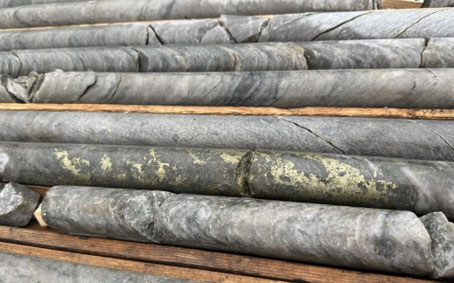
According to Tocvan, the drilling to date outlines a vertically extensive system of strongly silicified hydrothermal breccia with pyrite, tourmaline and magnetic andesite dikes. At greater depth, indications of sphalerite and galena, meaning zinc and lead minerals, also become more prominent.
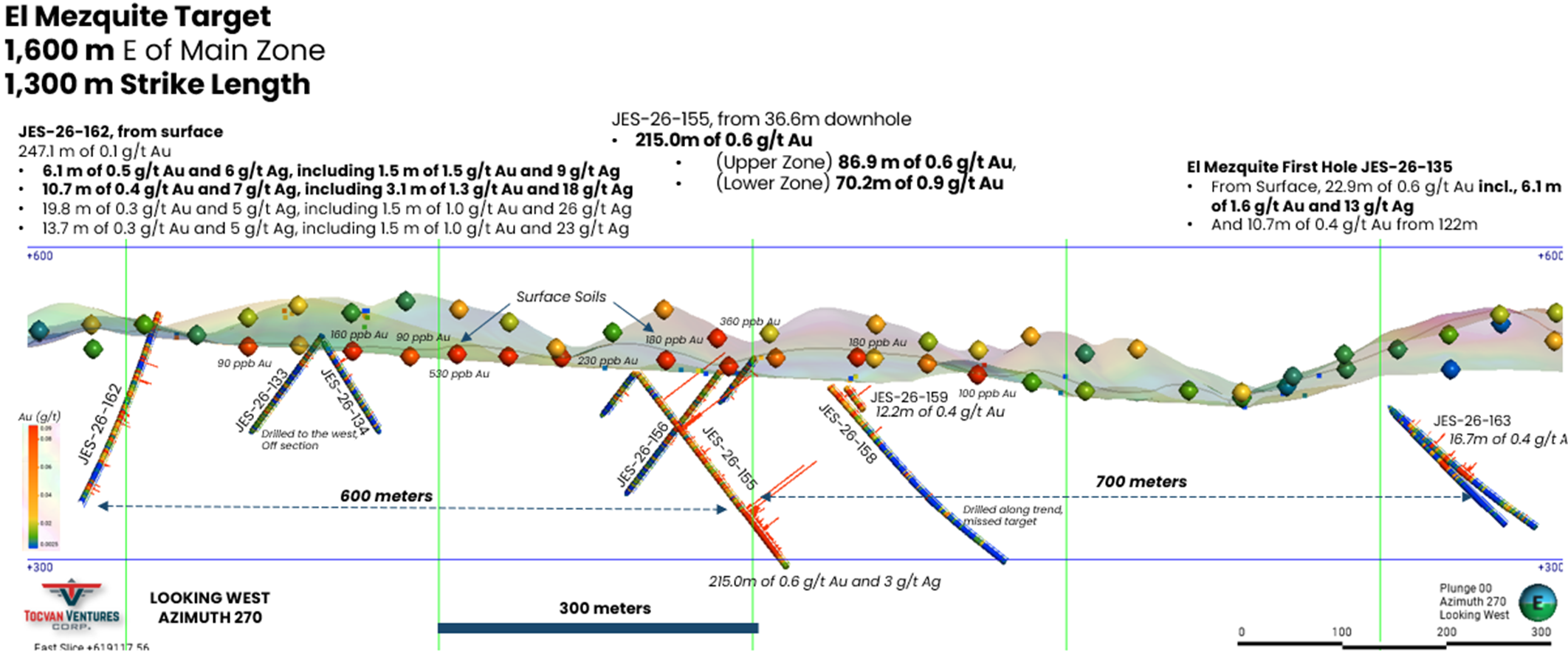
Information like this is critical for further exploration. Gold is not distributed randomly in the rock by hydrothermal fluids. The fluids preferentially use fractures, faults and other permeable pathways. Where structures intersect, where the rock has been particularly fractured or brecciated, or where the pressure, temperature and chemistry of the fluids changed, significantly stronger mineralized zones could form.
The task is therefore not simply to “drill for gold”, but to understand the plumbing system of the hydrothermal system: Where did the mineralizing fluids rise, which structures did they use and at which points could gold and silver become especially concentrated?
The better this system is understood, the more precisely higher-grade shoots can be targeted.
Exploration thus increasingly becomes a process of improving probabilities. The more Tocvan learns about the structure, alteration and geometry of El Mezquite, the less future drilling has to search for gold “blindly”. Instead, drill holes can be aimed more directly at those areas where the geological model suggests a stronger concentration of mineralization.
THE SEARCH FOR THE NEXT JES-26-155
That is exactly what Tocvan itself describes as the next step.
“JES-26-162 is an important step-out confirmation hole. Anomalous gold over 247 metres tells us the hydrothermal system at El Mezquite has vertical and lateral continuity consistent with a district-scale gold-silver corridor. Our focus now is to tighten the geometry of the higher-grade shoots already seen in JES-26-155 and to keep stepping along the 1,300-metre trend.”
Brodie Sutherland, Executive Chair of Tocvan, in today’s news-release
The company now intends to prioritize additional RC and core drilling along strike and down-dip of the higher-grade shoots identified particularly in JES-26-155, JES-26-162 and JES-26-163.
This represents an important transition. In the early stages of exploration, the first objective is to discover a mineralized system at all. The next step is to determine its scale.
After that, geologists work to decipher its internal architecture. And ultimately, drilling is directed toward those areas where the more economically interesting grades are concentrated.
El Mezquite now appears to be increasingly entering that phase, where the focus is no longer only on testing the extent of the system, but on defining its internal architecture and the location of the higher-grade zones.
The current drilling is expanding Tocvan’s geological understanding. As that understanding improves, future drill holes can become less exploratory in nature and increasingly focused on structures interpreted as potential higher-grade corridors.
BOTTOM LINE
The most important number in today’s news may not be 0.1 g/t gold. The more important number could be 1,300 m. Following the standout JES-26-155 intercept of 215 m @ 0.6 g/t gold, Tocvan is now showing that gold-silver mineralization extends across a much larger area of El Mezquite.
With 247 m of anomalous gold-silver mineralization, JES-26-162 confirms that the discovery intercept does not appear to sit in isolation within a small system. That changes the exploration picture. At El Mezquite, Tocvan increasingly no longer has to simply search for any gold mineralization at all.
The company now has strong evidence for a large mineralized hydrothermal system and can begin to decipher its internal architecture.
The next step is to identify the structures and higher-grade shoots where gold has become concentrated within that system. JES-26-155 has already shown that such zones exist.
The current drilling is now providing Tocvan with additional information about how these zones may be connected and where future drill holes should be positioned.
And while this geological model continues to become more refined, assay results are still pending for a further 4,511 m of drilling, representing around 40% of the total metres drilled so far in 2026.
The key question at El Mezquite is therefore increasingly shifting: Less toward whether a large-scale gold-silver system is present and more toward where, within this 1.3 km-long trend, the next broad and higher-grade zones are located.
Company Details

Tocvan Ventures Corp.
Suite 1150 Iveagh House
707 – 7th Avenue S.W.
Calgary, Alberta, Canada T2P 3H6
Phone: +1 403 668 7855
Email: bsutherland@tocvan.ca (Brodie Sutherland)
www.tocvan.com
ISIN: CA88900N1050
Shares Issued & Outstanding: 78,735,014

Canada Symbol (CSE): TOC
Current Price: 0.87 CAD (09/09/2026)
Market Capitalization: 69 Million CAD

Germany Symbol / WKN (Tradegate): TV3 / A2PE64
Current Price: 0.546 EUR (09/09/2026)
Market Capitalization: 43 Million EUR
Contact
Rockstone News & Research
Stephan Bogner (Dipl. Kfm., FH)
Müligässli 1, 8598 Bottighofen
Switzerland
Phone: +41-71-5896911
Email: info@rockstone-news.com
Disclaimer and Forward-Looking Information: Rockstone and Tocvan Ventures Corp. (“Tocvan”; “the Company”) expressly point out that all forward-looking information contained in this report does not represent a guarantee of future results or performance. Actual results may differ materially from those projected. Readers are referred to Tocvan’s public filings, available on SEDAR+ at www.sedarplus.ca, for a more detailed discussion of risk factors and their potential impact. All statements in this report, other than statements of historical fact, constitute forward-looking statements. This report includes expectations, interpretations, projections and assumptions based on information available at the time of writing, including public disclosures by the Company and statements made by its management. Forward-looking statements include, but are not limited to, statements, expectations and assumptions regarding: The interpretation, significance and potential economic relevance of the latest drilling at the El Mezquite trend within the Gran Pilar Gold-Silver Project; the possibility that El Mezquite represents a large mineralized hydrothermal system extending along an ~1.3 km-long trend; the possible vertical and lateral continuity of mineralization identified in JES-26-155, JES-26-162 and other drill holes; the potential existence, geometry, continuity and distribution of higher-grade shoots within the broader mineralized system; the possibility that additional step-out, infill and follow-up drilling may identify further broad, higher-grade or potentially economically significant gold-silver zones; the possibility that mineralization similar in grade, thickness or character to JES-26-155 may be repeated elsewhere along the El Mezquite trend; the interpretation of anomalous gold mineralization over 247 m in JES-26-162 as evidence of the scale and internal architecture of the hydrothermal system; the possibility that improved geological understanding may allow future drill holes to be targeted more effectively; the timing, receipt, interpretation and potential significance of approximately 4,511 m of pending assay results from the 2026 drilling program; the continued refinement of the geological model at El Mezquite; the potential integration of El Mezquite into the broader Gran Pilar exploration and development strategy; the possible strategic importance of mineralization located approximately 1.6 to 1.9 km from the Main Zone and planned pilot facility; the continuation of drilling along the El Mezquite trend; the possible definition of one or more future mineral resources; and the continued advancement of Gran Pilar toward pilot-scale gold-silver production. Statements in this report regarding the interpretation of El Mezquite as a large or district-scale hydrothermal gold-silver system, the possible continuity of mineralization along the ~1.3 km trend, the existence of higher-grade shoots or the potential for further broad mineralized zones represent the author’s interpretation of publicly available Company information as of the publication date. Such statements reflect current geological interpretations and expectations and should not be interpreted as confirmation that the entire 1.3 km trend is continuously mineralized, that all mineralized zones are physically connected or that the system contains sufficient grade, continuity, tonnage or metallurgical characteristics to support an economically mineable deposit. The latest drilling includes JES-26-162, which returned approximately 247 m of anomalous gold-silver mineralization. Anomalous or low-grade mineralization should not be interpreted as economically mineable mineralization. The average grades reported across broad mineralized envelopes may include narrower higher-grade intervals, but such higher-grade intervals are not necessarily representative of the average grade, true width, continuity or economic significance of the broader mineralized system. There can be no assurance that additional drilling will demonstrate continuity between the higher-grade intervals identified to date or that such intervals will ultimately form part of a mineral resource or mineral reserve. References in this report to JES-26-155 and its reported intercept of 215 m @ approximately 0.6 g/t gold, including higher-grade sub-intervals, are used to illustrate the presence of stronger mineralized zones within the broader El Mezquite system. There can be no assurance that mineralization of comparable grade, thickness or continuity will be repeated elsewhere along strike, at depth or in future drill holes. Individual drill holes, regardless of grade or thickness, do not establish the size, continuity or economic viability of a mineral deposit. Reported drill intervals represent drilled lengths and may not correspond to true widths. According to Tocvan, true widths for the intervals discussed in the current news release are estimated to be approximately 60-80% of drilled widths, although such estimates remain subject to geological uncertainty and may change as additional drilling and structural interpretation are completed. Statements regarding the internal architecture of the El Mezquite hydrothermal system, including interpretations concerning faults, fractures, breccias, alteration, fluid pathways, structural corridors and higher-grade shoots, are geological interpretations based on currently available drilling, geophysical, geochemical and mapping data. There can be no assurance that current interpretations accurately reflect subsurface geology or that structural targeting based on these interpretations will result in stronger mineralization, higher grades or economically significant discoveries. Geological models may be revised materially as additional drilling data becomes available. Statements concerning the approximately 4,511 m of pending assay results are forward-looking. The reference to pending assays should not be interpreted as implying that such results will be positive, higher-grade, economically significant or supportive of the current geological model. Pending results may be weaker than expected, may not confirm interpreted structures or continuity and may lead to revisions of the current exploration model. Assay timing is dependent on drilling progress, sample preparation, laboratory capacity, quality-control procedures and other factors outside the Company’s direct control. Statements regarding Tocvan’s ability to improve drill targeting as the geological model becomes more refined are forward-looking. Although additional geological information may increase the precision of future targeting, exploration remains inherently uncertain and there can be no assurance that more refined targeting will result in additional discoveries, higher-grade intercepts, broader mineralized zones or economically viable mineralization. Statements regarding El Mezquite’s proximity to the Main Zone, existing road access and the planned pilot facility are also forward-looking to the extent they imply future strategic, operational or economic benefits. Proximity to infrastructure does not establish economic viability, mineability or the ability to incorporate El Mezquite mineralization into any future mine plan. Further drilling, resource estimation, metallurgical testing, technical studies, permitting, engineering, financing and economic evaluation would be required before any such conclusions could be made. Statements concerning the planned pilot facility, its construction, commissioning, operation and the targeted commencement of initial gold-silver doré production in Q4 2026 are forward-looking. Although the facility is reported by the Company to be permitted and advancing, there can be no assurance that construction or commissioning will be completed according to the current schedule, that production will commence in Q4 2026 or at all, or that the facility will achieve anticipated throughput, grades, recoveries, reagent consumption, operating costs or other technical and economic parameters. Past bulk-sample results and metallurgical test work may not be representative of future pilot-scale or commercial-scale operating conditions. Pilot-scale production is not equivalent to demonstrated commercial-scale economic viability and does not replace a mineral resource estimate, mineral reserve estimate, Preliminary Economic Assessment, Pre-Feasibility Study or Feasibility Study. There are currently no mineral reserves defined for the Gran Pilar Project and, unless otherwise disclosed by the Company, no completed maiden mineral resource estimate. Drill intersections, surface samples, geophysical anomalies, alteration zones, historic workings and geological interpretations do not constitute mineral resources or mineral reserves. There can be no assurance that additional exploration will define economically recoverable mineral resources or ultimately support commercial mining operations. Forward-looking statements are subject to numerous known and unknown risks and uncertainties that could cause actual results to differ materially from those expressed or implied. These include, but are not limited to: The speculative nature of mineral exploration and development; geological, structural, sampling, geochemical, geophysical and metallurgical uncertainties; uncertainty regarding grade, true width, continuity, orientation, depth extent and lateral extent of mineralization; the possibility that higher-grade shoots may be discontinuous, narrower, lower-grade or less extensive than currently interpreted; the possibility that the broader anomalous mineralized envelope may not contain sufficient economically significant mineralization; the possibility that current geological models, hydrothermal interpretations or structural relationships may not be confirmed by additional drilling; risks associated with pending assay results and future exploration drilling; drilling productivity, equipment availability and exploration costs; laboratory delays and assay turnaround times; financing and liquidity risks; future shareholder dilution; construction, commissioning and operating risks relating to the pilot facility; uncertainties regarding metallurgical recoveries, ore characteristics, reagent consumption, throughput and operating costs; permitting, environmental, water, infrastructure, land-access and community-relations risks; political, legal, regulatory, taxation, security and social risks associated with operating in Mexico; fluctuations in gold and silver prices, exchange rates, energy prices, labour costs, operating costs and capital costs; capital-market conditions; and other risks beyond the Company’s control. Assumptions made by management or interpretations made by the author may prove to be incomplete, overly optimistic or incorrect. Future drill results may be weaker than expected; the 1.3 km trend may prove less continuous than currently interpreted; higher-grade shoots may be smaller, less connected or less predictable than anticipated; geological models may be revised; pending assays may fail to support current expectations; mineralization may prove lower-grade, less continuous, more structurally complex or more metallurgically challenging than currently anticipated; future resources, if defined, may be smaller or lower-grade than expected; and timelines for drilling, assay reporting, resource definition, construction, commissioning, pilot production or potential commercial development may be materially delayed. Any references in this report to El Mezquite as a large hydrothermal system, the 1.3 km-long mineralized trend, the search for higher-grade shoots, improved drill targeting, the possibility of additional broad mineralized zones, pending assay catalysts, future resource growth, pilot production, project expansion, district-scale potential, project value, market re-rating or similar expressions represent the opinions, expectations and interpretations of the author based on publicly available information at the time of publication. Such statements should not be interpreted as confirmation of a mineral resource, mineral reserve, economically mineable deposit, future mine, commercial production, economic viability, financing, profitability, share-price appreciation or investment returns. Forward-looking statements are inherently subject to significant risks and uncertainties and there can be no assurance that such statements will prove to be accurate. Assumptions made by management or interpretations made by the author may prove to be incomplete, overly optimistic or incorrect. Actual results, exploration outcomes, construction progress, production timelines, economic conditions and future events may differ materially from those expressed or implied in this report. Readers are cautioned not to place undue reliance on forward-looking statements and should review the risk factors described in the Company’s public filings before making any investment decision. Neither Rockstone, the author nor Tocvan Ventures Corp. undertakes any obligation to update or revise forward-looking statements, except as required by applicable law.
Disclosure of Interests and Legal Notice: Nothing in this report should be construed as an invitation to buy or sell securities. Rockstone, its owners, and the author of this report are not registered broker-dealers or financial advisors. Before investing in securities, you should always consult your financial advisor and a registered broker-dealer. Never make an investment decision based solely on online or printed reports, including reports from Rockstone – particularly when it comes to small, thinly traded companies. The author of this report, Stephan Bogner, received compensation from Tocvan Ventures Corp. in the amount of 19,000 CAD for a period of 3 months. In addition, he holds securities of Tocvan and will therefore also benefit from increased trading volume and share price appreciation. This represents a significant conflict of interest that may affect the objectivity of this reporting. The author may buy or sell securities of Tocvan at any time without notice, which may give rise to additional conflicts of interest. This report should be understood as a promotional publication and does not replace individual investment advice. All information is current as of the date of publication and is subject to change without notice. Liability for financial losses resulting from investments made on the basis of this report is excluded. The views of Rockstone and the author regarding the companies presented in this report reflect solely their own assessments and are based on information from public sources deemed reliable. Rockstone and the author have not conducted independent due diligence. Neither Rockstone nor the author guarantees the accuracy, completeness, or usefulness of the content, nor its suitability for any particular purpose. There is likewise no guarantee that the companies mentioned will perform as expected, or that comparisons with other companies will prove valid. Please read the full disclaimer carefully. If you do not agree with it, do not use this website or report. By using the website or this report, you agree to the disclaimer, regardless of whether you have read it in full. The information provided is of a general and educational nature. Data, tables, figures, and images, unless otherwise indicated or linked, originate from Tradingview.com, Stockwatch.com, Tocvan Ventures Corp., and publicly available sources. The cover picture has been obtained and licenced from 123rf.com.





[…] Tocvan Confirms 1.3 km-Long Gold-Silver System at El Mezquite: The Search for Higher-Grade Zones N… […]