


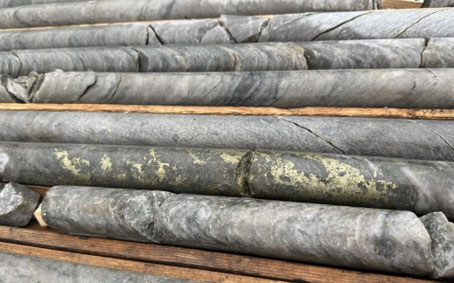
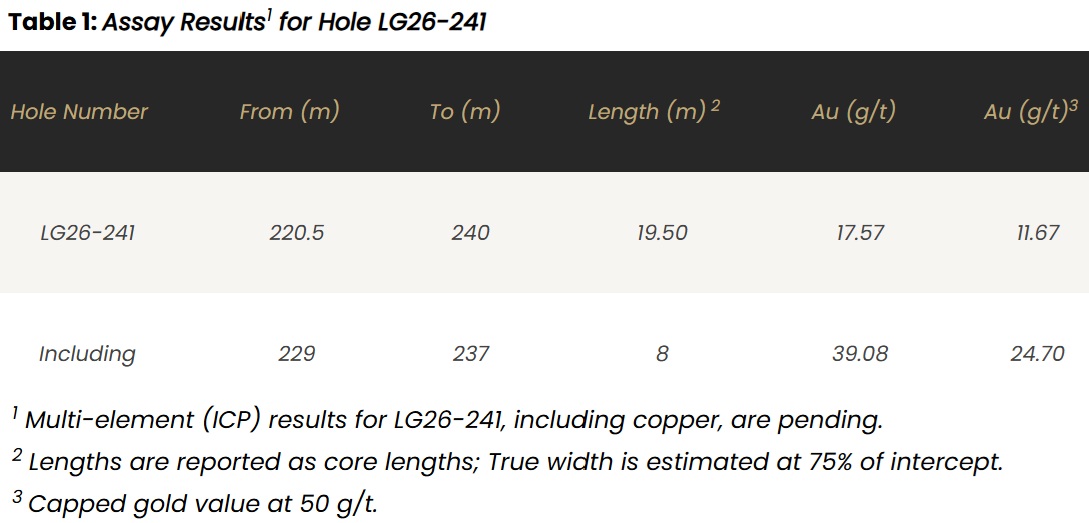
Yesterday, Lux Metals Corp. reported 17.57 g/t gold over 19.5 m, including 39.08 g/t gold over 8 m, from LG26-241, the very first hole it has drilled at its La Grande Gold Project in Québec’s James Bay region. A single metre ran 165 g/t gold, and the drill core shows specks of gold visible to the naked eye. Even with that exceptional sample capped at 50 g/t, the interval still grades 11.67 g/t gold over 19.5 m. More holes are still in the ground, and their assays are pending.
In 1996, a team of Virginia Gold Mines geologists walking the edge of a granite-like rock called the La Grande-Sud tonalite stopped at an outcrop that looked different. The rock had been bleached by hot fluids, cut by quartz veins and peppered with sulphides. Samples ran up to 62.4 g/t gold in the veins. They called it the Zone Tonalite Showing. Within a year, it had a new name: Zone 32.
Over the following years, Virginia and others drilled more than 40,000 m into it and outlined a gold-copper system 600 m long and 350 m deep. Then, as gold prices stayed low and owners’ priorities shifted, the drills went quiet.
30 years later, a new company has put a new drill hole into the same rock. And the core that came out of LG26-241 tells almost exactly the same story: Bleached, sheared tonalite, quartz veins, copper sulphides and, this time, gold you can see. The rock has not changed in 30 years; only the company drilling it has.
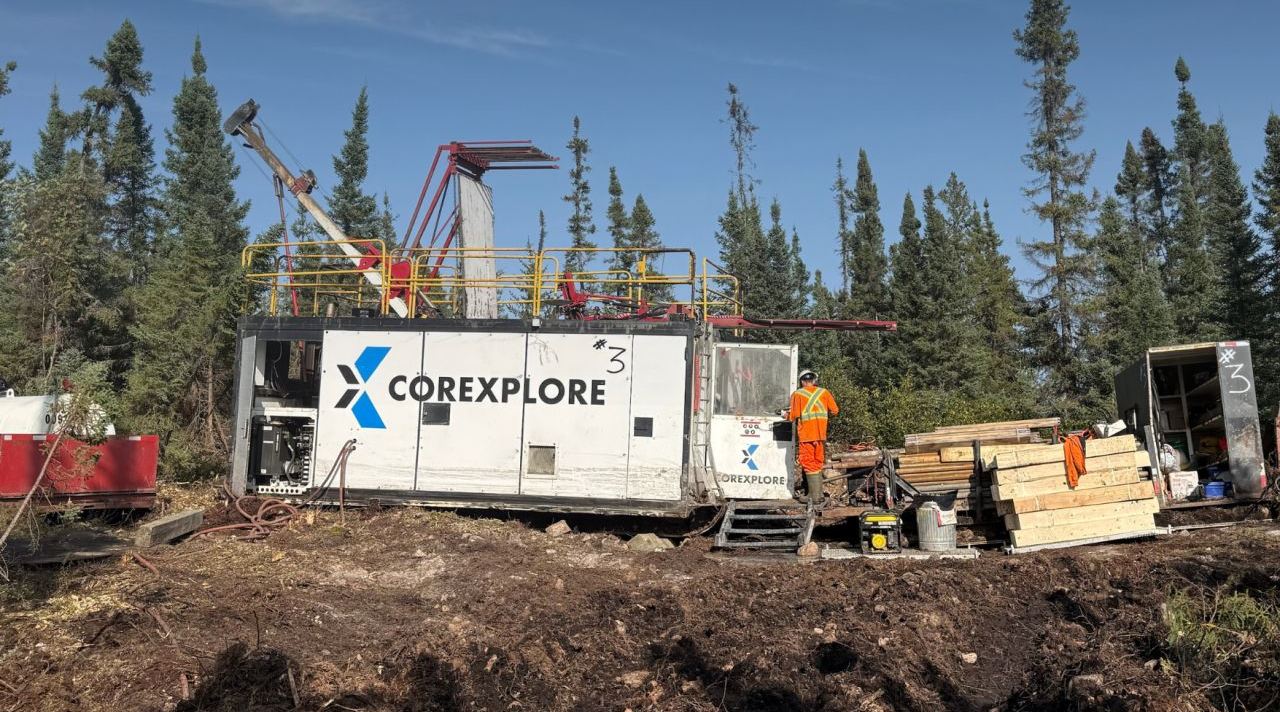
When Rockstone published its Report #3 in August, the drill rig had not yet arrived. That report ended with the sentence: “On August 25, Lux begins drilling to determine just how far the Zone 32 system extends.”
7 weeks later, the first answer is in. And it is a good one.
READING THE NUMBERS LIKE A GEOLOGIST
Assay tables can look like a wall of decimals. Here is what the LG26-241 numbers actually say, in plain language.
Grade × Width: The number professionals look at first
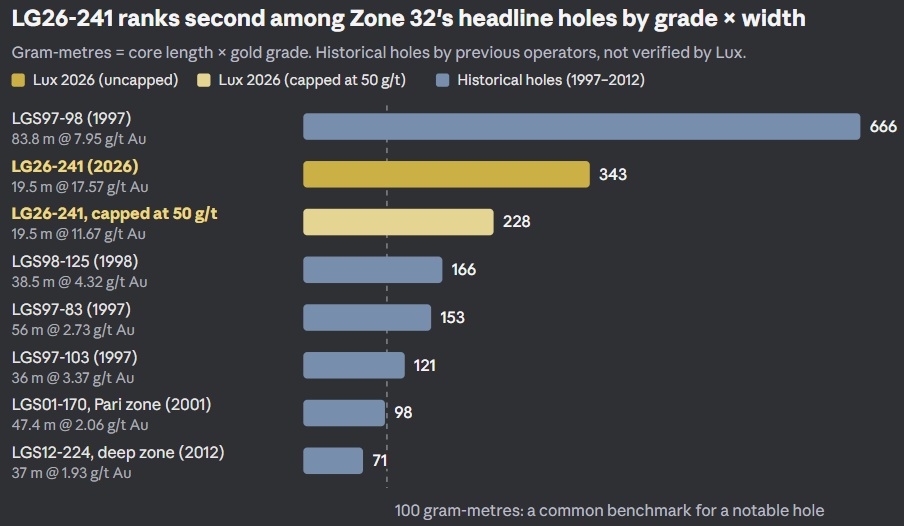
A high grade over a few centimetres is a curiosity. A high grade over a thick interval is what builds deposits. That is why geologists and fund managers often multiply grade by width to get a “gram-metre” figure. LG26-241 works out to roughly 343 gram-metres (17.57 g/t × 19.5 m). The 8 m high-grade core alone accounts for about 313 of those. Even on the conservative capped numbers, the hole still carries about 228 gram-metres.
As a rough rule of thumb in the junior market, anything above 100 gram-metres tends to get noticed.
Gram-metres are a quick way to compare drill holes. They are not a resource estimate and say nothing about how many ounces are in the ground.
CAPPED vs. UNCAPPED: WHAT EACH NUMBER MEANS
Capping means setting a ceiling on individual assays before averaging them. Lux chose 50 g/t. Any 1-metre sample above 50 g/t is counted as 50 g/t. Every sample below that stays as it is. In LG26-241, only 1 sample was affected: The 165 g/t metre, which counts as 50 g/t in the capped figures.
Why do it? Because an extreme sample can pull a whole average upward. Think of a street with 9 ordinary houses and 1 mansion. The average house price says little about what most homes are worth. Capping trims the mansion back so the average describes the street.
Here is what that means in practice:
- The uncapped grade is what the lab actually measured. The 165 g/t is a real result, and the gold in that metre is real. Nothing is thrown away. Capping is a cautious way of counting, not a correction of the data.
- The capped grade is the more conservative, “bankable” view. Capping trims the main interval from 17.57 to 11.67 g/t gold, about 34% lower. The 8 m high-grade core goes from 39.08 to 24.7 g/t, a drop of about 37%. In gram-metres, the hole goes from about 343 to about 228.
- It is closer to how a future resource would count the gold. When a Qualified Person calculates a resource, extreme values are routinely capped. Earlier operators did the same at Zone 32: SGS Geostat capped at 45 g/t in 2010, close to Lux’s 50 g/t. So investors trying to picture what a future resource could look like should lean on the capped numbers.
- The “true” value of that metre is uncertain. The quarter-core duplicate of the same metre returned 31.5 g/t, against 165 g/t in the main half sent to the lab. The real average of that metre of rock probably lies somewhere between both of them. Capping at 50 g/t lands comfortably within that range, which is a key reason it is a sensible choice.
- Capping does not change the story. Even capped, LG26-241 returns 11.67 g/t gold over 19.5 m, and the hole still ranks second among the headline Zone 32 intercepts shown in the above chart. The high grade is not riding on a single sample.
A tip for comparing projects: Many companies headline uncapped grades only. Lux published both, which makes its numbers easier to trust. When comparing Lux with other explorers, compare capped with capped where possible, or at least check which figure is being quoted. The nugget-effect section below explains why grades at Zone 32 swing so much from sample to sample.
WHAT IS LEFT ONCE YOU TAKE OUT THE BEST METRE
The obvious question with any 165 g/t sample is whether a single metre is doing all the work. We ran the numbers from the figures Lux published:
- Outside the high-grade core, the remaining 11.5 m of the 19.5 m interval average about 2.6 g/t gold. That is a solid grade on its own, and in line with the 1.8 to 2.6 g/t grades that previous operators reported for Zone 32 as a whole.
- Inside the high-grade core, if the 165 g/t metre is removed entirely, the other 7 m still average about 21 g/t gold.
- Capping at 50 g/t affects only 1 sample, the 165 g/t metre. That is why the capped grade of the 8 m interval (24.7 g/t) can be reproduced exactly by replacing 165 with 50.
In other words, the high-grade section is not a spike in an otherwise ordinary interval. It is a run of rich metres, with a single exceptional metre in the middle.
Rockstone calculations are based on Table 1 of the October 14, 2026 news-release. They assume 1 m sample lengths and are approximations for illustration only.
HOW DEEP AND HOW WIDE?
The numbers 220.5 m and 240 m are measured along the drill hole, not straight down. LG26-241 was drilled at 50° from horizontal toward the south-southeast (azimuth 165°). Assuming the hole stayed straight, the interval sits roughly 170 to 185 m below surface.
That depth matters. It is well within reach of the historical drilling and well above the deep zone at ~750 m downhole in LGS12-224. Lux is filling in the heart of the deposit first, which is exactly what is needed before anyone can calculate a modern resource.
The drill also crossed the zone at an angle, so the core is longer than the zone is thick. Lux estimates true width at about 75% of core length. That gives roughly 14.6 m of true width for the main interval and about 6 m for the high-grade core.
THE NUGGET EFFECT AND WHY LUX REPORTS CAPPED GRADES
This is the part of the release that many readers will skim past. It deserves a minute.
Drill core is sawn in half on site. One half goes to the lab for assaying, the other is kept for the record. As a quality check, Lux also cut a quarter of the core from selected metres and sent it as a “duplicate”. For the 165 g/t metre, the duplicate came back at 31.5 g/t.
That is not a contradiction. Think of a fruit cake. Cut a slice down the middle and you may find 3 raisins on the left and only 1 on the right. Gold in quartz veins behaves the same way. It often sits in coarse, scattered flecks, so pieces cut from the same rock can return very different grades. Geologists call this the nugget effect.
Keep 2 points in mind here:
- Both halves are very high grade. At 31.5 g/t, the “low” duplicate is still a grade most gold explorers would be delighted with.
- It is nothing new at Zone 32. When Strathcona Mineral Services audited the deposit in 1999, and again when SGS Geostat modelled it in 2010, both noted a strong nugget effect. Both used grade caps, at 10 g/t and 45 g/t respectively.
This is exactly why Lux published capped grades beside the uncapped ones, as explained above. Showing both is a sign of careful disclosure.
Coarse gold has another implication: It can lead to grades being under-reported in individual samples just as easily as over-reported. Over many holes and many samples, these swings tend to average out. That is another reason why the infill drilling Lux is doing now matters so much.
A GUIDED TOUR OF THE MAPS AND THE CORE
Lux published 2 figures and 2 core photos with the release. They are worth reading slowly, because together they show where the hole went, what it hit and what the rock actually looks like.
Figure 1: The plan map – A corridor open at both ends
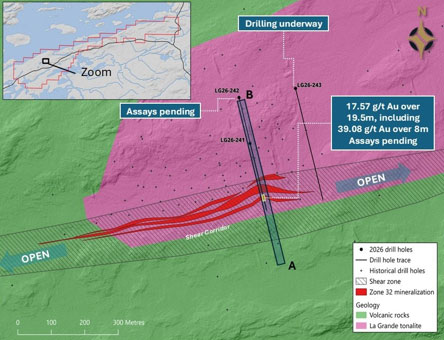
This map shows 2 things worth noticing: First, look at how densely the black dots cluster around the red zone. That is more than 40,000 m of historical drilling, and it is the reason Lux can target its holes so precisely. Second, look at the shear corridor itself. It runs right across the map and well beyond the drilled area, with the word “OPEN” at both ends. Gold systems of this type tend to follow these corridors, which is why Lux is now drilling toward the eastern extension.
Figure 2: The cross-section – A slice through the deposit
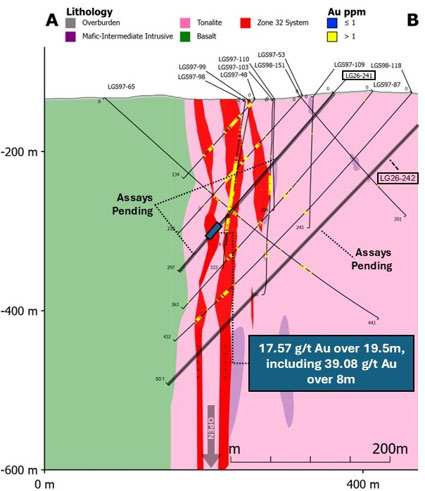
This is the most telling picture in the release. The red zone is not a single thin vein. It is a set of several steep, parallel lenses packed side by side, and LG26-241 crosses right through them. The same section also carries holes LGS97-98 and LGS97-103, which produced 2 of Zone 32’s best-known historical intercepts: 83.8 m @ 7.95 g/t gold and 36 m @ 3.37 g/t gold. Notice also how few yellow dots there are below a depth of about 300 m. That is not because the gold stops. It is because very few holes were drilled that deep. LG26-242 is the first modern test of that deeper part of the section.
The core: what high grade looks like
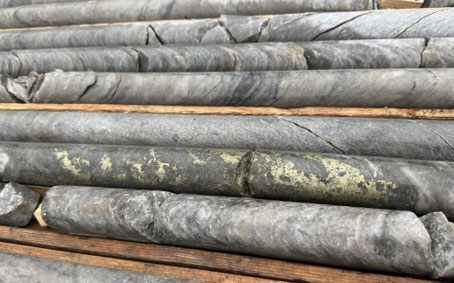
The streaky, stretched look of the grey rock is the shear zone at work. Some 2.7 billion years ago, the rock was squeezed and smeared, which opened pathways for hot, gold-bearing fluids. Those fluids left behind 3 things: A pale mica called sericite, sulphide minerals and quartz veins. That is the recipe Lux says controls most of the gold at Zone 32.
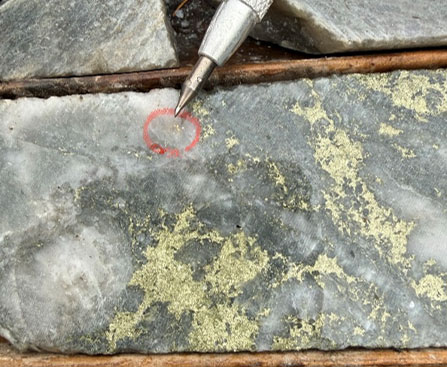
It is easy to look at the photos and assume all the yellow is gold. It is not. The bright, brassy blotches are chalcopyrite, which, like pyrite, is often mistaken for gold. The gold is the small, richer-yellow fleck inside the red circle.
For a core sample to show gold visible to the naked eye is still unusual, because most gold in deposits like this is too fine to see. Seeing it here fits both the very high grades and the nugget effect discussed above.
Lux notes that the photos show mineralization observed in the core and are not necessarily representative of grades across the whole interval. That is a fair caution. Their main value is geological: They show the gold sits exactly where the deposit model says it should.
“IT DELIVERED”: WHAT THE CEO IS TELLING SHAREHOLDERS
Kim Quyên Nguyên, President and CEO of Lux Metals, commented in yesterday’s news-release:
“This is the first hole Lux has drilled at La Grande, and it delivered. After more than a decade without drilling at Zone 32, we’re seeing the same style of shear-hosted gold-copper mineralization the previous operators reported. We acquired this project because we believed the system was open, and today’s result is the first step in demonstrating that.”
It is a short statement, and it is notably restrained for a release that contains a 165 g/t sample. Each of its 3 sentences carries a specific message:
- “This is the first hole … and it delivered.” First holes carry a lot of weight in junior exploration. A miss, or a weak result, can cast doubt on a whole project before the program is even finished. A strong first hole does the opposite. It tells the market that the targeting works and that the next holes are worth waiting for.
- “After more than a decade without drilling at Zone 32, we’re seeing the same style of … mineralization the previous operators reported.” The last holes drilled into Zone 32 were 5 holes by Virginia Mines in 2012, including LGS12-224. Since then, the deposit’s story has rested on paper records, some of them from the late 1990s when quality-control standards were looser. When the CEO says the rock looks the same as what previous operators described, she is saying that the historical database can be trusted. For investors, that may be the single most valuable message in the release. More than 40,000 m of historical drilling, which would cost many millions of dollars to replicate today, becomes a far more useful asset once modern holes start confirming it.
- “We acquired this project because we believed the system was open, and today’s result is the first step in demonstrating that.” Note the words “first step”. LG26-241 was designed to confirm grade and continuity inside the known deposit. It was not designed to prove the deposit is bigger. That job belongs to the holes now pending: LG26-242 below it, and the holes targeting the eastern extension and the LGS12-224 deep zone. The CEO is telling shareholders, fairly, that the expansion story is still to be tested.
WHO IS BEHIND THE PROGRAM
Kim Quyên Nguyên took over as President and CEO on July 27, 2026, a month before drilling started. She is a materials engineer with an MBA and more than 15 years in mining operations and project management. She has led numerous NI 43-101 technical studies, held several management positions at Osisko Mining and, most recently, served as Chief Operating Officer of Winsome Resources, which is advancing the Adina Lithium Project in James Bay.
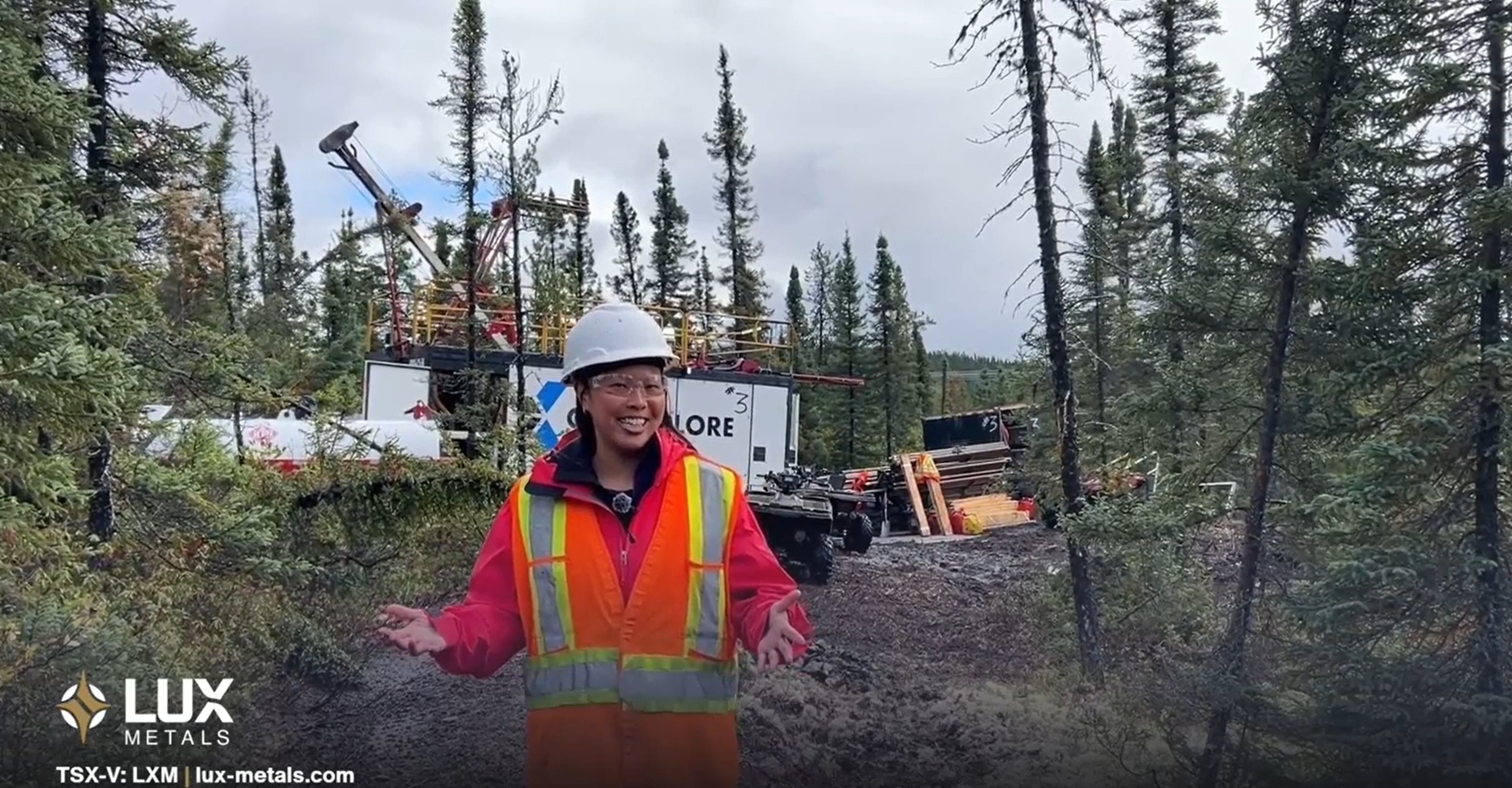
On September 1, 2026, Lux announced the appointment of Simon T. Hébert, P.Geo., as Senior Geological Advisor. His appointment adds a touch of history to the story. Mr. Hébert spent part of his career at Virginia Mines, the company that discovered Zone 32 in the 1990s. He later served as Mining Director of the Société de développement de la Baie-James and is currently Vice President, Development at Brunswick Exploration. Few geologists have a better feel for this part of Québec.
The exploration program is supported by Dahrouge Geological Consulting, whose Jonathan Marleau, P.Geo., is the independent Qualified Person who approved yesterday’s news-release. As our Report #1 in May 2026 noted, Dahrouge was involved in the discovery of Patriot Battery Metals’ Shaakichiuwaanaan Lithium Project in the same region.
BOTTOM LINE
Zone 32 was never lost. It was forgotten.
“They forgot about the project”, CEO Kim Quyên Nguyên told The Northern Miner this month, describing how La Grande slipped down Virginia Mines’ list of priorities after years of work. Asked why so much lower-grade gold around the rich core was left behind, she said: “The cut-off was not the same as it is today. It just fell out.”
That is the whole investment case in a nutshell. The gold did not disappear. The economics around it changed. When most of Zone 32 was drilled, gold traded at around 300 USD an ounce. Rock that was not worth counting then may well be worth counting now.
Previous operators drilled 253 holes and 52,472 m across the project between 1996 and 2015, most of it at Zone 32, and their historical estimates pointed to something in the order of 280,000 to 320,000 ounces of gold together with copper. Those figures are historical, not current, and should not be relied upon. But they show what earlier owners believed they were looking at, and they explain why a modern, NI 43-101-compliant resource is the prize Lux is now working toward.
Yesterday, the first new hole at Zone 32 in 14 years delivered its answer to the most important question of all: Does the old data hold up? LG26-241 hit the zone where the model said it would be, in the rock the model said would host it, with grades that stand up to the best historical holes. 19.5 m @ 17.57 g/t gold. 8 m @ 39.08 g/t. 19.5 m @ 11.67 g/t even with the best sample capped. Gold you can see in the core. Copper sulphides still waiting to be counted at the lab.
“We’re revisiting everything”, Nguyên said. Investors should take that literally. The deeper hole beneath LG26-241 is already drilled. The rig has been stepping out to the east, along a shear corridor marked “OPEN” at both ends, and toward the deep zone that LGS12-224 hit some 400 m down-plunge back in 2012. Final assays are expected between mid and late November. A tighter geophysical survey is planned for the winter. And copper, a metal the market values far more today than when this deposit was last studied, has yet to enter the conversation.
None of this is proven yet. This is just a first hole. The expansion holes carry more risk than the hole that confirmed the core, and the nugget effect will keep individual grades swinging. But exploration is a series of doors, and each must open before the next can be tried. The first door at La Grande has now swung open, and it opened wide.
In 1996, a handful of geologists stopped at an outcrop because the rock looked different. 30 years, several owners and a forgotten decade later, the rock still looks different. Only this time, a company built around this gold system is looking at it, with modern tools, a gold price more than 10 times higher and every reason to keep drilling.
The story of Zone 32 is being written again. Its first new chapter came out of the ground at 220.5 m. The next ones are already in the core boxes.
Company Details

Lux Metals Corp.
1055 West Georgia Street, 1500 Royal Centre
Vancouver, BC V6E 4N7 Canada
Phone: +1 604 678 5308
Email: info@lux-metals.com
www.lux-metals.com
ISIN: CA55067G1081 / CUSIP: 55067G108
Shares Issued & Outstanding: 77,155,216
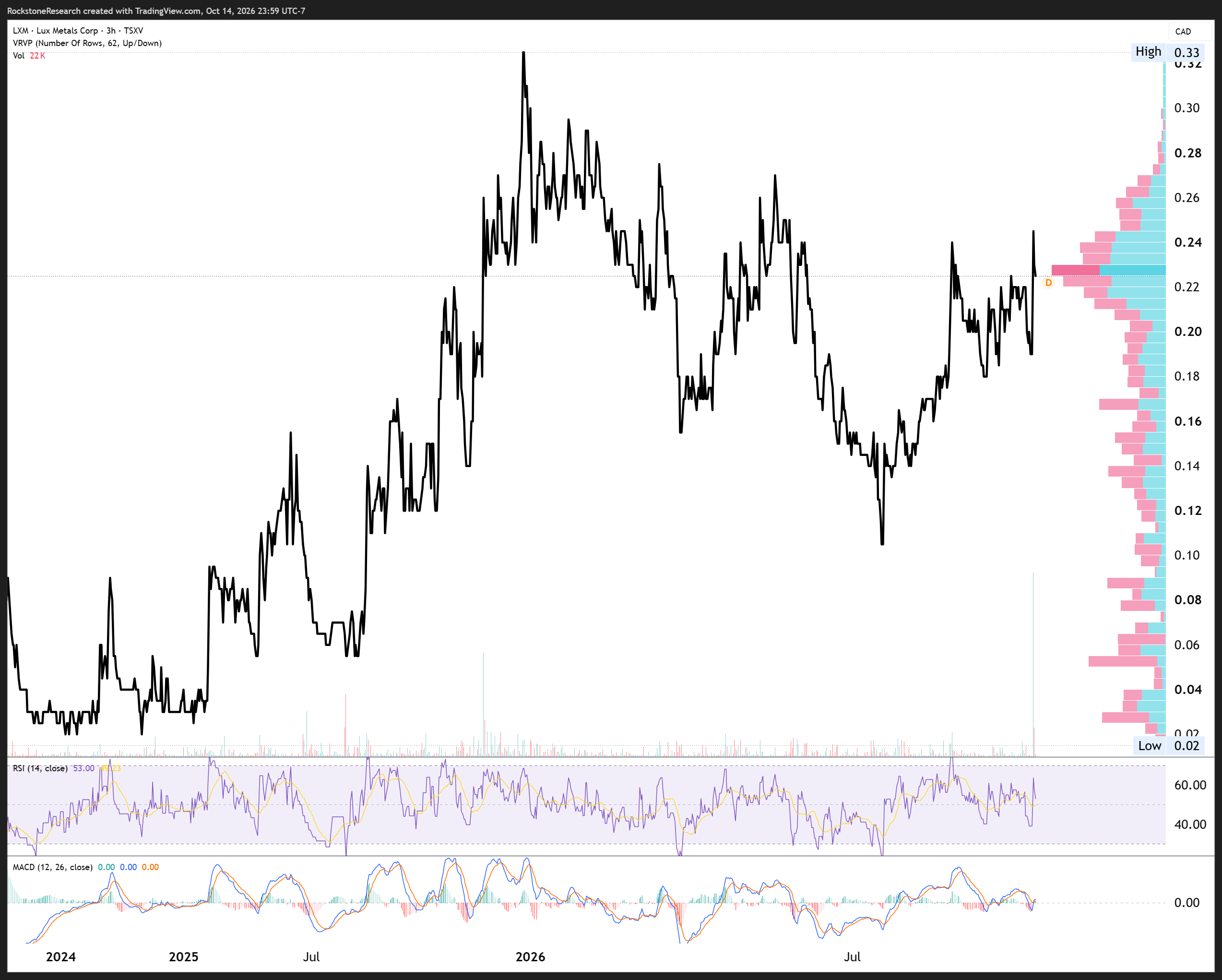
Canada Symbol (TSX.V): LXM
Current Price: 0.215 CAD (10/14/2026)
Market Capitalization: 17 Million CAD
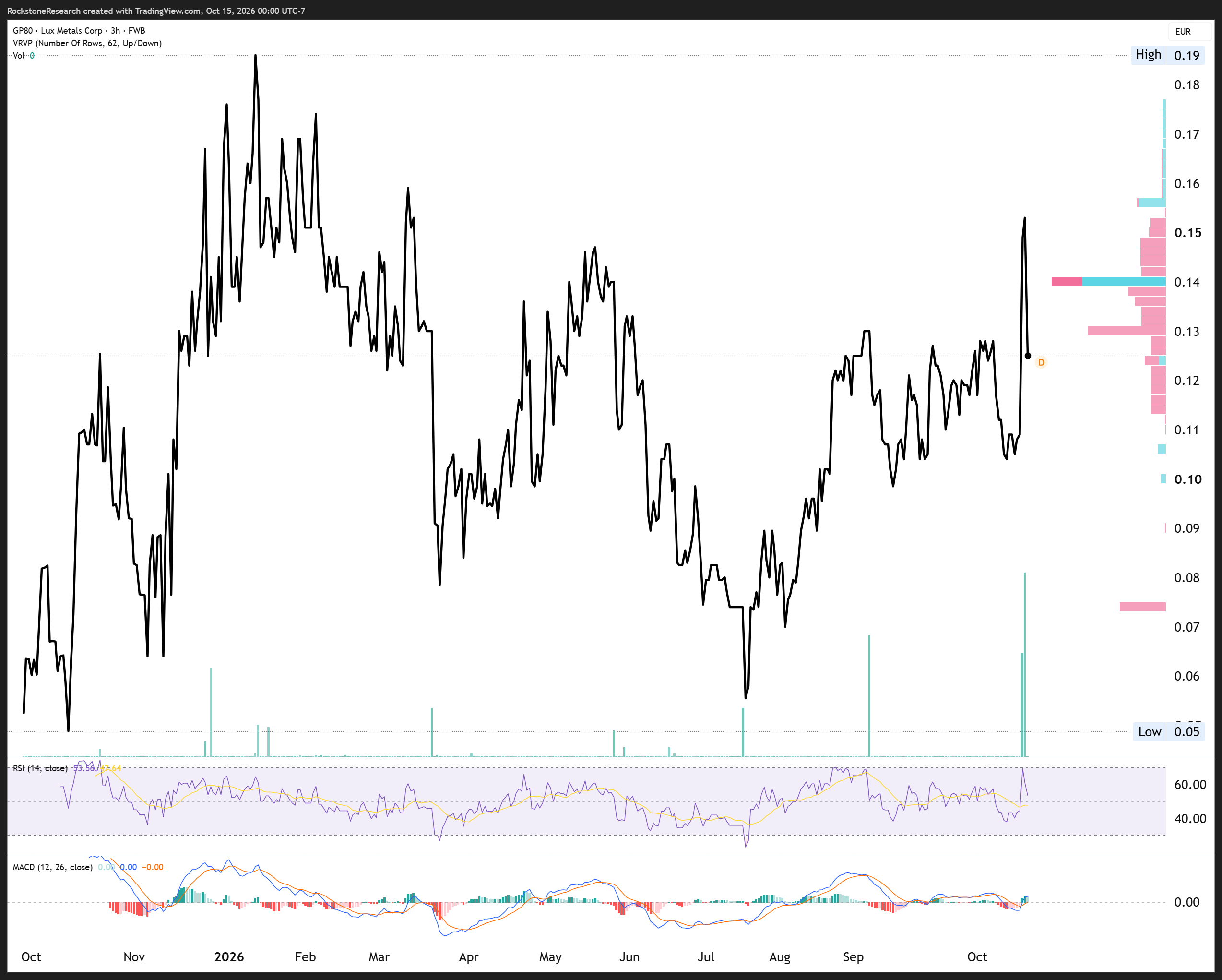
Germany Symbol / WKN: GP80 / A41JQW
Current Price: 0.125 EUR (10/15/2026)
Market Capitalization: 10 Million EUR

Stephan Bogner
Contact
Rockstone News & Research
Stephan Bogner (Dipl. Kfm., FH)
Müligässli 1, 8598 Bottighofen
Switzerland
Phone: +41-71-5896911
Email: info@rockstone-news.com
Disclaimer and Information on Forward Looking Statements: Rockstone, Lux Metals Corp. (“Lux“; “the Company“) and Zimtu Capital Corp. caution investors that any forward-looking information provided herein is not a guarantee of future results or performance, and that actual results may differ materially from those in forward-looking information as a result of various factors. The reader is referred to Lux’s public filings for a more complete discussion of such risk factors and their potential effects, which may be accessed through its documents filed on SEDAR+ at www.sedarplus.ca. All statements in this report, other than statements of historical fact, should be considered forward-looking statements. Much of this report is comprised of statements of projection. Such statements involve known and unknown risks, uncertainties and other factors that may cause actual results or events to differ materially from those anticipated in these forward-looking statements. There can be no assurance that such statements will prove to be accurate, as actual results and future events could differ materially from those anticipated in such statements. Forward-looking statements in this report include statements, interpretations, conclusions and expectations regarding Lux Metals Corp.’s exploration strategy and the advancement of the La Grande Gold Project in Québec’s James Bay region. Such statements include expectations regarding the ongoing 2026 diamond drilling program at Zone 32, the timing of its completion around mid-October 2026, the receipt of pending assay results, the planned winter geophysical survey, the testing of the eastern extension of Zone 32 and the deep zone identified in LGS12-224 and the potential expansion of mineralization down-plunge and along strike. Forward-looking statements also include interpretations regarding the geological significance of drill hole LG26-241, including statements that its results confirm the grade and continuity of Zone 32 and the reliability of the historical drill database, as well as interpretations regarding the scale and continuity of the Zone 32 gold-copper system, the relevance of historical drill intercepts and historical estimates, the potential significance of copper as a by-product and the possibility that future drilling may support a future NI 43-101-compliant mineral resource estimate. Forward-looking statements further include Rockstone’s own calculations and interpretations, including gram-metre comparisons, partial-interval grades, approximate vertical depths and estimated true widths derived from the Company’s published figures, as well as interpretations of capped and uncapped grades, the nugget effect and the significance of visible gold observed in drill core. These calculations have not been reviewed by a Qualified Person and are approximations for illustration only. Forward-looking statements are based on current expectations, estimates, interpretations and assumptions and are subject to significant geological, technical, operational, regulatory, financial and market uncertainties. Such risks and uncertainties include, but are not limited to: Exploration & Geological Interpretation Risks: The results of a single drill hole may not be representative of the broader Zone 32 system. Geological models, structural interpretations and cross-sections may not accurately predict the grade, width, continuity, location or economic significance of mineralization encountered in pending or future drill holes. There can be no assurance that step-out or deeper drilling will confirm current interpretations or extend known mineralization. Historical Data & Verification Risks: A substantial portion of the technical information referenced in this report is based on exploration work and historical estimates completed by previous operators. Historical drill results and historical estimates have not been independently verified by Lux Metals Corp., were prepared before current CIM standards and should not be relied upon. Confirmation of historical results in one drill hole does not verify the historical database as a whole. Drill Program Execution Risks: The completion date, total meterage, hole locations and target selection of the current program, as well as the timing and scope of the planned geophysical survey and future drilling, are subject to change. Programs may be delayed, modified, reduced or cancelled due to weather, wildfire conditions, contractor or equipment availability, logistical constraints, permitting matters, technical challenges, financing limitations or other unforeseen circumstances. Drilling & Assay Risks: Pending assays, including multi-element and copper results, may differ materially from expectations. Zone 32 exhibits a strong nugget effect, as shown by the variance between the 165 g/t Au sample and its 31.5 g/t Au field duplicate, and individual high-grade results may not be reproduced in other samples or holes. Results reported from rushed laboratory batches may be subject to further review. Visible gold and drill core photos are not necessarily representative of grades across the reported interval. Mineral Resource Risks: The La Grande Project does not currently host a mineral resource estimate compliant with NI 43-101 standards. Statements regarding potential scale, future resource delineation, metallurgical recovery, copper by-product potential or development potential are speculative, and there can be no assurance that future exploration will define an economically recoverable mineral resource. Financing & Market Risks: Mineral exploration is capital intensive and Lux may require additional financing to advance future exploration activities. Commodity prices, capital market conditions and investor sentiment toward junior exploration companies may affect the Company’s ability to finance operations or maintain market valuation. Regulatory & External Risks: Exploration activities are subject to permitting, environmental, Indigenous consultation and regulatory requirements in Québec and Canada. Operations may also be affected by weather, wildfires, logistics, labor availability, supply-chain disruptions, regulatory changes or broader economic and market conditions. Accordingly, readers should not place undue reliance on forward-looking information. Actual results may differ materially from those expressed or implied in the forward-looking statements contained in this report. Rockstone and the author of this report do not undertake any obligation to update any statements made in this report except as required by law. Past performance, comparisons to other companies, projects, deposits, jurisdictions, historical drill holes, exploration results, geological analogies, commodities, market events or industry trends are provided for illustrative purposes only and should not be considered indicative of future results.
Disclosure of Interest and Advisory Cautions: Nothing in this report should be construed as a solicitation to buy or sell any securities mentioned. Rockstone, its owners and the author of this report are not registered broker-dealers or financial advisors. Before investing in any securities, you should consult with your financial advisor and a registered broker-dealer. Never make an investment based solely on what you read in an online or printed report, including Rockstone’s report, especially if the investment involves a small, thinly-traded company that is not well known. The author of this report, Stephan Bogner, is paid by Zimtu Capital Corp. (“Zimtu”), a TSX Venture Exchange listed investment company. Part of the author’s responsibilities at Zimtu is to research and report on companies in which Zimtu has an investment. Accordingly, while the author of this report is not paid directly by Lux Metals Corp. (“Lux” or the “Company”), the author’s employer Zimtu Capital Corp. may benefit from volume and appreciation of Lux’s stock price. Zimtu currently holds securities of Lux Metals Corp., including common shares and share purchase warrants. According to Lux’s news-release dated March 9, 2026, Zimtu currently holds 2,750,000 common shares of Lux and 2,750,000 warrants comprised of: (i) 1,000,000 warrants exercisable at 0.05 CAD per share until February 14, 2027; and (ii) 1,750,000 warrants exercisable at 0.40 CAD per share until January 26, 2028. The author of this report also owns equity of Lux Metals Corp. and equity of Zimtu Capital Corp., and therefore may benefit from volume and price appreciation of these securities. This represents a significant conflict of interest that may affect the objectivity of this report. The author may buy or sell securities of Lux Metals Corp., Zimtu Capital Corp. or comparable companies at any time without notice, which may create additional conflicts of interest. Lux Metals Corp. has engaged Zimtu Capital Corp. to provide advertising, marketing and investor awareness services pursuant to a consulting agreement announced by Lux on February 13, 2026 and updated on March 9, 2026. Under the agreement, Zimtu is to provide services including investor presentations, online publications, digital marketing, newsletters, social media content, video news releases and related investor awareness activities. The agreement is for a term of 12 months at a rate of 16,666.67 CAD per month plus applicable GST, representing aggregate annual cash compensation of approximately 200,000 CAD plus GST. All payments under the agreement are payable in cash. Lux Metals Corp. has stated that no securities are proposed to be issued to Zimtu as compensation for the services provided under the agreement. The agreement remains subject to approval of the TSX Venture Exchange. Zimtu Capital Corp. is located at Suite 1450 – 789 West Pender Street, Vancouver, BC V6C 1H2 Canada and may be contacted at 604-681-1568 or info@zimtu.com. Overall, multiple conflicts of interest exist. Therefore, the information provided in this report should not be construed as independent financial analysis or investment advice, but rather as paid promotional commentary and market awareness material. This report does not constitute a recommendation to buy or sell securities and does not replace independent investment advice or independent due diligence. Rockstone’s and the author’s views and opinions regarding Lux Metals Corp. are the author’s own views and are based upon information believed to be reliable, including publicly available information, company disclosures and third-party sources. Rockstone and the author have not independently verified all technical, financial or corporate information referenced in this report. Rockstone and the author do not guarantee the accuracy, completeness or usefulness of any content contained in this report, nor its fitness for any particular purpose. Furthermore, Rockstone and the author do not guarantee that Lux Metals Corp. will perform as anticipated or that any comparisons made to other companies, projects or geological systems will prove to be accurate or applicable. For the avoidance of doubt, this report is not intended for distribution to, or use by, any person or entity in any jurisdiction where such distribution, publication or use would be contrary to local law or regulation. Readers are solely responsible for ensuring that their review and use of this report complies with applicable laws in their jurisdiction. Neither Rockstone nor the author accepts liability for any direct or indirect loss arising from the use of this report or from any investment decision made in reliance upon it. Please read the entire Disclaimer carefully. If you do not agree to all of the Disclaimer, do not access this website or any of its pages including this report in form of a PDF. By using this website and/or report, and whether or not you actually read the Disclaimer, you are deemed to have accepted it. Information provided is educational and general in nature and should not be interpreted as personalized investment, financial, legal, tax or professional advice. Data, tables, figures and pictures, if not labeled or hyperlinked otherwise, have been obtained from Stockwatch.com, Tradingview.com, Lux Metals Corp. and the public domain.


