


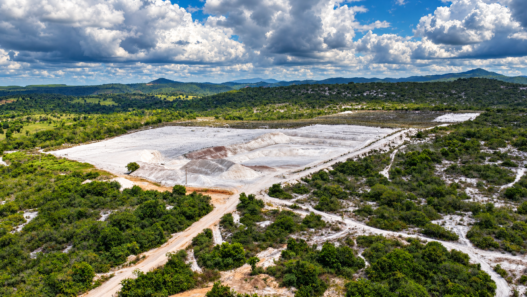
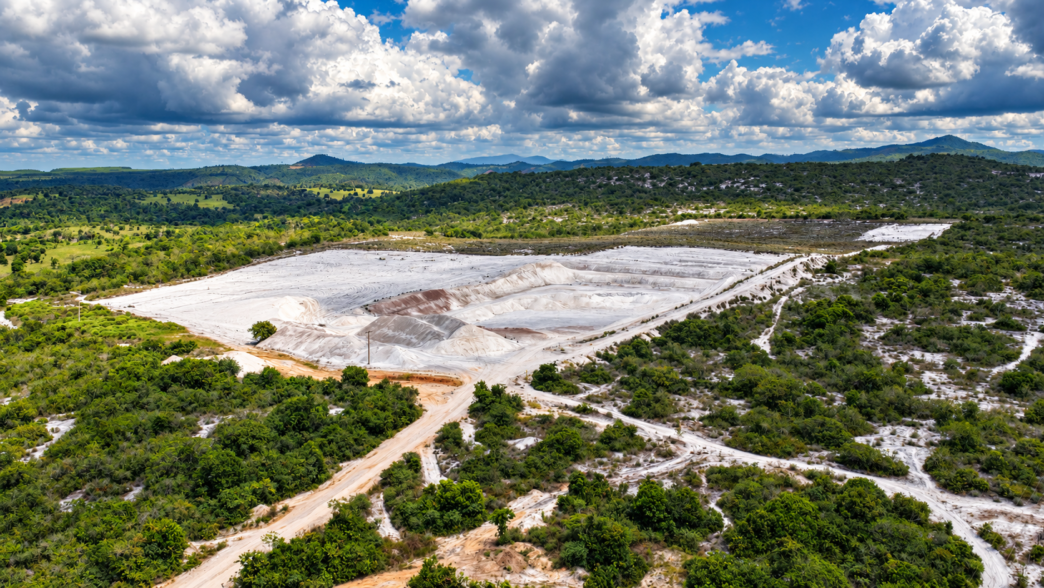
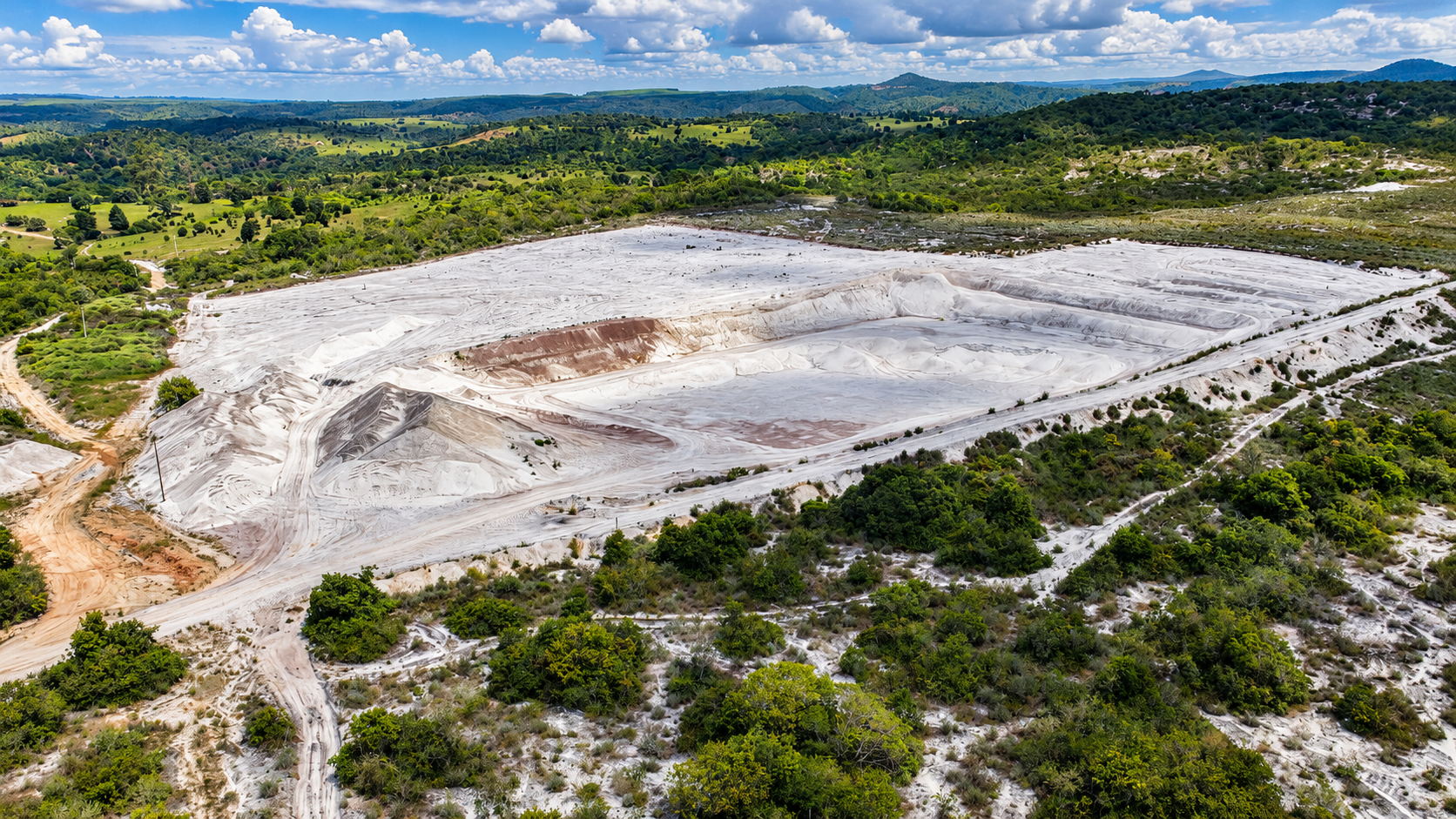
Somewhere between the Atlantic and the green hills of southern Bahia, inland from the small town of Belmonte, the ground turns white. Not the pale beige of an ordinary beach, but a bright, almost luminous white that shines through the green as far as the eye can see. Its name is Santa Maria Eterna. A former CEO of Sibelco Asia once called it “the most unique silica sand deposit in the world”.
For years, the established operator here was Jundu, a joint venture of the European industrial giants Sibelco and Saint-Gobain. Then, in 2023, a newcomer arrived from 10,000 kilometres away: A small company from Vancouver, carrying little more than a lease from the state of Bahia, a handful of lab results and a plan that sounded far too big for its size: Turn this sand into high-value products, right where nature put it.
Fast forward 3 years, and the landscape has shifted. In July, after more than 60 years together, Sibelco and Saint-Gobain announced that they would split their Jundu joint venture. Yesterday, the separation was completed: Jundu’s operation in Belmonte, home to Santa Maria Eterna, is now part of Sibelco.
Meanwhile, Homerun Resources Inc. has been busy. On October 21, Homerun closed the purchase of 442.7 hectares of land right next to its planned industrial site. 6 days later, it received the price tag for a key part of its plan: A cost estimate (CAPEX) for turning its sand into 99.99% pure silica (4N).
And today, Homerun welcomed a new director who already knows Santa Maria Eterna well: He ran M&A projects at Sibelco and sat on Jundu’s board.
With the Jundu separation now complete, 2 companies of consequence share the district. They could hardly be more different. The first is a 150-year-old Belgian group with 2.2 billion EUR in annual revenue, whose Spruce Pine mines in North Carolina supply the high-purity quartz the world’s chip industry depends on. The second is a Canadian junior with a market value of about 42 million CAD. Small, but not empty-handed: It already holds 3 permitted leases, a mining permit, its own industrial land and a commercial LOI with Jundu, whose Belmonte operation Sibelco has now taken over.
This report explores the new landscape: What Homerun has built, where its sand is headed, who has joined the board and who is next door.
THE NEWS AT A GLANCE: PROPERTY, PURITY, PEOPLE
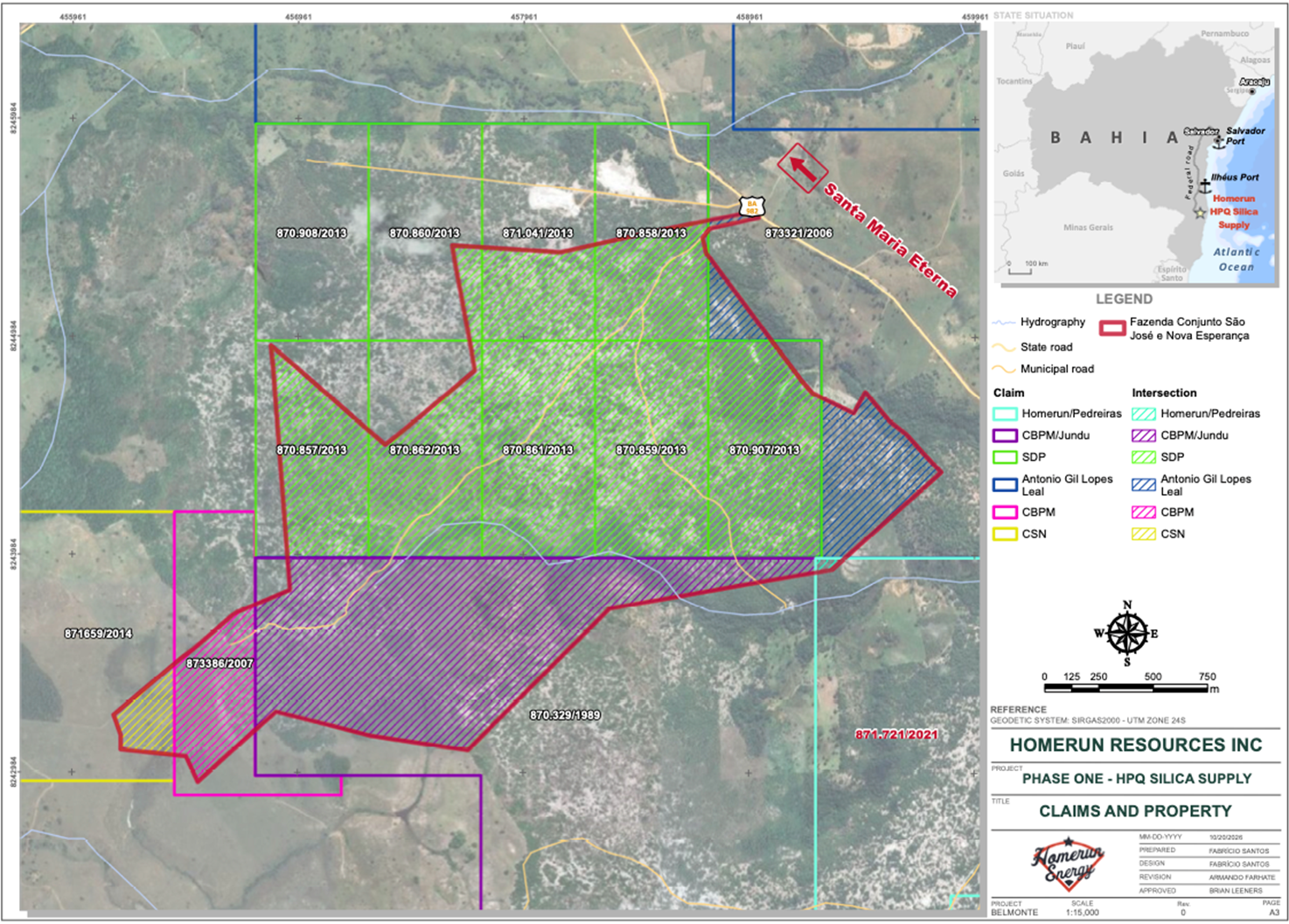
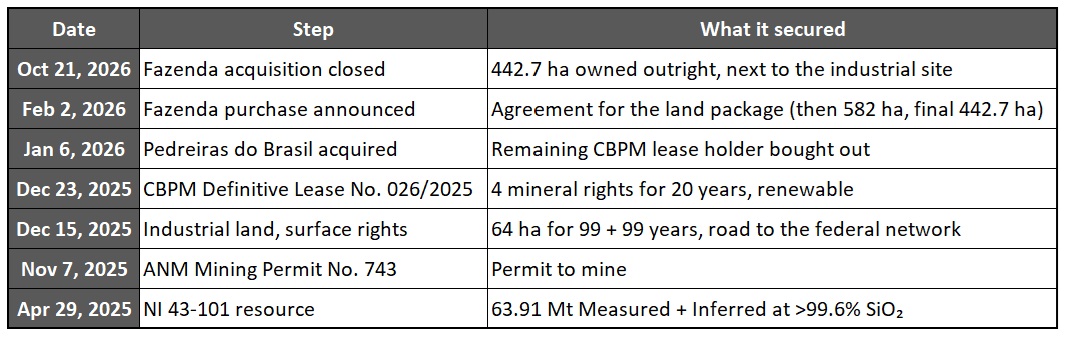
On October 21, Homerun completed the acquisition of the 442.7-hectare Fazenda Conjunto São José e Nova Esperança (fazenda is Portuguese for “farm”) in the Municipality of Belmonte, Bahia. The 1.1 million USD price (500,000 USD in cash plus 864,055 shares) has been paid in full. The property borders the 64-hectare site with 99-year surface rights, renewable for another 99, where the processing plant and the solar glass factory are planned.
It also overlaps parts of other companies’ claims: About 59% of the Silica Del Pietro claims area and 27.5% of the CBPM/Jundu claims area. With the purchase, Homerun takes over the Brazilian mineral lease and royalty rights tied to third-party mining activity on the land.
On October 27, Homerun received the final cost estimate from Dorfner ANZAPLAN, the German purification specialist, for a modular 4N silica purification plant producing 99.99% pure silica sand with an initial capacity of about 30,000 tonnes per year. Depending on the configuration, the plant would cost 19.6 to 27.6 million USD. Including the 3N plant, the full purification path from 2N to 4N comes to about 29 to 37 million USD.
Today, Homerun appointed Leonardo Cunha, a Brazilian-trained engineer who has worked for DuPont, Imerys, Borealis and Sibelco, to its Board of Directors. He brings more than 20 years of experience in industrial minerals, chemicals and corporate development across South America, Europe and North America, including in Bahia.
THE LAND UNDER THE PLANTS
Deposits make headlines. Ground decides projects. An industrial complex like the one Homerun plans, with 3N and 4N purification plants and a solar glass factory, needs space for stockpiles, water, power, roads for a steady stream of trucks and room to grow. Whoever owns the surface around a project can speed it up, slow it down or make it expensive. Homerun has spent the past year closing these gaps step by step.
In Brazil, the minerals underground belong to the federal government and are granted by permit, while the surface is private land. With the farm, Homerun now holds both: The right to mine and 442.7 hectares of its own land, right next to the 64 hectares planned for its industrial complex.
THE PATH TO 99.99%
Owning the ground is half the plan. The other half is what Homerun wants to do with the sand: Purify it step by step, from industrial grade (2N) through 3N to 4N, and sell each stage into markets that pay more for higher purity.
On October 27, Homerun received the final cost estimate for the 4N stage. Dorfner ANZAPLAN, the German specialist behind much of Homerun’s purification test work, completed an AACE Class 5 CAPEX estimate for a modular 4N plant with an initial capacity of about 30,000 tonnes per year. It is the earliest stage of cost engineering, with an expected accuracy of about −30% to +50%. The study is based on lab test work for the most demanding target: 4N2 silica (99.992% SiO₂), which also requires the most capital-intensive process.
ANZAPLAN looked at 2 configurations. Both use the same chemical purification circuit: Hydrofluoric acid leaching, hydrochloric acid washing, rinsing with deionized water, filtration, dewatering and drying. Where they differ is in how the sand is heat-treated before that circuit, as the table shows:
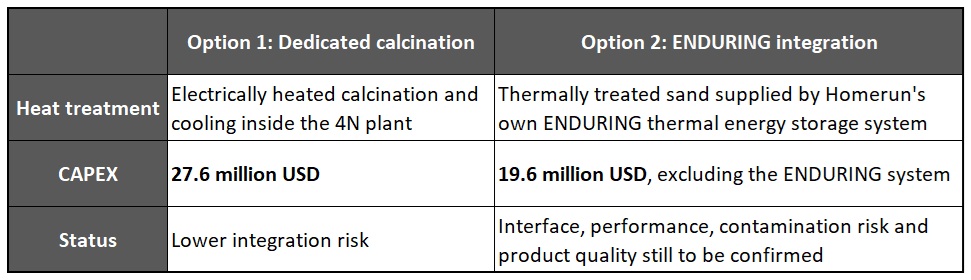
The ENDURING option is about 8 million USD cheaper, mainly because it leaves out the calcination system and related material handling. That saving comes before the cost of the ENDURING system itself, the thermal energy storage technology Homerun has worked on with the National Laboratory of the Rockies (formerly NREL) of the US Department of Energy.
Together with the earlier studies, each step of the purification path now has a price tag:
- 2N: No CAPEX, as processing runs through Jundu’s existing plant under Homerun’s commercial partnership.
- 3N: At least 350,000 tonnes per year for 9.38 million USD (MIE).
- 4N: About 30,000 tonnes per year initially for 19.6 to 27.6 million USD (ANZAPLAN).
Combined, the 3N and 4N plants come to about 29 to 37 million USD, less than a tenth of the roughly 396.5 million USD planned for the solar glass plant.
What will 4N silica be used for? According to Homerun, its markets include fused silica, specialty glass, glass core substrates for chip packaging, electronics fillers and upgraded metallurgical-grade silicon. The company believes these markets may support prices materially above industrial-grade silica, but it has not yet published an economic assessment for the 4N product.
“Receipt of ANZAPLAN’s 4N CAPEX estimate is an important execution milestone for Homerun. We now have a defined process pathway across all 3 stages of purification, 2N supported by the current Jundu plant, and conceptual engineering, process design, mass-balance work, equipment definition and capital-cost estimates for the 3N and 4N Plants. The conventional 4N configuration provides an independent, dedicated calcination pathway, while the ENDURING-integrated 4N configuration highlights the potential capital efficiency of incorporating our thermal energy storage platform into the silica purification value chain based on the work previously done with NLR, previously NREL (US Department of Energy). This work gives us a clear picture of the capital requirements for our planned 3N and 4N plants and supports our phased purification development strategy in the Silica Valley of Bahia. As we continue technical optimization and selection of the preferred configuration, Homerun is advancing the permitting process for the planned facilities and preparing to proceed with early earthworks, subject to the required approvals.”
Homerun CEO Brian Leeners on October 27, 2026
THE NEIGHBOUR: SIBELCO IN SANTA MARIA ETERNA
For more than 60 years, Jundu Mineração was a joint venture between Sibelco and Saint-Gobain, and it is among Brazil’s established suppliers of industrial minerals.
On July 20, 2026, both partners announced that they would separate the business. On November 3, Sibelco announced that the separation is complete. It has now taken over the operations in Analândia (São Paulo), Balneário Barra do Sul (Santa Catarina), Belmonte (Bahia) and Estância (Sergipe). The Belmonte operation is the one in Santa Maria Eterna.
Sibelco describes the JV separation as part of its “Build 2030” strategy, concentrating resources “where it can create the greatest long-term value”. Jundu’s site in Santa Maria Eterna is among those it now operates.
Homerun is no stranger to Jundu: On March 3, 2026, Homerun announced a non-binding commercial LOI with Jundu that updated an MOU from November 2024. It sets target volumes of up to 365,000 tonnes of silica sand per year for Homerun’s industrial complex. Jundu would handle extraction and initial processing (washing and sizing) and supply at least 50,000 tonnes a year from its own leases in Santa Maria Eterna (SME). The LOI also includes an option to build an upgraded processing plant inside Homerun’s industrial complex.
With the separation complete, the SME operation, where the sand under this LOI would come from, now belongs to Sibelco.
The other former Jundu partner is connected to Homerun as well. Cebrace, Brazil’s largest float glass manufacturer, is a joint venture of Saint-Gobain and NSG Group. On August 19, 2026, Homerun announced an exclusive MOU with Cebrace to evaluate a partnership: Cebrace would supply back glass for Homerun’s solar modules and advise on building and running the solar glass plant. If the evaluation leads to definitive agreements, Homerun could switch its plant to 3 front glass lines plus 1 hybrid line, focusing on front glass, the product with the highest margin (see also Report #27).
So both former Jundu partners are now connected to Homerun: Sibelco through the sand, Saint-Gobain through the glass.
Sibelco is not a typical neighbour for a junior. The Belgian group runs the high-purity quartz operations at Spruce Pine in North Carolina, the benchmark deposit that much of the semiconductor industry depends on for crucible quartz. In earlier reports (#2 and #9) we described SME as a possible second pillar next to Spruce Pine, complementing it rather than replacing it. With Sibelco now operating its own site in SME, that comparison has become more literal than we expected.
On the mining side, here is what each of the 2 companies holds in the district:
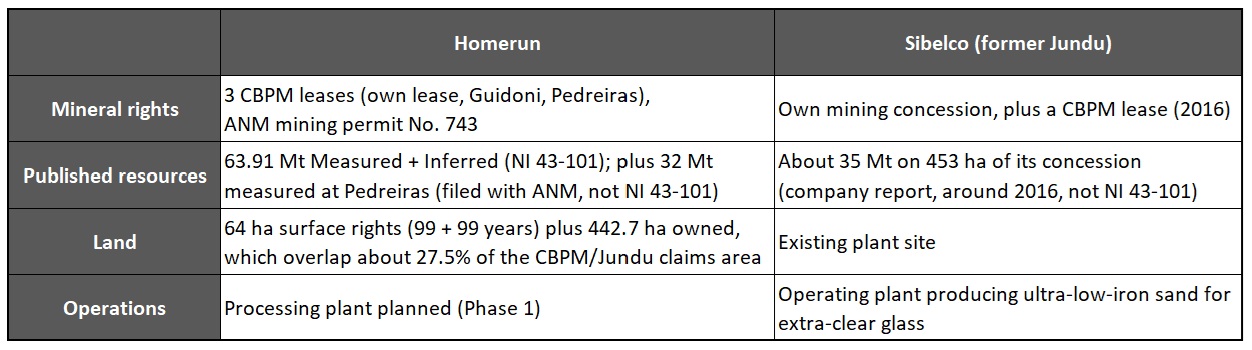
The positions are different in kind: Homerun has the larger published resource (although estimated under different standards), the permits and the land for its industrial complex. Sibelco, through the former Jundu operation, has what Homerun does not yet have: An operating plant, a customer base and years of experience with this sand.
Homerun has always described its district control as a combination of ownership and partnership: Its own leases and land, plus supply agreements covering partner ground, including Jundu’s. With Jundu’s SME site now part of Sibelco, the partner ground in that strategy belongs to one of the world’s largest silica companies. SME is not strictly a 2-company district, since several smaller private operators work in the municipality, but no other company comes close in size.
SIBELCO: 150 YEARS OF SILICA, BUILDING FOR 2030
Sibelco is a Belgian minerals group based in Antwerp. Founded in 1872, it today operates 118 production sites in 31 countries with a team of more than 5,000 people. The company calls itself a global leader in 3 materials: Industrial silica, high-purity quartz (HPQ) and recycled glass. Brazil is familiar ground: Sibelco built its first South American quartz sand plant in São Paulo in 1978.
Sibelco Key Figures
- Revenue 2025: 2,237 million EUR
- EBITDA 2025: 455 million EUR
- Revenue H1 2026: 1,088 million EUR
- EBITDA H1 2026: 220 million EUR
- Sources: Sibelco, 2025 full-year results and 2026 half-year results
The best-known part of Sibelco is Spruce Pine in North Carolina, where it mines the quartz that ends up in the crucibles used to grow silicon crystals for chips and solar cells. It is also North America’s and Poland’s largest glass recycler, after buying Strategic Materials Inc. and Krynicki.
Build 2030: Sibelco’s Vision
Sibelco’s strategy for this decade is called Build 2030. Its vision: “Sibelco – the growth company driving a sustainable world through silicate materials.” Sibelco strives for global leadership in industrial silica, high-purity quartz and recycled glass, and for regional leadership in selected silicate materials such as olivine, feldspathics and clays. It wants to grow by helping its customers decarbonise.
According to Sibelco, Build 2030 rests on 5 themes: Empowering its people, sharpening its material portfolio, winning with customers through innovation and partnership, growing through organic and selective inorganic opportunities and diversifying into high-growth markets.
2026: A Strategic Year
In the first half of 2026, Sibelco reported revenue of 1,088 million EUR and EBITDA of 220 million EUR, a margin of 20.2%. HPQ sales to the semiconductor market grew, supported by AI, 5G and electric vehicles, and most of the capital spending went into the US HPQ operation. Its stated priority is a financial position that supports its investment-grade rating, and it spoke of “selective investments that are aligned with our Build 2030 priorities”. The last highlight of the half-year report is the Jundu separation.
On October 22, Sibelco announced that it has signed an LOI with the US Commerce Department for up to 56 million USD under the CHIPS and Science Act. The money would go to Sibelco North America to develop and scale high-purity quartz processing and product technologies, such as next-generation leaching and hot chlorination, plus a pilot and demonstration facility. The award is not yet final, and the US government would receive a minority, non-voting equity stake.
On November 3, Sibelco completed the Jundu separation. Alexandre Lazari, Sibelco’s VP South America, commented: “This is the beginning of a new chapter for Sibelco in Brazil. We enter this phase with deep respect for what has been built over many years and above all, for the people behind these operations. We believe in Brazil and South America, and we want to grow together with our customers, employees, communities and partners, building lasting relationships based on trust, responsibility and respect.”
Put together, Sibelco describes itself as a company that wants to lead in silica worldwide and grow together with its customers. Since November 3, it is also Homerun’s direct neighbour in Santa Maria Eterna.
MEET LEONARDO CUNHA

Leonardo Passos da Cunha is a mechanical engineer trained in Brazil who has spent more than 20 years moving between chemicals, industrial minerals and deal-making.
His career at a glance:
- DuPont and Braskem (early career): Cunha started in business development and operational excellence at DuPont, the US science and chemicals group founded in 1802, and at Braskem, the largest petrochemical company in the Americas by production capacity, whose Camaçari complex in Bahia is among Brazil’s largest.
- Imerys (Brazil and France): Imerys, based in Paris, is among the world’s largest industrial minerals producers. Cunha moved into corporate development and market leadership there, and from 2014 to 2018 he represented Imerys at the American Chamber of Commerce in Campinas.
- Borealis (Vienna): Borealis is among Europe’s largest producers of polyolefin plastics. Cunha was Senior Global Marketing Manager in its Energy and Communications segment, which supplies polymers for power and data cables.
- Sibelco (Antwerp, then North America): At Sibelco he became Global Director of Growth & Optimization, responsible for the full M&A cycle: Screening targets, due diligence, negotiation, closing and integration. He later moved to the US as Director of M&A and Integration for North America, covering the United States, Canada and Mexico. A former colleague writes that Cunha coordinated the due-diligence team on an M&A case for Sibelco South America. Cunha also served on the board of Jundu.
Cunha studied mechanical engineering at UNICAMP, the State University of Campinas, where he also earned a master’s degree. He holds an Executive MBA from the Kellogg School of Management at Northwestern University, completed a venture capital program at UC Berkeley’s Haas School of Business and is a professor at Toulouse Business School. He serves on the advisory boards of CICC and Rosetta Omics. He serves on the advisory boards of CICC and Rosetta Omics.
For Homerun, the fit is clear: He knows Sibelco’s M&A work from the inside and Jundu from its board. He has done deal work at leading industrial-minerals companies. He knows Brazil’s process industry. According to Homerun, his background is expected to support its work on commercial strategy, industrial partnerships, capital planning, project execution and the potential expansion of downstream silica applications.
“We are pleased to welcome Leonardo Cunha to Homerun’s Board of Directors. His experience across mining, industrial minerals, chemicals, strategy and M&A is highly relevant to the next stages of Homerun’s development. Leonardo has held senior leadership positions with globally recognized companies operating across the industrial-materials value chain. His experience in evaluating growth opportunities, guiding strategic transactions, advancing industrial operations and building international partnerships will be a valuable addition as Homerun progresses its silica-processing platform in Brazil and expands into solar glass, energy storage and advanced silica materials.”
Homerun CEO Brian Leeners in today's news-release
“Homerun has assembled a differentiated position in high-purity silica and is advancing an ambitious strategy to develop downstream value-added applications in Brazil. I look forward to working with the Board and management team as the Company progresses its industrial development plans and pursues strategic opportunities across the silica, solar, energy-storage and advanced-materials sectors.”
Leonardo Cunha in today's news-release
THE ROAD SO FAR
In 2023, Homerun started in Santa Maria Eterna with a supply agreement and a lease agreement with the state mining company CBPM, securing exclusive rights to extract high-purity silica sand from CBPM concessions in the district.
In 2024, the test work began: Dorfner ANZAPLAN in Germany and MIE in Italy started validating the purity of the sand, while Homerun worked on infrastructure and logistics for the district and signed a first MOU with Jundu in November.
In 2025 came the NI 43-101 resource of 63.91 million tonnes, the selection by Brazil’s development banks BNDES and Finep for a joint support plan and the assignment of the Guidoni lease. The year ended with 3 milestones within 7 weeks: The mining permit in November, the 99-year surface rights for the 64-hectare industrial site and the definitive lease in December.
2026 has been the busiest year so far. In January, Homerun closed the acquisition of Pedreiras, its third and final CBPM lease, and in February it agreed to buy the farm next to its industrial site. In March came a first silica sales contract with Cristal Sand and the commercial LOI with Jundu. In May, the bankable feasibility study for a 1,000-tonne-per-day solar glass plant, with an after-tax NPV of about 670 million USD and an IRR of 20.2%. In June, MIE put a price tag of 9.38 million USD on the 3N plant. Along the way: Acceptance into Bahia’s Desenvolve industrial incentive program, an exclusive MOU with Cebrace, an MOU with CEITEC on silicon carbide and a patent application for antimony-free solar glass. And most recently, the 3 steps covered in this report.

BOTTOM LINE
Some 3 years ago, a newcomer from Vancouver arrived in Santa Maria Eterna with a plan that sounded far too big for its size. Today, it holds 3 permitted CBPM leases, a mining permit, 99-year surface rights and 442.7 hectares of its own land. It has also turned a handful of lab results into an NI 43-101 resource, a bankable feasibility study and a first silica sales contract with Cristal Sand.
Across the fence, the former Jundu site now belongs to Sibelco, which completed the separation yesterday.
Into this setting, Homerun now brings a director who ran M&A projects for Sibelco and sat on Jundu’s board. His experience adds industrial-minerals and corporate development know-how to Homerun’s board. The farm cost 1.1 million USD, paid in cash and shares. What it buys is certainty: The ground for the processing plants, the glass factory and their expansion is secured. With the 4N estimate, both purification stages now have a price tag: About 29 to 37 million USD for the 3N and 4N plants combined. This shows how the purification path is designed: In modules rather than in one big leap.
Property, purity, people: Within 2 weeks, Homerun added to all 3 at once. Behind the plan now stand the support of Brazil’s development banks and the state of Bahia, a convertible financing facility of up to 15 million CAD with The Lind Partners, with Benchmark and StoneX as placement agent and financial advisor, and MOUs with established Brazilian players such as Cebrace, the country’s largest float glass manufacturer, and CEITEC, its state-owned semiconductor company.
The sand is as white as ever, still breaking through the green wherever the bushes part. What has changed is everything around it. The district’s established operator has been divided between its owners. And the newcomer is no longer just a visitor. It owns a strategic piece of the land it once came to explore.
The landscape has shifted. Homerun now has its own ground to stand on, and with it the starting point for what it set out to build: An industrial complex in Bahia that turns Brazilian sand into Brazilian products.
For generations, Brazil has exported much of its mineral wealth as raw material, only to buy it back as finished goods. Homerun’s plan points the other way: To keep the value in the country, from the sand in the ground to purified silica, solar glass and advanced materials. That ambition fits the goals of Brazil’s federal industrial policy and Bahia’s own incentive programs: More processing at home, more skilled jobs in the region and less dependence on imports.
In Santa Maria Eterna, the white sand has waited a long time to become more than sand. Now someone owns the ground beneath it and is working to make it a reality.
Company Details

Homerun Resources Inc.
#2110 – 650 West Georgia Street
Vancouver, BC, V6B 4N7 Canada
Phone: +1 844 727 5631
Email: info@homerunresources.com
www.homerunresources.com
ISIN: CA43758P1080 / CUSIP: 43758P
Shares Issued & Outstanding: 78,878,618
Canada Symbol (TSX.V): HMR
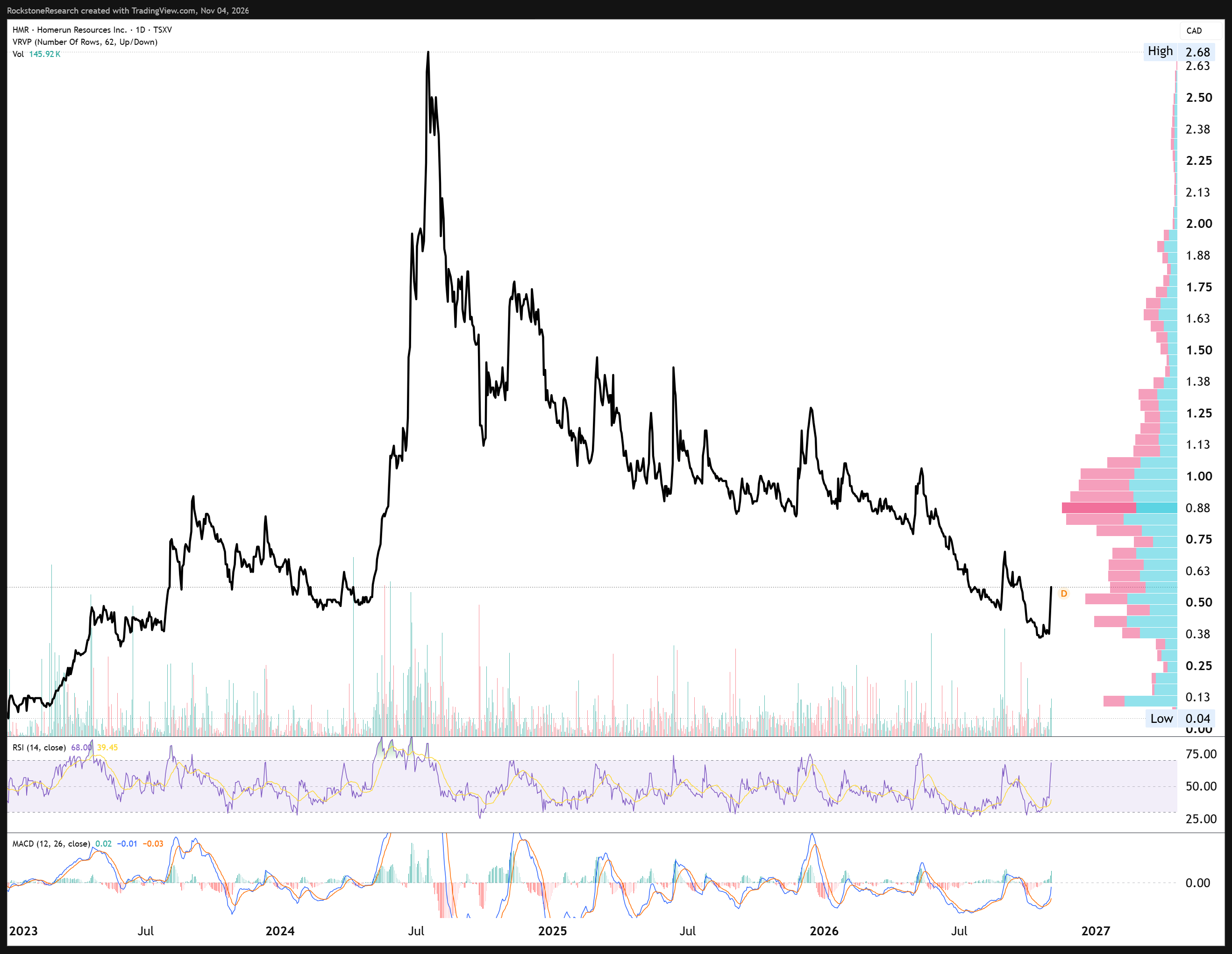
Current Price: 0.53 CAD (11/03/2026)
Market Capitalization: 42 Million CAD
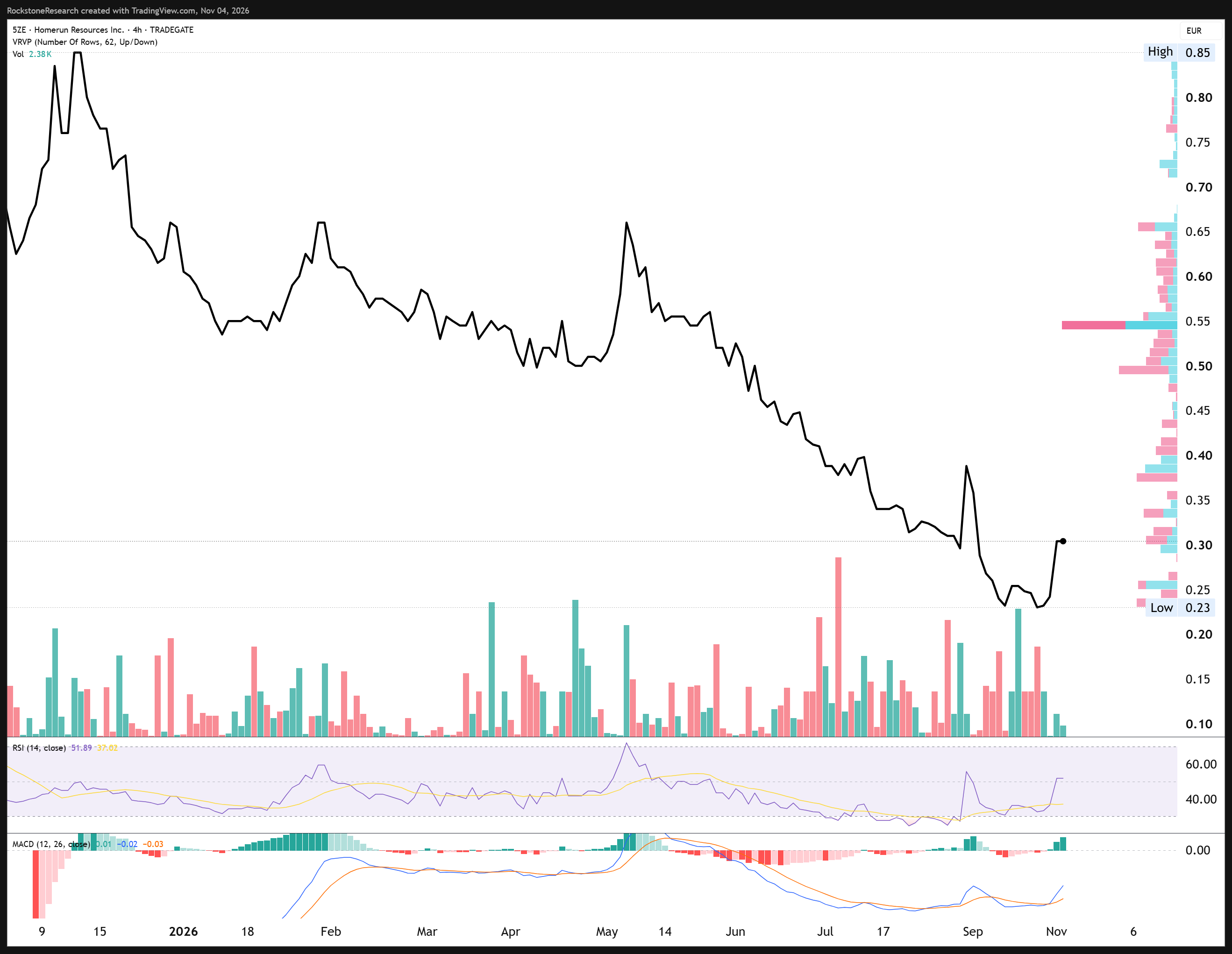
Germany Symbol / WKN: 5ZE / A3CYRW
Current Price: 0.336 EUR (11/03/2026)
Market Capitalization: 27 Million EUR
Stephan Bogner
Contact
Rockstone News & Research
Stephan Bogner (Dipl. Kfm., FH)
Müligässli 1, 8598 Bottighofen
Switzerland
Phone: +41-71-5896911
Email: info@rockstone-news.com
Disclaimer and Information on Forward Looking Statements: Rockstone and Homerun Resources Inc. (“Homerun“) caution investors that any forward-looking information provided herein is not a guarantee of future results or performance, and that actual results may differ materially from those in forward-looking information as a result of various factors. The reader is referred to Homerun’s public filings for a more complete discussion of such risk factors and their potential effects, which may be accessed through its documents filed on SEDAR+ at www.sedarplus.ca. All statements in this report, other than statements of historical fact, should be considered forward-looking statements. Much of this report is comprised of statements of projection, interpretation and strategic analysis. Such statements involve known and unknown risks, uncertainties and other factors that may cause actual results, developments or events to differ materially from those anticipated in these forward-looking statements. There can be no assurance that such statements will prove to be accurate, as actual results and future events could differ materially from those anticipated in such statements. Forward-looking statements in this report include statements, interpretations, conclusions, strategic observations and analytical opinions regarding Homerun Resources Inc.’s high-purity silica resources, mineral rights, surface rights and land holdings in the Santa Maria Eterna district of Bahia, Brazil, the completed acquisition of the Fazenda Conjunto São José e Nova Esperança, the AACE Class 5 CAPEX estimate for a modular 4N silica purification plant, the appointment of Leonardo Cunha to Homerun’s Board of Directors, the completed separation of the Jundu joint venture between Sibelco and Saint-Gobain, and Homerun’s broader strategy of developing an integrated silica purification and industrial complex in Brazil. Forward-looking statements include, without limitation, expectations regarding the use of Homerun’s land and surface rights for planned processing, purification and manufacturing facilities; the royalty and mineral lease rights associated with the acquired land; the cost, capacity, configuration and timing of the planned 3N and 4N purification plants; the potential integration of the ENDURING thermal energy storage system; the suitability of Homerun’s silica for 4N applications; and the potential markets and pricing for 4N silica products. Statements regarding the separation of the Jundu joint venture, the future operation of the Santa Maria Eterna site by Sibelco and the potential continuation, amendment or termination of Homerun’s commercial Letter of Intent with Jundu under new ownership are forward-looking. The Letter of Intent with Jundu is non-binding and does not constitute a definitive supply or processing agreement. Homerun’s Memoranda of Understanding with Cebrace and CEITEC are likewise non-binding and do not guarantee definitive agreements, purchase commitments or revenues. Statements regarding Homerun’s ability to retain greater economic value from its silica resources within Brazil, develop domestic processing capabilities and align with Brazilian federal and Bahia state industrial policies are also forward-looking. Such outcomes will depend on successful technical development, permitting, financing, customer qualification, partnerships and commercial execution. Statements regarding Sibelco, Saint-Gobain, Jundu, Cebrace, CEITEC and other third parties are based solely on publicly available information, including company websites, news-releases and financial reports. These companies have not reviewed or endorsed this report, and nothing in this report implies any relationship, agreement or intention between Homerun and these companies beyond what has been publicly disclosed. Information regarding the professional background of Leonardo Cunha has been compiled from publicly available sources, including Homerun’s news-release and professional networking profiles, and may be incomplete or subject to change. Land and title risks: The acquired land area was revised from 582 hectares, as described in Homerun’s February 2026 news release, to 442.7 hectares following a final review of the registered land documentation. There can be no assurance that land boundaries, surface rights, overlapping third-party mineral claims, mineral lease rights or royalty rights will not be subject to further review, dispute or regulatory interpretation. The economic value of royalty rights tied to third-party mining activity depends on the activities of third parties over which Homerun has no control. Cost estimate and technical risks: The 4N CAPEX estimate is an AACE Class 5 estimate based on conceptual-level engineering and laboratory-scale test work, with an expected accuracy range of approximately minus 30% to plus 50%. Actual capital costs may differ materially. The ENDURING-integrated configuration excludes the cost of the ENDURING system itself and remains subject to further validation of system interface, operating performance, contamination risk and product quality. There can be no assurance that Homerun will achieve 4N purity at commercial scale, consistently and at competitive cost. Market and qualification risks: Homerun has not yet published an economic assessment for its planned 4N product. Customer qualification of high-purity silica can be lengthy and does not necessarily result in commercial orders. Prices, demand and competitive conditions in high-purity silica, solar glass and advanced-material markets may differ materially from current expectations, and established producers may have substantially greater technical, financial and commercial resources. Resource and comparison risks: Resource figures cited for Homerun and for Jundu were estimated under different standards and at different times and are not directly comparable. Comparisons between the positions of Homerun and other companies in the Santa Maria Eterna district represent the author’s interpretation of publicly available information. There can be no assurance regarding the size, quality or development of any third-party operations in the district. Permitting, financing and execution risks: The development of the planned 3N and 4N purification plants, the solar glass plant and related infrastructure will require additional permits, approvals, engineering, financing and construction. There can be no assurance that required permits will be granted, that financing will be available on acceptable terms or at all, or that projects will proceed according to current expectations, schedules or budgets. Homerun’s convertible security financing with The Lind Partners may result in shareholder dilution depending on future share prices, conversions, warrant exercises and repayment decisions. There can be no assurance that additional tranches, institutional financing, government support or development bank programs will be completed as contemplated. Brazilian policy and regulatory risks: Statements regarding the support of Brazil’s development banks, Bahia’s industrial incentive programs and Brazil’s industrial policy objectives are based on current public information. There can be no assurance that such policies, incentives, funding programs or regulatory frameworks will continue or evolve in a manner favorable to Homerun. Board and governance risks: The appointment of a new director does not guarantee any particular strategic outcome, partnership, transaction or financing. Statements regarding the potential contribution of Mr. Cunha’s experience to Homerun’s board represent the author’s opinion. Forward-looking analytical opinions: This report contains the author’s independent analysis and interpretation of publicly available information. Statements regarding the strategic significance of Homerun’s land position, the importance of the Jundu separation for the Santa Maria Eterna district, the relevance of Sibelco’s presence in the district, the significance of Homerun’s 3N and 4N cost estimates and the potential benefits of domestic value addition represent analytical opinions rather than statements of fact. Statements suggesting that Homerun could establish an integrated industrial complex in Brazil or produce high-value silica products are forward-looking and subject to the technical, financial, commercial and execution risks described above. Such opinions are inherently subjective and should not be interpreted as guarantees of technical success, commercial-scale production, customer qualification, commercial agreements, market adoption, competitive advantage, financing, profitability, shareholder value creation or future market performance. Accordingly, readers should not place undue reliance on forward-looking information. Actual results may differ materially from those expressed or implied in the forward-looking statements contained in this report. Rockstone and the author of this report do not undertake any obligation to update any statements made herein except as required by applicable law. Past performance, comparisons to other companies, projects, commodities, technologies, jurisdictions, feasibility studies, capital-market events or industry trends are provided for illustrative purposes only and should not be considered indicative of future results.
Disclosure of Interest and Advisory Cautions: Nothing in this report should be construed as a solicitation to buy or sell any securities mentioned. Rockstone, its owners and the author of this report are not registered broker-dealers or financial advisors. Before investing in any securities, you should consult with your financial advisor and a registered broker-dealer. Never make an investment based solely on what you read in an online or printed report, including Rockstone’s report, especially if the investment involves a small, thinly-traded company that isn’t well known. The author of this report, Stephan Bogner, is paid by Homerun Resources Inc. On September 8, 2025, Homerun announced that the company “entered into an agreement with Rockstone Research to provide marketing services to the company”, and that “Rockstone Research is an arm’s-length marketing firm and has been engaged for an initial three-month term for total consideration of $25,000, which is payable up front. The company does not propose to issue any securities to Rockstone in consideration for the services to be provided to the company.” The marketing services agreement has since been extended and remains in effect as of the date of this report. The author owns equity of Homerun and thus will profit from volume and price appreciation of the stock. This also represents a significant conflict of interest that may affect the objectivity of this reporting. The author may buy or sell securities of Homerun (or comparable companies) at any time without notice, which may give rise to additional conflicts of interest. Overall, multiple conflicts of interests exist. Therefore, the information provided in this report should not be construed as a financial analysis or recommendation but as an advertisement. This report should be understood as a promotional publication and does not replace individual investment advice. Rockstone’s and the author’s views and opinions regarding the companies that are featured in the reports are the author‘s own views and are based on information that was received or found in the public domain, which is assumed to be reliable. Rockstone and the author have not undertaken independent due diligence of the information received or found in the public domain. Rockstone and the author of this report do not guarantee the accuracy, completeness, or usefulness of any content of this report, nor its fitness for any particular purpose. Lastly, Rockstone and the author do not guarantee that any of the companies mentioned in the reports will perform as expected, and any comparisons that were made to other companies may not be valid or come into effect. For the avoidance of doubt, this report is not intended for distribution to, or use by, any person or entity in any jurisdiction where such distribution, publication or use would be contrary to local law or regulation. Readers are solely responsible for ensuring that their review and use of this report is lawful in their jurisdiction. Neither Rockstone nor the author accepts liability for any direct or indirect loss arising from the use of this report or from any investment decision made in reliance on it. Please read the entire Disclaimer carefully. If you do not agree to all of the Disclaimer, do not access this website or any of its pages including this report in form of a PDF. By using this website and/or report, and whether or not you actually read the Disclaimer, you are deemed to have accepted it. Information provided is educational and general in nature and should not be interpreted as personalized investment, financial, legal, tax or professional advice. Data, tables, figures and pictures, if not labeled or hyperlinked otherwise, have been obtained from Stockwatch.com, Tradingview.com, Homerun Resources Inc., Sibelco, Dorfner ANZAPLAN and the public domain.


