


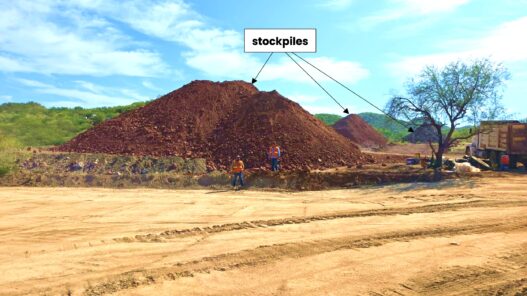
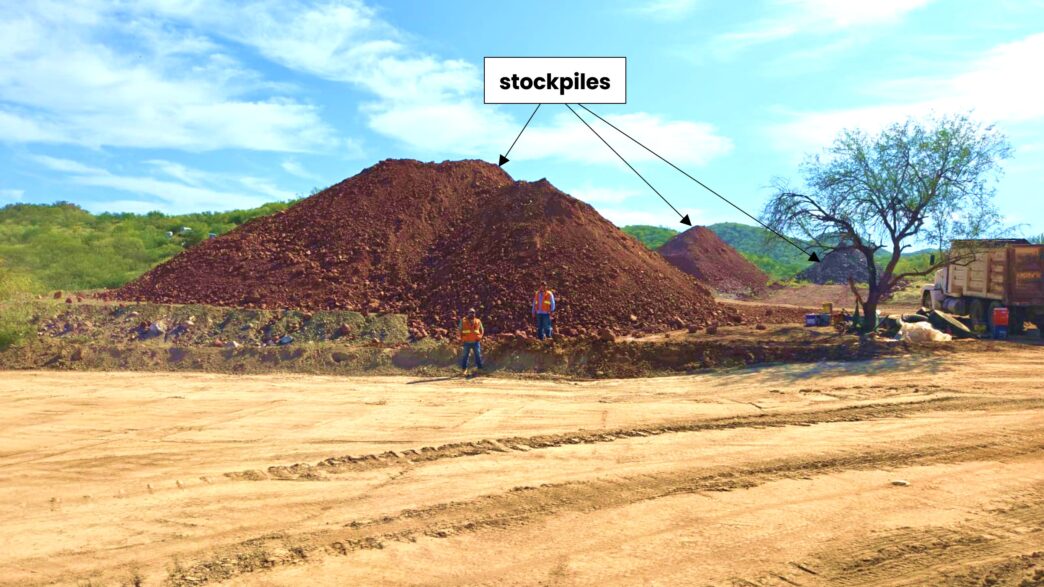
Initial stockpiles of trenched material at Gran Pilar’s fully permitted Pilot Facility.
Today, Tocvan Ventures Corp. released the first lab results from 3 trenches. The material excavated from these trenches has already been stockpiled and is intended as feed for the planned pilot operation. The highest individual sample returned 24.4 g/t gold. An even more telling figure, however, is one that does not appear in the news: The tonnage-weighted average of the sample results across all 3 trenches, which together account for ~6,000 tonnes. Based on the author’s calculation, it comes in well above the company’s planning assumption.
Weighting the reported sample averages by stockpile tonnage gives a combined average of ~2.1 g/t gold. Tocvan notes that individual sample results are not necessarily representative of the average grade of the stockpiled material, so this figure should be read as an indication rather than a measured stockpile grade.
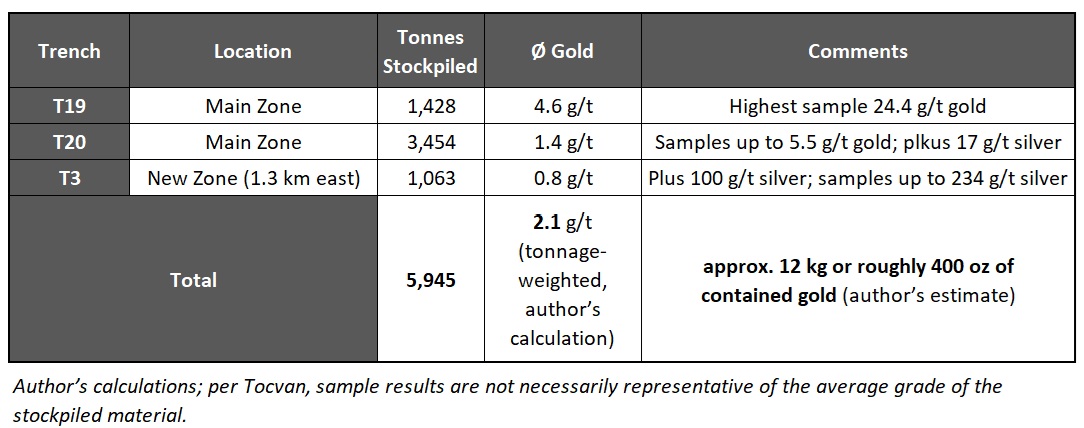
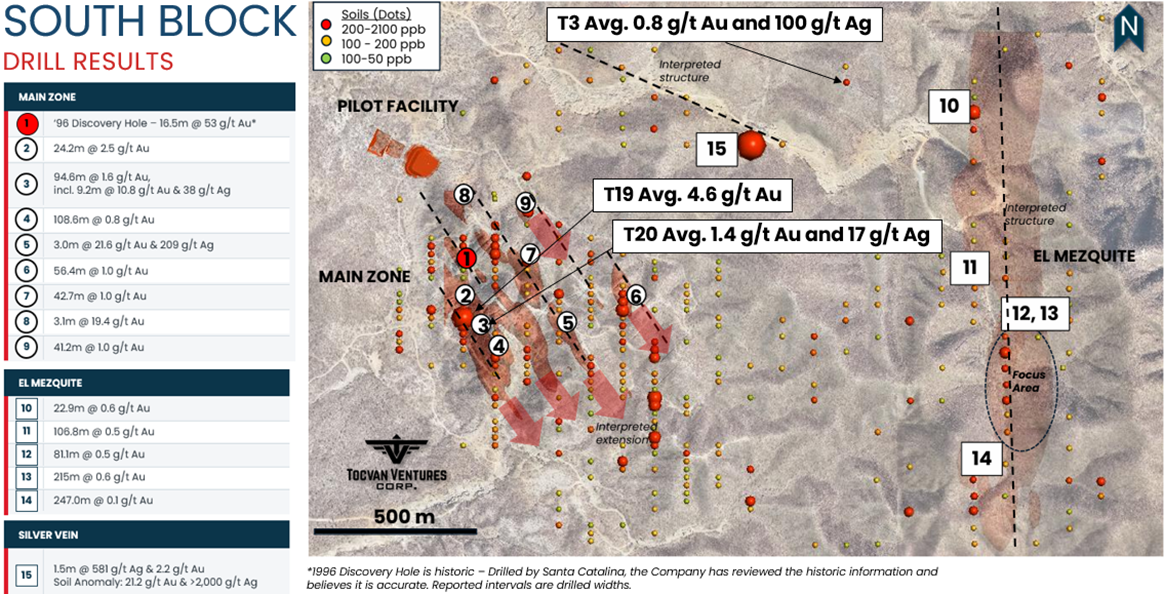
- Even the lower-grade Main Zone trench, T20, averaged 1.4 g/t gold, above the planning assumption, along with 17 g/t silver.
- The new zone to the east, located between the Main Zone and the El Mezquite trend, adds potential upside. At a gold-to-silver price ratio of 75:1, 100 g/t silver is roughly equivalent to 1.3 g/t gold. Combined with the 0.8 g/t gold, the material from T3 may be more valuable than its gold grade alone would suggest. It also indicates that mineralization at Gran Pilar may extend well beyond the Main Zone.
- Tocvan’s trench numbers are pre-planned IDs and not sequential.
- The averages are based on 23 samples with a combined weight of 145.5 kg. They provide an initial indication, which pending trench results will help to test further. The samples were assayed by the ISO/IEC 17025-accredited laboratory LTM in Hermosillo, and the technical information in the news-release was reviewed and approved by qualified person Brodie A. Sutherland.
Management appears to share this view. In today’s news-release, CEO Christopher Gordon commented:
“These initial trench results support our grade expectations for the pilot mine. High-grade samples from the Main Zone, including up to 24.4 g/t gold in Trench 19, combined with the discovery of a new mineralized zone 1.3 km to the east returning significant silver values, reinforce the near-surface potential across Gran Pilar. With roughly 6,000 tonnes stockpiled from these trenches and additional trench results pending, we are building momentum toward our targeted 2026 pilot operation.”
AUTHOR’S CALCULATIONS
The pilot permit covers heap leaching of up to 50,000 tonnes. Tocvan’s planning assumptions are an average grade of 1.2 g/t gold and a recovery rate of 70%. We modeled 4 scenarios using assumed prices of 4,000 USD per ounce of gold and 53 USD per ounce of silver.
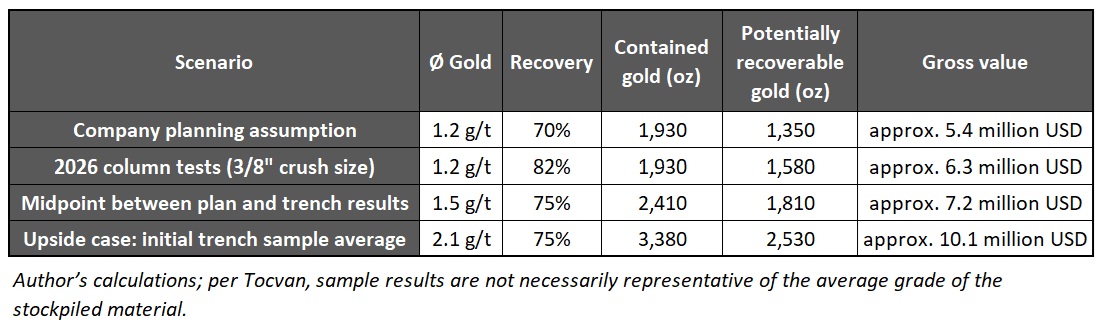
- Silver adds to this. Based on previous results from the Main Zone, the silver-to-gold ratio is roughly 5:1. Assuming a silver recovery of 55%, this could add roughly 5,000 ounces of silver, or ~0.27 million USD in additional gross value.
- The potential upside is tangible: If the entire pilot tonnage graded in line with the trench sample average of ~2.1 g/t, the calculation would point to just over 2,500 ounces of gold and a gross value of roughly 10 million USD. Upcoming trench results should help show whether this grade holds across the full 50,000 tonnes.
- These are gross values before costs, royalties and taxes; a leach cycle typically takes 60-90 days.
For shareholders, however, the most important value of the pilot operation may lie elsewhere. It is expected to generate real operating data and initial revenue, and could help demonstrate that the process works at Gran Pilar beyond the lab. This type of data can help inform a future preliminary economic assessment (PEA). With a first gold pour, Tocvan would also move from pure explorer toward pilot-scale production, a step the market typically watches closely for junior companies.
HEAP LEACHING CAN BE ECONOMIC EVEN AT LOW GOLD GRADES
At its core, heap leaching is simple. The mineralized material is crushed, stacked into a heap 4-6 meters high on a sealed liner and irrigated through drip lines with a highly diluted cyanide solution. The solution percolates through the heap, dissolves the gold and drains out at the bottom. Activated carbon captures the gold, which is ultimately poured into doré bars.
The key lies in what the process leaves out: No mill grinding the rock to powder, no large agitated tanks and comparatively little energy. Grinding is typically the largest cost item in conventional plants. As a result, processing a tonne of material by heap leaching can cost only a fraction as much and grades of just a few tenths of a gram of gold per tonne can be economic.
An example from the region illustrates this: For its Santana Mine, Minera Alamos assumed costs of ~2.30 USD per tonne for mining, 4.00 USD for leaching and 0.50 USD for administration in its 2023 resource estimate (source). That’s less than 7 USD per tonne in total. At 4,000 USD per ounce, 1 gram of gold is worth roughly 129 USD. Even 0.65 g/t at a 75% recovery would therefore yield a gross value of just over 60 USD per tonne. The 1.2 g/t Tocvan has assumed for the pilot would correspond to ~108 USD per tonne at a 70% recovery; before costs, which are typically higher at a small pilot scale than at a large mine.
3 conditions generally need to be in place and Gran Pilar appears to meet them:
- Oxidized material: Weathering has broken down the rock, allowing the solution to reach the gold. At Gran Pilar, oxidized mineralization occurs at surface.
- Low strip ratio: Little barren (unmineralized) rock needs to be moved before reaching the mineralized material, which helps keep mining costs down. The near-surface mineralization at Gran Pilar points in this direction.
- Dry climate: Low rainfall means less dilution and less risk of solution overflow, helping keep the solution in a closed circuit.
The trade-off is a somewhat lower recovery than in a mill, typically 60-85%. Tocvan’s column tests from September returned ~82%, at the upper end of this range.
HOW GRAN PILAR COMPARES WITH MINES IN SONORA
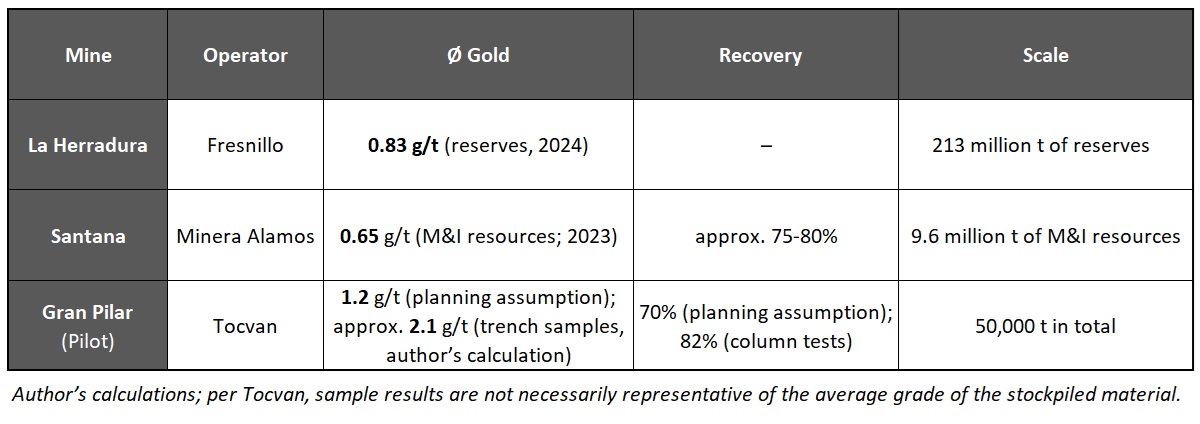
- At La Herradura (one of Mexico’s largest gold mines), Fresnillo reported reserves grading just 0.83 g/t gold. Gran Pilar’s pilot planning assumption is roughly 1.4 times that grade.
- The closest comparison to Tocvan is perhaps Santana. Minera Alamos started production there in 2021 at a small scale and without a feasibility study and reported measured and indicated resources grading 0.65 g/t gold in 2023, just over half of Tocvan’s planning assumption.
The neighbors show that in Sonora, gold is already being mined economically at grades as low as ~0.6 g/t. Gran Pilar’s pilot planning assumption lies well above this level and the average of the first trench samples is even higher.
BOTTOM LINE
The initial figures appear to support Gordon’s assessment. Approximately one-eighth of the permitted 50,000 tonnes has already been stockpiled, with initial sample results pointing to grades well above the planning assumption.
According to the company, the leach pad, the processing facility and the metallurgical work are well advanced, bringing a first pilot-scale production within reach. The company is targeting a first doré pour in late 2026.
For shareholders, several potential catalysts lie ahead: Additional trench results, the start of leaching, the first doré pour and the planned maiden resource estimate. In parallel, the ongoing drill program is expected to deliver new results, which should help show how large Gran Pilar may ultimately be and how much growth potential the project, covering more than 22 km², may hold.
Company Details

Tocvan Ventures Corp.
Suite 1150 Iveagh House
707 – 7th Avenue S.W.
Calgary, Alberta, Canada T2P 3H6
Phone: +1 403 668 7855
Email: bsutherland@tocvan.ca (Brodie Sutherland)
www.tocvan.com
ISIN: CA88900N1050
Shares Issued & Outstanding: 78,735,014
Canada Symbol (CSE): TOC
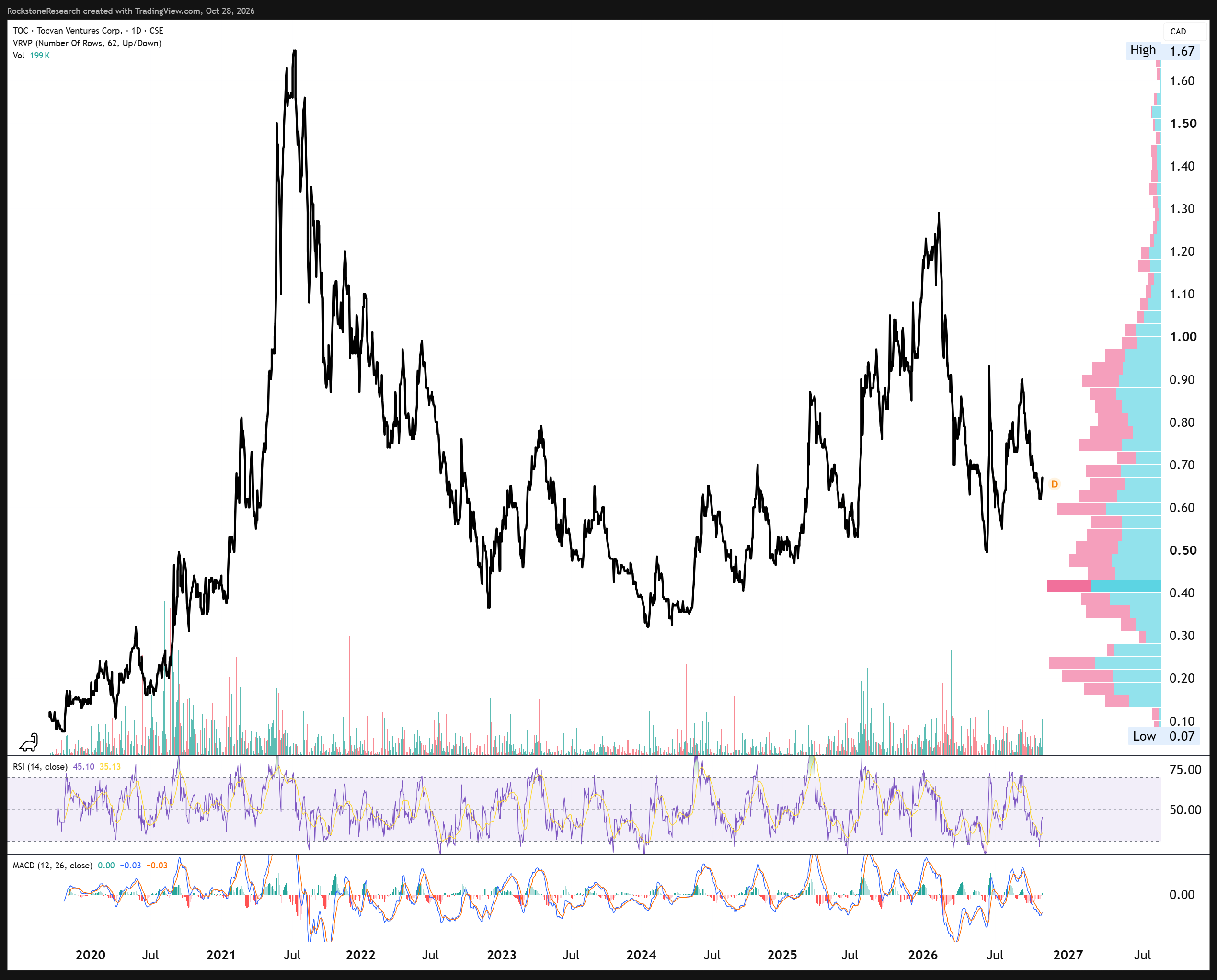
Current Price: 0.65 CAD (10/28/2026)
Market Capitalization: 52 Million CAD
Germany Symbol / WKN (Tradegate): TV3 / A2PE64
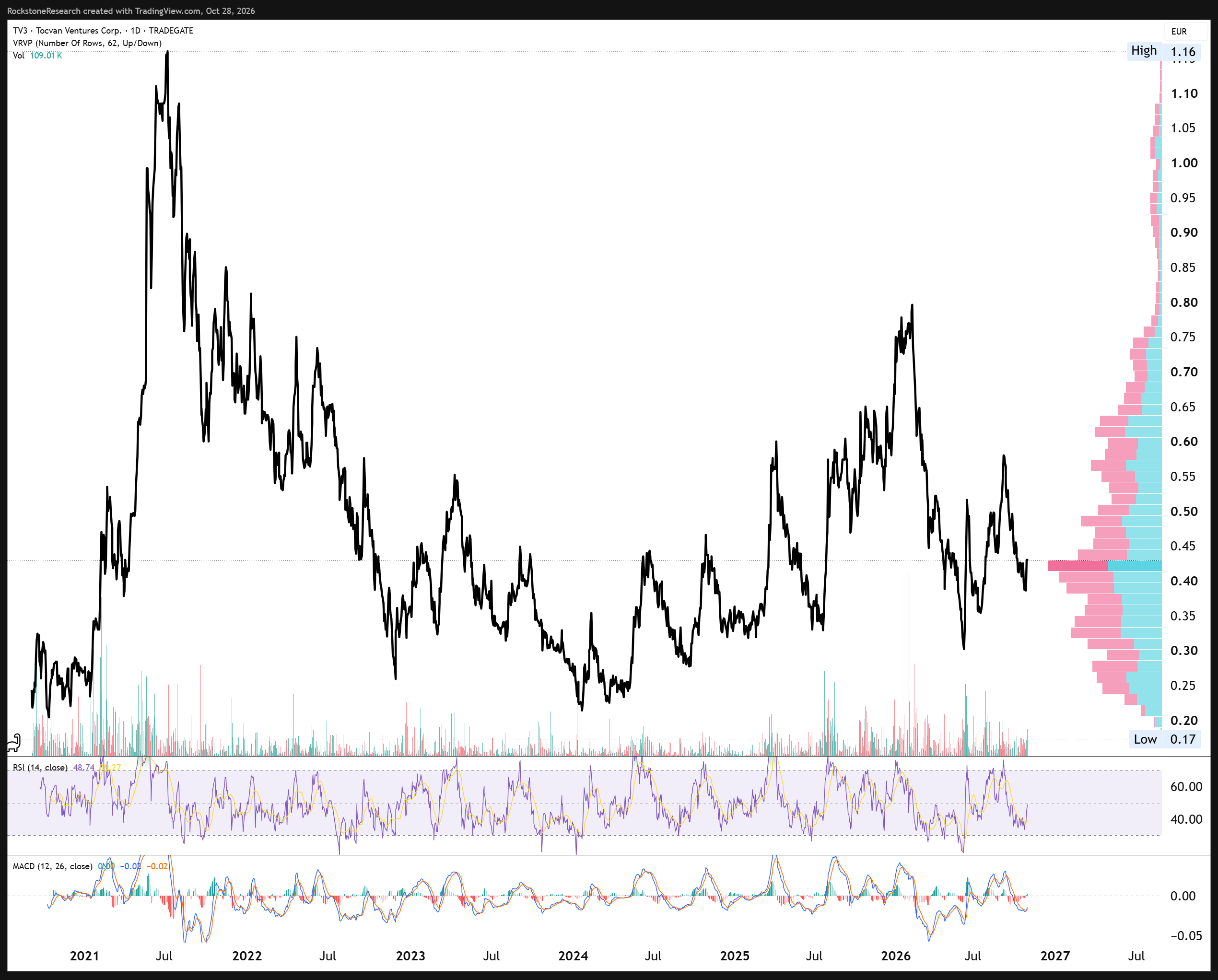
Current Price: 0.415 EUR (10/28/2026)
Market Capitalization: 33 Million EUR
Contact
Rockstone News & Research
Stephan Bogner (Dipl. Kfm., FH)
Müligässli 1, 8598 Bottighofen
Switzerland
Phone: +41-71-5896911
Email: info@rockstone-news.com
Disclaimer and Forward-Looking Information: Rockstone and Tocvan Ventures Corp. (“Tocvan”; “the Company”) expressly point out that all forward-looking information contained in this report does not represent a guarantee of future results or performance. Actual results may differ materially from those projected. Readers are referred to Tocvan’s public filings, available on SEDAR+ at www.sedarplus.ca, for a more detailed discussion of risk factors and their potential impact. All statements in this report, other than statements of historical fact, constitute forward-looking statements. This report includes expectations, interpretations, projections, calculations and assumptions based on information available at the time of writing, including public disclosures by Tocvan Ventures Corp., statements made by its management and publicly available disclosures by other mining companies. Forward-looking statements include, but are not limited to, statements, expectations and assumptions regarding: The interpretation, significance and potential economic relevance of the initial trench results from the Gran Pilar Gold-Silver Project; the extent to which the reported trench results are indicative of the grade of the approximately 5,945 tonnes of stockpiled material and of the remaining material intended as feed for the planned 50,000-tonne pilot facility; the tonnage-weighted average grade of approximately 2.1 g/t gold calculated by the author for the stockpiled material; the comparison of this estimated average grade with the Company’s planning assumption of 1.2 g/t gold and the interpretation that this planning assumption may prove conservative; the classification of Stockpile 1 by the Company’s field team as higher-grade material from Trench 20; the interpretation that oxidized material at Gran Pilar may be favourable for heap-leach processing; the significance of the gold and silver values reported from the new zone approximately 1.3 km east of the pilot area; the conversion of silver grades into approximate gold-equivalent values using an assumed gold-to-silver price ratio of approximately 75:1; the potential for mineralization at Gran Pilar to extend beyond the Main Zone, including at El Mezquite and the silver zone to the east; the four pilot scenarios prepared by the author, including assumed grades of 1.2 g/t to 2.1 g/t gold, assumed gold recoveries of 70% to 82%, contained and potentially recoverable gold ounces and gross values of approximately US$5.4 million to US$10.1 million; the assumed silver-to-gold ratio of approximately 5:1, the assumed silver recovery of 55% and the resulting potential silver ounces and gross value; the per-tonne gross value examples presented in this report; the applicability of column-test recoveries to pilot-scale heap-leach operations; the comparison of grades, recoveries, cost assumptions and production figures at Gran Pilar with those of La Herradura, La Yaqui Grande and Santana; the significance of pending trench and drill results; the completion, commissioning and operation of the permitted Gran Pilar pilot facility; the start of leaching and the targeted first doré pour in late 2026; the timing of a maiden mineral resource estimate and a preliminary economic assessment (PEA); the potential transition of Tocvan from exploration toward pilot-scale production; and the potential impact of these events on the share price of Tocvan Ventures Corp. The trench results referred to in this report are based on a limited number of samples, namely 23 samples with a combined weight of approximately 146 kg taken from three trenches. Average grades derived from these samples are not necessarily representative of all stockpiled material, of the material in each trench or of the remaining feed for the pilot facility. Individual high-grade samples, such as the reported 24.4 g/t gold sample from Trench 19, can significantly influence average grades. Trenches are typically excavated in areas of known mineralization and their results may not be representative of the broader project area. The tonnage-weighted average grade of approximately 2.1 g/t gold, the contained gold estimate of approximately 12 kg or roughly 400 ounces and all pilot scenarios presented in this report are simplified calculations prepared by the author. They are not projections, estimates or guidance of the Company and have not been reviewed or approved by a qualified person. They are based on assumed metal prices of US$4,000 per ounce of gold and US$53 per ounce of silver and on assumed grades, tonnages and recoveries. They represent gross values before mining, crushing, processing, transport, refining and administrative costs, royalties and taxes and are not an indication of revenue, profits or cash flows. The upside case assumes that the entire 50,000 tonnes would have an average grade similar to the estimated grade of the first stockpiled material. There can be no assurance that this will be the case, and the actual average grade of the pilot feed may be materially lower. Gold-equivalent values derived from silver grades are approximations that depend on metal prices and do not take into account differences in gold and silver recoveries. Statements regarding the suitability of Gran Pilar material for heap leaching are forward-looking. The Company has not published a strip ratio for the pilot operation, and the references in this report to oxidation, near-surface mineralization and climate describe general conditions that are typically considered favourable for heap leaching and should not be interpreted as confirmation of low mining or processing costs. The column-test recovery of approximately 82% gold was achieved under laboratory conditions and should not be interpreted as a guarantee that comparable recoveries will be achieved in the pilot facility or in any future commercial-scale operation. Laboratory and column-test performance may differ materially from larger-scale operating conditions due to variations in feed grade, mineralogy, oxidation, particle-size distribution, permeability, solution flow, stacking, irrigation, climate, reagent consumption, leach kinetics and operating practices. Comparisons with La Herradura, La Yaqui Grande, Santana and other mines in Sonora are based on public disclosures by the respective operators, have not been independently verified by the author and are provided for context only. These operations differ significantly from Gran Pilar in scale, geology, mineralogy, cost structure, infrastructure, stage of development and regulatory status. The figures cited for these mines refer to different categories, including mineral reserves, measured and indicated mineral resources, annual guidance and expected recoveries, which are not directly comparable with one another or with the trench results and planning assumptions for Gran Pilar. The cost assumptions cited for Santana were used in a 2023 resource estimate at a materially lower gold price, and costs at Santana and elsewhere may have increased since then. The fact that other operators mine material at lower grades should not be interpreted as an indication that Gran Pilar can be mined economically. Statements describing Tocvan as moving from pure explorer toward pilot-scale production, approaching a first gold pour or similar expressions represent forward-looking expectations based on the current construction status of the pilot facility, permitting, metallurgical test work and statements made by Tocvan management. Such statements should not be interpreted as confirmation that commercial production has commenced or will commence, that the project has demonstrated economic viability or that Gran Pilar constitutes an economically mineable mineral deposit. Although Tocvan reports that the leach pad, the processing facility and the metallurgical work are well advanced, there can be no assurance that construction or commissioning will be completed according to the current schedule, that leaching will commence as planned, that a first doré pour will occur in late 2026 or at all or that the facility will achieve anticipated throughput, feed grades, recoveries, reagent consumption, production rates, operating costs or other technical and economic parameters. Pilot-scale production is not equivalent to demonstrated commercial-scale economic viability. Any references in this report to first gold, a first doré pour, initial revenue, potential catalysts for shareholders or similar expressions should be understood in the context of the planned pilot-scale operation and not as confirmation of sustainable commercial production. Successful pilot operations would not, by themselves, establish a mineral resource or mineral reserve, demonstrate economic mineability or confirm that a full-scale commercial mine will be developed. There are currently no mineral resources and no mineral reserves defined for the Gran Pilar Project. The decision to proceed with a pilot operation is not based on a feasibility study, which entails increased technical and economic uncertainty. Mineralized material processed through the pilot facility does not necessarily constitute ore in the economic sense. There can be no assurance that a maiden mineral resource estimate or a PEA will be completed within any particular timeframe or at all, that pending or future trench and drill results will return similar grades or confirm current geological interpretations, or that exploration success will translate into mineral resources, mineral reserves or an economically viable operation. Further drilling, mineral resource estimation, metallurgical testing, engineering, mine planning, permitting, financing and economic studies may be required before any future commercial-scale mining operation could be developed. Forward-looking statements are subject to numerous known and unknown risks and uncertainties that could cause actual results to differ materially from those expressed or implied. These include, but are not limited to: The speculative nature of mineral exploration, development and pilot-scale mining; geological, sampling and metallurgical uncertainty; the limited number and representativeness of trench samples; variability in feed grade, mineralogy, oxidation and gold-silver deportment; uncertainty regarding laboratory-to-pilot-scale recovery performance; heap permeability, solution flow and leach kinetics; reagent availability and consumption; water availability and quality; weather events, including heavy rainfall; processing, construction, commissioning and operating risks; equipment availability and performance; contractor performance; labour availability and costs; delays in completing or commissioning the pilot facility; the possibility that the targeted first doré pour in late 2026 may be delayed or not achieved; the possibility that gold or silver recoveries may be lower than laboratory results, the author’s assumptions or management expectations; the possibility that operating costs may be higher than anticipated; uncertainty regarding product specifications and marketability; the possibility that prospective buyers may not enter into commercial arrangements; financing and liquidity risks; future shareholder dilution; commodity-price risk; gold and silver price volatility; exchange-rate fluctuations; energy, reagent, labour and capital-cost inflation; permitting, environmental, water, infrastructure, land-access and community-relations risks; political, legal, regulatory, taxation, security and social risks associated with operating in Mexico; capital-market conditions; and other risks beyond the Company’s control. Any references in this report to the estimated average grade of the stockpiled material, grades above the planning assumption, potential upside, potentially recoverable ounces, gross values, comparisons with other mines in Sonora, first production, transition from explorer toward producer, project scale, growth potential, potential catalysts, share-price appreciation or similar expressions represent expectations, interpretations, calculations or opinions based on publicly available information at the time of publication and, where applicable, statements made by Tocvan management. Such statements should not be interpreted as confirmation of future grades, recoveries, operating costs, economic viability, binding commercial agreements, future revenues, profitability, commercial production, financing, share-price appreciation or investment returns. The description of potential events as catalysts for shareholders does not constitute investment advice. Forward-looking statements are inherently subject to significant risks and uncertainties and there can be no assurance that such statements will prove accurate. Assumptions made by management or interpretations and calculations made by the author may prove to be incomplete, overly optimistic or incorrect. Actual trench and drill results, construction progress, commissioning, pilot production, metal prices, commercial negotiations, operating results, economic conditions and future events may differ materially from those expressed or implied in this report. Readers are cautioned not to place undue reliance on forward-looking statements and should review the risk factors described in Tocvan Ventures Corp.’s public filings before making any investment decision. Neither Rockstone, the author nor Tocvan Ventures Corp. undertakes any obligation to update or revise forward-looking statements, except as required by applicable law.
Disclosure of Interests and Legal Notice: Nothing in this report should be construed as an invitation to buy or sell securities. Rockstone, its owners, and the author of this report are not registered broker-dealers or financial advisors. Before investing in securities, you should always consult your financial advisor and a registered broker-dealer. Never make an investment decision based solely on online or printed reports, including reports from Rockstone – particularly when it comes to small, thinly traded companies. The author of this report, Stephan Bogner, received compensation from Tocvan Ventures Corp. in the amount of 19,000 CAD for a period of 3 months. In addition, he holds securities of Tocvan and will therefore also benefit from increased trading volume and share price appreciation. This represents a significant conflict of interest that may affect the objectivity of this reporting. The author may buy or sell securities of Tocvan at any time without notice, which may give rise to additional conflicts of interest. This report should be understood as a promotional publication and does not replace individual investment advice. All information is current as of the date of publication and is subject to change without notice. Liability for financial losses resulting from investments made on the basis of this report is excluded. The views of Rockstone and the author regarding the companies presented in this report reflect solely their own assessments and are based on information from public sources deemed reliable. Rockstone and the author have not conducted independent due diligence. Neither Rockstone nor the author guarantees the accuracy, completeness, or usefulness of the content, nor its suitability for any particular purpose. There is likewise no guarantee that the companies mentioned will perform as expected, or that comparisons with other companies will prove valid. Please read the full disclaimer carefully. If you do not agree with it, do not use this website or report. By using the website or this report, you agree to the disclaimer, regardless of whether you have read it in full. The information provided is of a general and educational nature. Data, tables, figures, and images, unless otherwise indicated or linked, originate from Tradingview.com, Stockwatch.com, Tocvan Ventures Corp., and publicly available sources.


