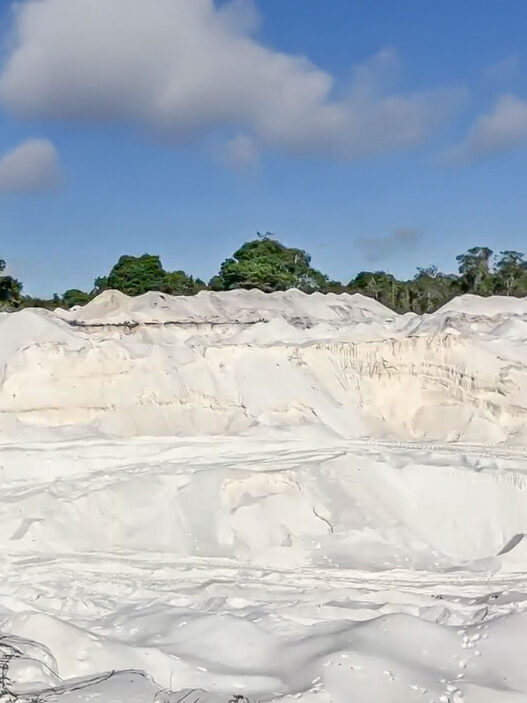


Today, Homerun Resources Inc. announced the results of an independent testwork program by Germany-based Dorfner Anzaplan GmbH – and the outcome marks a true turning point for the company. What was once “remarkably clean silica sand” has now been validated as something far more consequential: A strategic technology feedstock with the kind of purity, upgradeability, and processing flexibility so rare that only the most exceptional deposits on the planet even begin to compare.
Today’s news may read like a routine purity test, but the implications reach much deeper.
It is independent confirmation that Santa Maria Eterna (SME) sits in a completely different league, both in its natural (“raw“) starting quality and in its ability to reach ultra-high purities without relying on the usual cocktail of aggressive acids.
That combination is exceptionally rare in the silica industry, and it’s precisely what opens pathways not only into the booming solar glass market but all the way up to the pinnacle of materials demand: Semiconductor-grade high-purity quartz (HPQ). And that is where the story becomes truly fascinating.
Let’s explore why these results stand out, how SME compares to the best-known silica projects globally, and why this news may represent one of the most strategically important steps in Homerun’s journey so far, demonstrating just how special this is.

What Dorfner Anzaplan Actually Confirmed
The Dorfner Anzaplan program did 3 big things for Homerun:
1) Ultra-low impurities straight out of the ground
Washed raw silica sand from Homerun’s SME Project shows an outstanding grade of 99.9694% SiO₂ and exceptionally low impurity levels:
- Iron (Fe): 6.1 ppm
- Aluminium (Al): 8.9 ppm
- Titanium (Ti): 33 ppm
- Sodium (Na): 4.1 ppm
To put that in perspective:
In most “high-grade glass sand” deposits, iron alone is often in the 80-150 ppm Fe₂O₃ range, and that’s already considered good enough for solar glass after processing. In the high-purity quartz (HPQ) literature, a typical final product target is <10 ppm iron and <300 ppm aluminium after extensive processing.
Homerun is starting at 6.1 ppm iron and 8.9 ppm aluminium in washed sand – impurity levels that many HPQ producers only achieve after complex, multi-stage beneficiation. Such naturally clean chemistry is exceptionally rare.
2) Multiple purification routes without HF
Dorfner Anzaplan tested several flowsheets, all without hydrofluoric acid (HF):
- Caustic baking (high-temperature sodium hydroxide)
- Phosphoric acid baking
- Caustic leaching (pressurized alkaline treatment)
- Combinations with calcination (thermal treatment around 1,000°C)
Across these routes, SME showed:
- Iron reduced from 6.1 ppm to as low as 0.34 ppm (~94% reduction).
- Titanium reduced from 33 ppm to as low as 0.87 ppm (~97% reduction).
- Aluminium staying extremely low throughout processing.
Crucially, this performance was achieved without HF, which is the usual “last resort” in HPQ processing.
3) Validation across multiple premium markets
Dorfner Anzaplan concluded that SME sand meets or exceeds specification for a broad range of high-value uses, including:
- Solar glass (low-iron PV glass)
- Optical and specialty glass
- Engineered quartz surfaces and advanced ceramics
- Fused silica and high-purity quartz (HPQ) pathways, including SiC production
- Sodium and potassium silicates
- Ceramics, foundry sand, frac sand, and broader industrial applications
Most importantly, Homerun is not limited to one market segment.
This deposit can support not only high-volume applications like solar glass but also the much smaller, high-margin arena of semiconductor-grade quartz.
“These results from Dorfner Anzaplan, one of the world‘s most respected independent silica testing laboratories, validate what we‘ve believed about our Belmonte Project, we have a world-class silica sand deposit with truly exceptional starting quality. The fact that we can achieve premium use-case specifications without hydrofluoric acid is a game- changer for project economics and environmental permitting. The exceptionally low iron and aluminum content is extraordinarily rare in global silica deposits. Aluminum and Iron are notoriously difficult to remove, so starting with such low levels gives us an inherent competitive advantage that cannot be replicated through processing alone. With multiple confirmed market pathways spanning solar glass, optical glass, engineered stone, silicon carbide, and industrial applications, we have significant optionality to optimize our product mix for maximum value. The global transition to renewable energy and electrification is driving unprecedented demand for high-purity silica, and the Belmonte Project is positioned to serve these growth markets with a superior environmental footprint.“
Brian Leeners, CEO of Homerun Resources Inc., in today‘s news-release
This Kind of Starting Material is Virtually Unparalleled
On paper, silica sand seems everywhere. In reality, ultra-pure silica with ultra-low iron, aluminium and titanium is a geological oddity.
1) Benchmarking against Australian “tier-one” silica sand projects
Take some of the flagship projects in Australia:
VRX Silica Ltd. (Muchea & Arrowsmith in Western Australia)
- Resources: 99.6-99.9% SiO₂
- Typical iron levels: Often quoted in the <150 ppm range for premium products; already positioned as “high-grade, low-iron” glass sand.
Mitsubishi (Cape Flattery in Queensland)
- Widely considered one of the world’s best silica sands.
- Average product: 99.93% SiO₂ and 100 ppm Fe₂O₃.
Diatreme Resources Ltd. (Galalar & NSP in Queensland)
- Solar glass product: 99.9 % SiO₂ and <100-120 ppm Fe₂O₃, marketed specifically as PV-grade feedstock.
These are all excellent deposits. But even these “low-iron” sands typically sit roughly in the 80-150 ppm iron range. By contrast, Homerun’s washed raw sand shows 6.1 ppm iron, which is more than an order of magnitude cleaner on iron before serious processing.
And on aluminium, the gap is even more dramatic: HPQ research generally treats <300 ppm Al₂O₃ as a demanding target after advanced purification. Homerun starts at 8.9 ppm aluminium.
In other words, SME looks much more like a natural HPQ feedstock than a conventional glass sand deposit.
2) The Spruce Pine comparison
Globally, the classic reference point for ultra-pure quartz is Spruce Pine in North Carolina (USA). Estimates suggest 70-90% of the world’s ultra-pure quartz for semiconductors and solar glass comes from just 2 mines in the Spruce Pine district. Spruce Pine quartz is so pure that Wired called it “the purest natural quartz ever found” and a “near monopoly” resource.
Most other deposits worldwide require aggressive, multi-stage purification (including HF acid) to approach Spruce Pine levels. Homerun is now showing Spruce-Pine-like impurity levels in key elements (Fe, Al, Ti) at the raw washed stage, and the ability to go even lower via non-HF routes. Such a combination is highlighted in HPQ literature as truly uncommon and of considerable strategic value.

Avoiding HF is A Big Deal
To understand why Dorfner Anzaplan’s non-HF flowsheet matters, it’s worth looking at how the industry usually upgrades quartz.
1) The standard HPQ flowsheet
Most HPQ / advanced quartz processing follows a sequence along these lines:
- Crushing and grinding
- Magnetic separation (to remove iron-bearing minerals)
- Flotation (to separate feldspar, mica, heavy minerals; often already using some fluoride-based reagents)
- Acid leaching (often carried out in multiple stages, using hydrochloric, sulfuric, and nitric acids to remove a wide range of contaminants, while hydrofluoric acid (HF) is employed to attack silicates and other stubborn impurities)
- Thermal treatment (calcination, chlorination, quenching) to drive off or transform remaining impurities.
HF is the “big hammer”: Quartz itself is resistant to most acids, but HF dissolves many silicates and metals (and can even attack quartz if overused).
2) HF: Toxic, difficult, and expensive to live with
Hydrofluoric acid is not just another industrial acid:
- Medical and safety authorities describe HF as highly toxic, capable of causing deep, slow-healing burns and life-threatening systemic effects even from relatively small skin exposures.
- It readily penetrates tissue, binds calcium in bones, and can trigger cardiac arrhythmias; guidance from universities and regulators stress that even dilute HF must be handled under strict protocols.
From a plant design and permitting perspective:
- HF must be stored separately under lock and key; only specially trained personnel are allowed access.
- Process plants handling HF require special corrosion-resistant materials, double containment, scrubbers and dedicated waste-treatment systems, which raises both CAPEX and OPEX significantly.
- As a regulated hazardous chemical, HF involves additional compliance, insurance, and community-acceptance hurdles.
For a “normal” quartz plant, generic processing facilities can run hundreds of thousands to a few million dollars in capital cost depending on size. High-purity quartz plants with HF, off-gas treatment and advanced waste handling are inherently at the more expensive end of that spectrum, often with substantial additional investment over time as capacity is expanded.
3) Non-HF flowsheets are a strategic advantage
Against that backdrop, Dorfner Anzaplan’s conclusion that SME can reach sub-ppm Fe and Ti without HF is powerful:
- Lower technical risk: No need for highly specialized HF handling infrastructure.
- Simpler permitting & ESG story: Easier to secure environmental approvals and community support with no HF on site.
- Lower operating complexity: Fewer “red-flag” safety procedures, lower regulatory friction, and simpler waste management.
- Potentially lower costs: CAPEX goes into thermal and caustic circuits rather than HF handling, neutralisation and specialist safety systems.
This aligns perfectly with the global push for “cleaner” critical materials supply chains, especially for sectors like solar and semiconductors that are under intense ESG scrutiny themselves.

Target Markets
The Dorfner Anzaplan work doesn’t just say “this is pure silica”. It ties SME directly into several growing, high-margin markets.
1) Solar glass
- The ultra-clear glass used on PV modules.
- To maximize light transmission, it needs SiO₂ >99 % and very low Fe₂O₃ (typically <100–120 ppm) for PV-grade glass.
- Global silica sand for the glass industry is growing at around 7-8% CAGR towards 2030.
- High-purity silica sand for solar cells alone is estimated around 1.2 billion USD (2024), projected to reach 2.5 billion USD by 2033 (9% CAGR).
- Diatreme’s own investor material notes PV-grade silica demand is tightening, with China (a major PV glass producer) facing bottlenecks for low-iron feed.
With raw sand at 6.1 ppm iron and post-processing down to ~0.3 ppm, SME is orders of magnitude cleaner than the typical PV-grade threshold. That gives Homerun flexibility, such as:
- Blend SME sand with higher-iron material and still stay well within spec.
- Command potential premium pricing for ultra-clear solar glass, including antimony-free and next-generation formulations.
2) Optical glass
- For precision optics and specialty applications.
- Optical glass (e.g. Type I) goes into lenses, cameras, microscopes and precision instruments. It is extremely sensitive to trace metals: Iron and titanium cause unwanted colour and absorption. Aluminium, boron and phosphorus must be tightly controlled for specific refractive properties.
Dorfner’s results show that iron and titanium can be driven to very low levels, while aluminium starts and stays exceptionally low. That combination is exactly what optical-grade quartz and glass makers are seeking.
3) Engineered quartz surfaces and advanced ceramics
- Engineered quartz stone (countertops, architectural surfaces) mixes high-purity silica with resins and pigments.
- Advanced ceramics and composites use high-purity silica for strength, thermal stability and low impurity content.
- The engineered stone market is around 27-29 billion USD (2024-2025), with growth near 5% CAGR. While this sector uses more bulk tonnage and lower average pricing, there is a growing premium niche for very white, low-contaminant quartz, something SME can clearly support.
4) HPQ and semiconductors
This is where Homerun’s real strategic leverage lies. HPQ and fused silica are essential in semiconductor manufacturing for:
- Quartz crucibles used to grow silicon ingots for wafers.
- Quartz tubes, boats and reactors used in high-temperature processes.
- Optical components in lithography and metrology tools.
These products typically require SiO₂ grading ≥99.99-99.999% along with ultra-low levels (often sub-ppm to low tens of ppm) of Fe, Al, Ti, alkalis and other trace elements.
The global HPQ market is projected to increase from 651 million USD (2025) to 946 million (2035), driven heavily by semiconductors and solar. In the U.S., semiconductors alone account for about half of HPQ demand.
Approximate market prices illustrate how differentiated this segment is:
- Ordinary construction / industrial silica sand: 20-100 USD/t.
- Generic high-purity silica sands (>99% SiO₂, low iron): 100-200+ USD/t.
- Fused silica sands (99.8-99.9% SiO₂) used in advanced glass and refractory: often 400-600 USD/t on wholesale markets.
- Inner-layer HPQ sand for crucibles, at 99.998%+ SiO₂ and very tight impurity specs, is quoted around 7,000-11,000 USD/t in recent industry pricing, and has traded even higher in the past.
So going from “ordinary sand” to “HPQ for crucibles” is not a 10-20% uplift, it’s a 2-orders-of-magnitude step change in value per tonne.
The Spruce Pine bottleneck:
Today, the bulk of that HPQ market relies on Spruce Pine. Roughly 70-90% of the world’s highest-purity quartz comes from 2 ore bodies there, marketed mainly under Sibelco’s IOTA quartz brand. The vulnerability of this concentration was highlighted when Hurricane Helene temporarily shut key mines in 2024, raising concerns about supply disruptions for electronics, solar and AI hardware. That‘s why companies and policymakers are actively seeking additional HPQ sources around the world.
SME’s “Spruce-Pine-like” chemistry, combined with non-HF processing, positions Homerun as a potential second pillar in this ecosystem, especially for Americas-Europe-Asia semiconductor and solar supply chains seeking diversified, reliable, high-purity feedstock.
Link to Taiwan & global chip capacity:
The importance of HPQ is magnified by how concentrated semiconductor manufacturing is:
- Taiwan alone holds around 44% of global foundry capacity and an even larger share of the most advanced nodes.
- TSMC captured about 70% of the global pure-play foundry market in Q2 2025, riding surging demand for AI and high-performance chips.
Rather than focusing on geopolitical tensions, it’s enough to say the following:
The world’s digital infrastructure (AI, cloud, smartphones, EVs) depends on a small number of highly concentrated semiconductor hubs. Those hubs, in turn, depend on a tiny number of ultra-pure quartz sources.
In that context, developing Brazilian HPQ supply is a positive, collaborative contribution to global resilience:
- It gives fabs and equipment makers in Asia, the Americas and Europe more options.
- It complements, rather than replaces, existing suppliers like Spruce Pine.
- It aligns with broader efforts to diversify and strengthen critical materials supply chains worldwide.
5) Sodium and Potassium Silicates
- Dorfner Anzaplan also confirmed SME’s suitability for sodium and potassium silicate (“waterglass”) production (an important, steady-demand market used in detergents, adhesives, coatings, cements, catalysts and specialty chemicals).
- Silicate producers require >99% SiO₂ and very low iron (<0.02% Fe₂O₃) to ensure clear, stable, high-performance products. SME easily exceeds these thresholds, providing a reliable feedstock for this multi-billion-dollar industrial segment.
- While not as high-value as optical glass or semiconductor applications, silicates offer a large, consistent outlet for premium silica, reinforcing Homerun’s market optionality and supporting long-term revenue stability.
6) Foundry, frac sand and industrial markets
- Finally, SME easily qualifies for foundry sands for metal casting (where grain shape and high-temperature stability are key), frac sand for oil & gas (where strength and roundness matter more than ultra-low impurities) and general industrial uses (ceramics, fillers, filtration).
- These are more commoditized in terms of pricing, but they provide volume and revenue stability alongside the premium niches.

Strategic Upside
Homerun has been framing SME as part of a broader “silica-powered energy transition” strategy: From ultra-pure silica on the materials side to long-duration energy storage and AI-driven energy management on the systems side.
The Dorfner Anzaplan results do 3 important things for that vision:
- They de-risk the resource quality: The sand is not just “good enough for glass”; it clearly has the headroom to move up the value stack into HPQ, fused silica and semiconductor-adjacent applications.
- They highlight a strong ESG angle: Being able to hit ultra-low impurities without HF is a major differentiator at a time when customers, regulators and communities are all looking closely at chemical footprints.
- They unlock product and pricing optionality: Homerun can, in time, choose how much of its product mix goes into high-volume solar glass and engineered stone, versus lower-volume, high-margin HPQ for semiconductors, optics and advanced ceramics.
Given that the overall silica sand market is expected to grow from about 25 billion in 2024 to >34 billion USD by 2030, and the HPQ segment alone is approaching 1 billion USD with solid growth, the available runway is long.
For a company of Homerun’s size, it doesn’t take a huge market share to be transformative. Capturing even a small fraction of the HPQ / fused-silica value chain – on top of solar glass volumes – could translate into very meaningful cash flow.

Bottom Line
If the earlier drilling and purity tests told the story of a beautiful deposit, the Dorfner Anzaplan program confirms the scale of that opportunity: SME is operating in a different class of silica projects.
Where most “high-grade silica sand” deposits aim squarely at the solar glass market, SME begins at impurity levels that many top Australian projects only reach after processing (and in some cases, not even then). Iron levels that typically sit around 80-150 ppm in leading glass-sand deposits come in at just 6.1 ppm at SME, and aluminium (one of the hardest impurities to remove in HPQ processing) starts at only 8.9 ppm. Those are not the numbers of a conventional sand project; they are the signatures of a potential HPQ feedstock.
Just as importantly, SME demonstrates the ability to reach even higher purities without hydrofluoric acid, a step-change in both ESG profile and processing simplicity.
And this is precisely where the deposit truly separates itself: Not only does it exceed the requirements of the booming solar glass market, but it also has the purity, upgradeability, and flexibility to move into optical glass, fused silica, SiC production, and the ultra-premium semiconductor-grade quartz segment.
In short, SME offers a rare combination:
- Exceptional natural purity far beyond standard glass sand deposits.
- Strong response to gentle, non-HF purification.
- Versatility across multiple high-value markets.
- A direct link to global growth sectors in energy and electronics.
It’s this blend – between Brazilian geology, German process expertise, and the world’s appetite for cleaner, higher-performance materials – that makes Homerun’s latest news so compelling.
And as Homerun advances into its next phase, shareholders may be standing at the threshold of a story whose vast upside is only just beginning to break over the horizon.
Company Details

Homerun Resources Inc.
#2110 – 650 West Georgia Street
Vancouver, BC, V6B 4N7 Canada
Phone: +1 844 727 5631
Email: info@homerunresources.com
www.homerunresources.com
ISIN: CA43758P1080 / CUSIP: 43758P
Shares Issued & Outstanding: 64,061,179

Canada Symbol (TSX.V): HMR
Current Price: 1.08 CAD (12/08/2025)
Market Capitalization: 69 Million CAD

Germany Ticker / WKN: 5ZE / A3CYRW
Current Price: 0.63 EUR (12/09/2025)
Market Capitalization: 40 Million EUR

Stephan Bogner
Contact
Rockstone News & Research
Stephan Bogner (Dipl. Kfm., FH)
Müligässli 1, 8598 Bottighofen
Switzerland
Phone: +41-71-5896911
Email: info@rockstone-news.com
Disclaimer and Information on Forward Looking Statements: Rockstone and Homerun Resources Inc. (“Homerun“) caution investors that any forward-looking information provided herein is not a guarantee of future results or performance, and that actual results may differ materially from those in forward-looking information as a result of various factors. The reader is referred to Homerun’s public filings for a more complete discussion of such risk factors and their potential effects, which may be accessed through its documents filed on SEDAR+ at www.sedarplus.ca. All statements in this report, other than statements of historical fact, should be considered forward-looking statements. Much of this report is comprised of statements of projection. Such statements involve known and unknown risks, uncertainties and other factors that may cause actual results or events to differ materially from those anticipated in these forward-looking statements. There can be no assurance that such statements will prove to be accurate, as actual results and future events could differ materially from those anticipated in such statements. Forward-looking statements in this report include, but are not limited to, statements regarding the exploration, development, processing, commercialization, and potential market positioning of Homerun Resources Inc.’s Santa Maria Eterna (“SME”) Project. Such statements involve known and unknown risks, uncertainties, and assumptions that may cause actual results to differ materially from those expressed or implied. Forward-looking statements include expectations related to: SME’s silica resource quality, including assumptions that future drilling, sampling, or independent testwork will continue to confirm impurity levels and SiO₂ grades consistent with those reported by Dorfner Anzaplan. Processing and purification pathways, including assumptions that laboratory-scale non-HF flowsheets (e.g. caustic baking, phosphoric acid baking, calcination, alkaline leaching) will scale effectively to pilot or industrial levels; that impurity reduction will remain consistent; and that the flowsheets will maintain economic, ESG, or permitting advantages. Potential to achieve high-purity quartz (HPQ) or fused-silica specifications, including assumptions that future testwork will confirm or exceed sub-ppm impurity outcomes; that SME material will meet end-market specifications for optical glass, fused silica, semiconductor-adjacent applications, silicon carbide (SiC) production, or advanced ceramics; and that the material will be accepted by downstream processors or manufacturers. Target-market access, including expectations that SME silica will be suitable for: Solar glass and PV-grade applications, optical and specialty glass, engineered quartz, ceramics, and composites, fused silica, HPQ feedstock, and semiconductor-related components, sodium and potassium silicates, foundry, frac sand, and industrial markets.
These expectations rely on assumptions regarding continued market demand, pricing, bulk-sample qualification, third-party validation, and the scalability of SME’s processing flowsheets. Strategic positioning relative to global supply chains, including assumptions that ultra-low impurity levels and non-HF processing will provide competitive advantages; that the project may offer optionality to semiconductor, solar, and advanced-materials supply chains; and that SME could complement rather than replace existing sources such as Spruce Pine. Assumptions further include expectations that customers, policymakers, or industrial partners will value diversified, lower-footprint silica supply. ESG, permitting, and regulatory outcomes, including assumptions that the absence of HF in proposed flowsheets will reduce permitting complexity; that regulatory agencies will approve project development on expected timelines; and that environmental, social, or community-acceptance factors will align with company expectations. Economic and commercial outcomes, including assumptions that: Project CAPEX and OPEX for silica processing (including non-HF circuits) will align with internal projections; premium markets such as HPQ, fused silica, or optical glass will remain accessible and economically attractive; Homerun can secure financing, partnerships, or offtake arrangements needed to advance development; variability within the resource, market conditions, or supply-chain dynamics will not materially alter project economics. Comparison to other projects, including assumptions that SME’s impurity levels, upgradeability, or scalability will continue to benchmark favorably against other silica deposits globally, including tier-one Australian glass-sand projects or ultra-high-purity systems such as those in Spruce Pine. Such forward-looking statements are based on assumptions that Rockstone considers reasonable, but no assurance can be given that these expectations will prove correct. Readers are cautioned not to place undue reliance on forward-looking information. Risks and uncertainties include, but are not limited to: Geological & Resource Risks: The quantity, quality, homogeneity, or distribution of silica at Santa Maria Eterna (“SME”) may differ from expectations. Future drilling, sampling, or independent analyses may not confirm the impurity levels, SiO₂ grades, or grain characteristics indicated by current testwork. Geological variability may affect recoveries, processing outcomes, or economic potential. Metallurgical, Processing & Scale-Up Risks: Laboratory-scale purification results, including caustic baking, phosphoric-acid baking, calcination, and alkaline leaching, may not scale effectively to pilot or commercial levels. Impurity reduction observed by Dorfner Anzaplan may not be consistently reproducible at industrial throughput. Non-HF flowsheets may underperform, require modification, or prove uneconomic at scale. Purification costs, energy requirements, and reagent consumption may differ materially from assumptions. High-Purity Quartz (HPQ) & Product-Qualification Risks: SME silica may not meet end-market specifications for fused silica, optical glass, silicon carbide production, engineered quartz, or semiconductor-adjacent applications. Achieving sub-ppm impurity levels may require additional processing steps or capital investment. Downstream customers or processors may reject SME material based on chemistry, grain morphology, consistency, or performance criteria. Market Access & Commercial Adoption Risks: Entry into premium markets (solar glass, optical glass, fused silica, HPQ feedstock, SiC production, silicates, engineered quartz, ceramics, etc.) typically requires multi-stage qualification, bulk sampling, and long-term performance validation. Customers may delay qualification, choose incumbent suppliers, negotiate lower pricing, or require additional quality metrics not yet verified. Demand in target markets may fluctuate or grow more slowly than expected. Competitive & Industry Risks: Global silica and HPQ markets are competitive. Established producers, including those with operations in Spruce Pine and major Australian glass-sand districts, may expand capacity, reduce prices, or secure long-term contracts with key customers. Competitors may develop alternative processing routes, HF-free purification methods, or new geological sources that reduce SME’s relative advantage. Permitting, ESG & Regulatory Risks: Silica mining, purification facilities, or related infrastructure may require environmental approvals, land-use permits, water-use authorizations, or community engagement processes that may be delayed, denied, or modified. ESG expectations may increase compliance costs. Although SME’s non-HF processing approach is designed to reduce environmental impact, permitting agencies may impose additional requirements or constraints. Infrastructure, Logistics & Operational Risks: Construction, commissioning, and operation of silica-processing or HPQ-upgrading facilities may face technical challenges, delays, cost overruns, or supply-chain issues. Availability of specialized equipment (kilns, leaching units, filtration systems, dryers, analyzers), reagents, power, and transport infrastructure may affect project timelines and economics. Operational performance may differ from models. Financing & Capital Market Risks: Advancing SME through drilling, testwork, pilot purification, feasibility studies, plant construction, and commercial scaling will require significant capital. Financing may not be available on acceptable terms due to market volatility, interest rates, investor sentiment, or macroeconomic conditions. Share dilution, debt constraints, or funding shortfalls may impair project development. Pricing & Economic Risks: Silica, HPQ, fused silica, and specialty glass markets are subject to pricing volatility driven by supply-demand imbalances, technological shifts, energy costs, and global economic trends. Long-term assumptions regarding premium pricing for ultra-low-impurity silica may not be realized. Project economics may be adversely affected by changes in reagent costs, energy costs, labor costs, or FX fluctuations. Offtake, Partnership & Counterparty Risks: Discussions with potential industrial partners, glass manufacturers, engineered-stone producers, foundries, or semiconductor-adjacent companies may not lead to commercial agreements. Counterparties may delay decisions, alter technical specifications, or fail to fulfill commitments. Pilot or demonstration partnerships may require terms or investments not anticipated. Regulatory, Trade & Policy Risks: Changes in Brazilian regulations, export rules, mining laws, tax regimes, or environmental policies may affect project development. International trade policies, tariffs, or supply-chain reshoring initiatives may alter market access or competitiveness. Policy changes in solar, semiconductor, or advanced-materials sectors may impact demand. Macroeconomic, Commodity & Currency Risks: Inflation, recession, global instability, or commodity-market disruptions may influence project costs, financing availability, and end-market demand. Currency fluctuations between BRL, USD, CAD and EUR may affect capital costs, operating costs, and revenue projections. Force Majeure & External Event Risks: Extreme weather, natural disasters, pandemics, geopolitical tensions, supply-chain disruptions, or unexpected environmental events may materially delay or impede exploration, construction, or operations. Liquidity & Trading Risks: As a small-cap issuer, Homerun’s shares may experience significant volatility, limited liquidity, or wide bid-ask spreads. Market sentiment may influence valuation independent of project fundamentals. Accordingly, readers should not place undue reliance on forward-looking information. Rockstone and the author of this report do not undertake any obligation to update any statements made in this report except as required by law. Past performance and comparisons to other companies or jurisdictions are provided for illustrative purposes only and should not be considered indicative of future results.
Disclosure of Interest and Advisory Cautions: Nothing in this report should be construed as a solicitation to buy or sell any securities mentioned. Rockstone, its owners and the author of this report are not registered broker-dealers or financial advisors. Before investing in any securities, you should consult with your financial advisor and a registered broker-dealer. Never make an investment based solely on what you read in an online or printed report, including Rockstone’s report, especially if the investment involves a small, thinly-traded company that isn’t well known. The author of this report, Stephan Bogner, is paid by Homerun Resources Inc. On September 8, 2025, Homerun announced that the company “entered into an agreement with Rockstone Research to provide marketing services to the company”, and that “Rockstone Research is an arm’s-length marketing firm and has been engaged for an initial three-month term for total consideration of $25,000, which is payable up front. The company does not propose to issue any securities to Rockstone in consideration for the services to be provided to the company.” The author owns equity of Homerun and thus will profit from volume and price appreciation of the stock. This also represents a significant conflict of interest that may affect the objectivity of this reporting. The author may buy or sell securities of Homerun (or comparable companies) at any time without notice, which may give rise to additional conflicts of interest. Overall, multiple conflicts of interests exist. Therefore, the information provided in this report should not be construed as a financial analysis or recommendation but as an advertisement. This report should be understood as a promotional publication and does not replace individual investment advice. Rockstone’s and the author’s views and opinions regarding the companies that are featured in the reports are the author‘s own views and are based on information that was received or found in the public domain, which is assumed to be reliable. Rockstone and the author have not undertaken independent due diligence of the information received or found in the public domain. Rockstone and the author of this report do not guarantee the accuracy, completeness, or usefulness of any content of this report, nor its fitness for any particular purpose. Lastly, Rockstone and the author do not guarantee that any of the companies mentioned in the reports will perform as expected, and any comparisons that were made to other companies may not be valid or come into effect. Please read the entire Disclaimer carefully. If you do not agree to all of the Disclaimer, do not access this website or any of its pages including this report in form of a PDF. By using this website and/or report, and whether or not you actually read the Disclaimer, you are deemed to have accepted it. Information provided is educational and general in nature. Data, tables, figures and pictures, if not labeled or hyperlinked otherwise, have been obtained from Stockwatch.com, Tradingview.com, Homerun Resources Inc. and the public domain.