

Recently, the World Gold Council has released 2 important publications on the current state of the gold market: The “Central Bank Gold Reserves Survey 2026” in June and the “Gold Demand Trends Q2 2026” in July.
Taken together, the 2 reports paint a notably constructive picture. Gold continues to play a strategically important role for central banks around the world, buying intentions remain strong and the recent pullback in the gold market appears to have been viewed by many long-term participants as an opportunity rather than a warning sign.
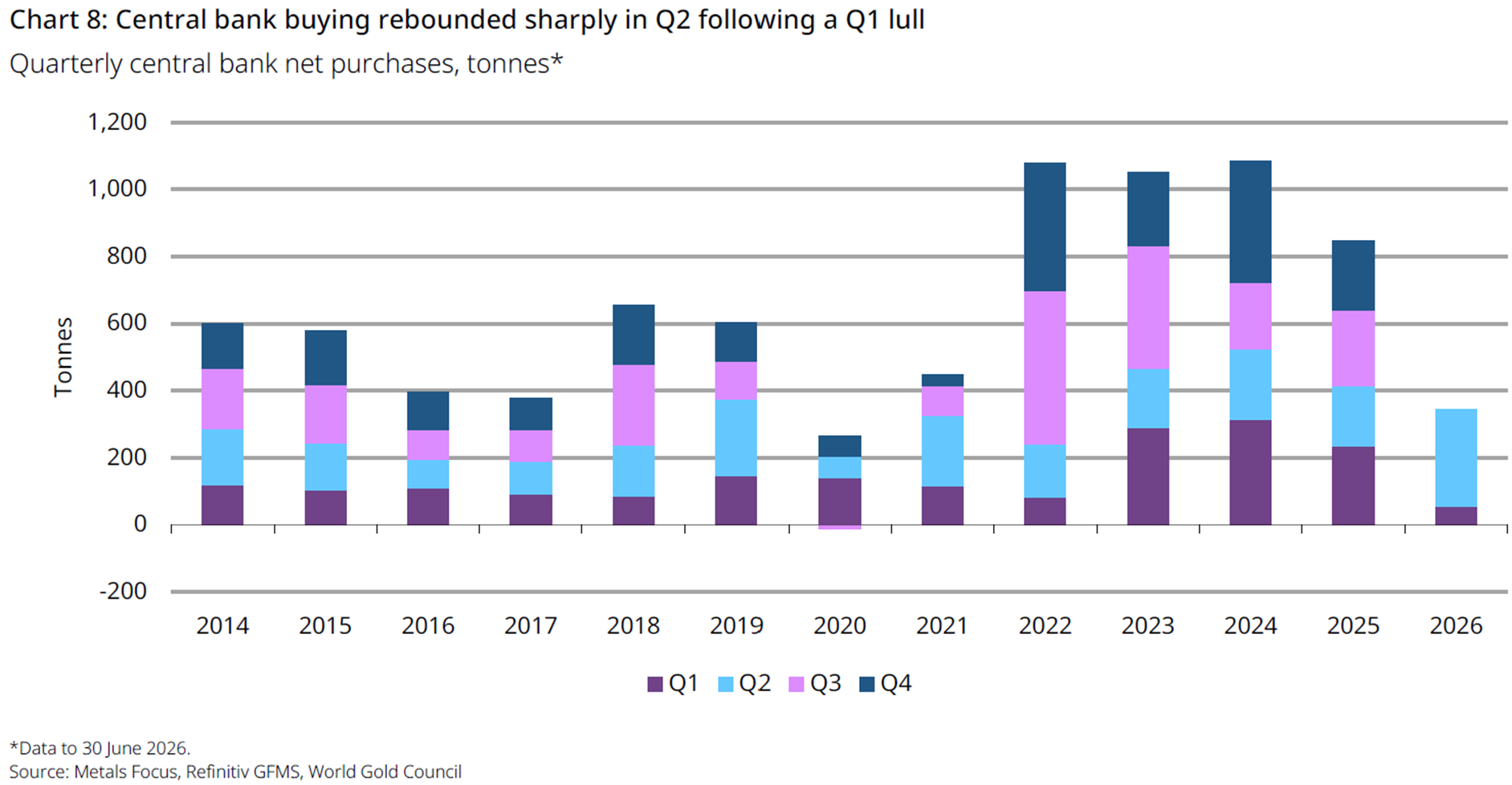
After an exceptional rally that carried gold to new record highs, prices entered a consolidation phase during the second quarter of 2026. Yet it was precisely during this period of weakness that central banks stepped up their purchases sharply. Between April and June, central banks and other official-sector institutions bought a net 289 tonnes of gold.
That was 62% more than in the second quarter of 2025 and roughly five times the revised volume recorded in the first quarter of 2026. According to the World Gold Council, it was also the highest level of second-quarter central bank buying ever recorded.
For investors, this is a noteworthy development. Short-term price swings can be substantial, but the strategic buyers in the gold market appear to be holding firmly to their long-term conviction.
CENTRAL BANKS STEP UP BUYING AGAIN AFTER THE CORRECTION
The latest purchases are not an isolated development. Over the past 4 years, central banks have bought an average of around 1,000 tonnes of gold per year. During the preceding decade, the annual average was only about 500 tonnes. The pace at which official institutions have been building their gold reserves has therefore increased significantly.
The World Gold Council points to both the geopolitical environment and gold prices being below their recent record highs as factors that may have supported the renewed strength in central bank buying.
MORE CENTRAL BANKS THAN EVER PLAN TO INCREASE THEIR OWN GOLD RESERVES
Even more telling than individual quarterly purchases is how central banks themselves view the years ahead.
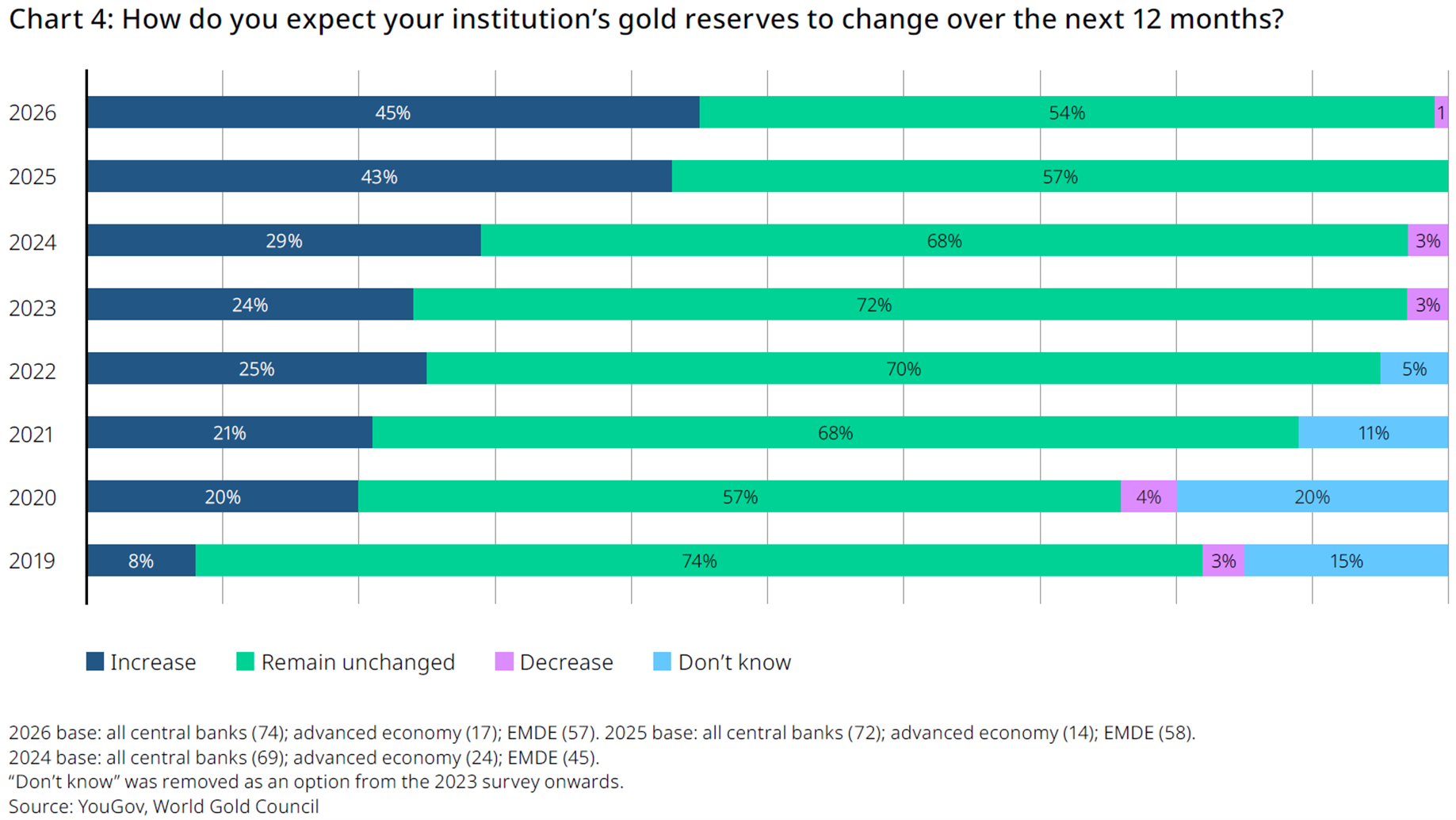
The latest Central Bank Gold Reserves Survey 2026 provides a clear answer. 89% of the central banks surveyed expect global central bank gold reserves to increase over the next 12 months. At the same time, 45% expect their own institution to increase its gold holdings. This marks a new record since the survey began. Only 1% expect their own gold reserves to decline.
The trend over time is particularly striking. In 2019, only 8% of the central banks surveyed expected to increase their own holdings. By 2023, that figure had risen to 24%, followed by 29% in 2024, 43% in 2025 and now 45% in 2026.
Gold is therefore increasingly being viewed not merely as a legacy reserve asset, but as an actively managed strategic asset.
WHY CENTRAL BANKS HOLD GOLD
The reasons why central banks hold gold in their reserves are particularly revealing. 90% of respondents cite gold’s resilience in times of crisis as an important or very important factor. 84% regard gold as a long-term store of value or inflation hedge and 83% value its role as a portfolio diversifier. In addition, reserve diversification and protection against geopolitical risks play a central role.
These reasons are precisely what make the findings relevant for private investors as well. Many of the questions central banks face ultimately arise in private wealth management too: How can wealth be preserved over long periods of time? How can exposure to individual currencies be reduced? And which assets can provide stability during economically or geopolitically difficult periods?
Of course, the decisions of a central bank cannot be applied directly to private investors. What stands out, however, is that reserve managers hold gold primarily for long-term and strategic reasons rather than because of short-term price forecasts.
GOLD IS EXPECTED TO GAIN FURTHER IMPORTANCE IN GLOBAL RESERVES
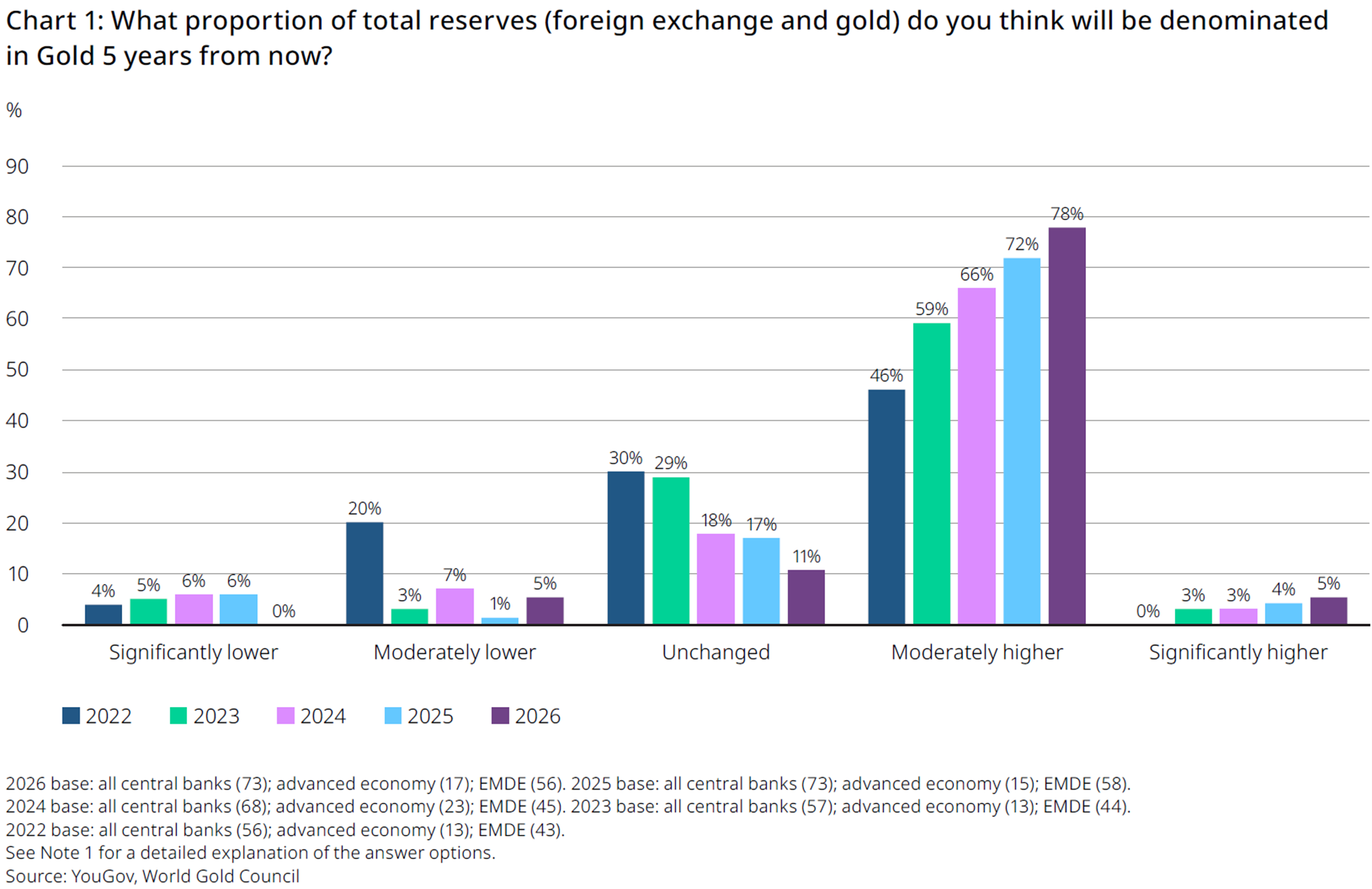
The 5-year outlook also clearly favours gold. 84% of the central banks surveyed expect gold to account for a larger share of global reserves in the future. In the previous year, that figure stood at 76%. Particularly notable is the increase in the share of respondents expecting a moderately higher allocation to gold.
This reinforces a trend that has already been visible for several years: Gold is once again gaining strategic importance within the reserve policies of many central banks.
AT THE SAME TIME, THE US DOLLAR IS LOSING RELATIVE IMPORTANCE
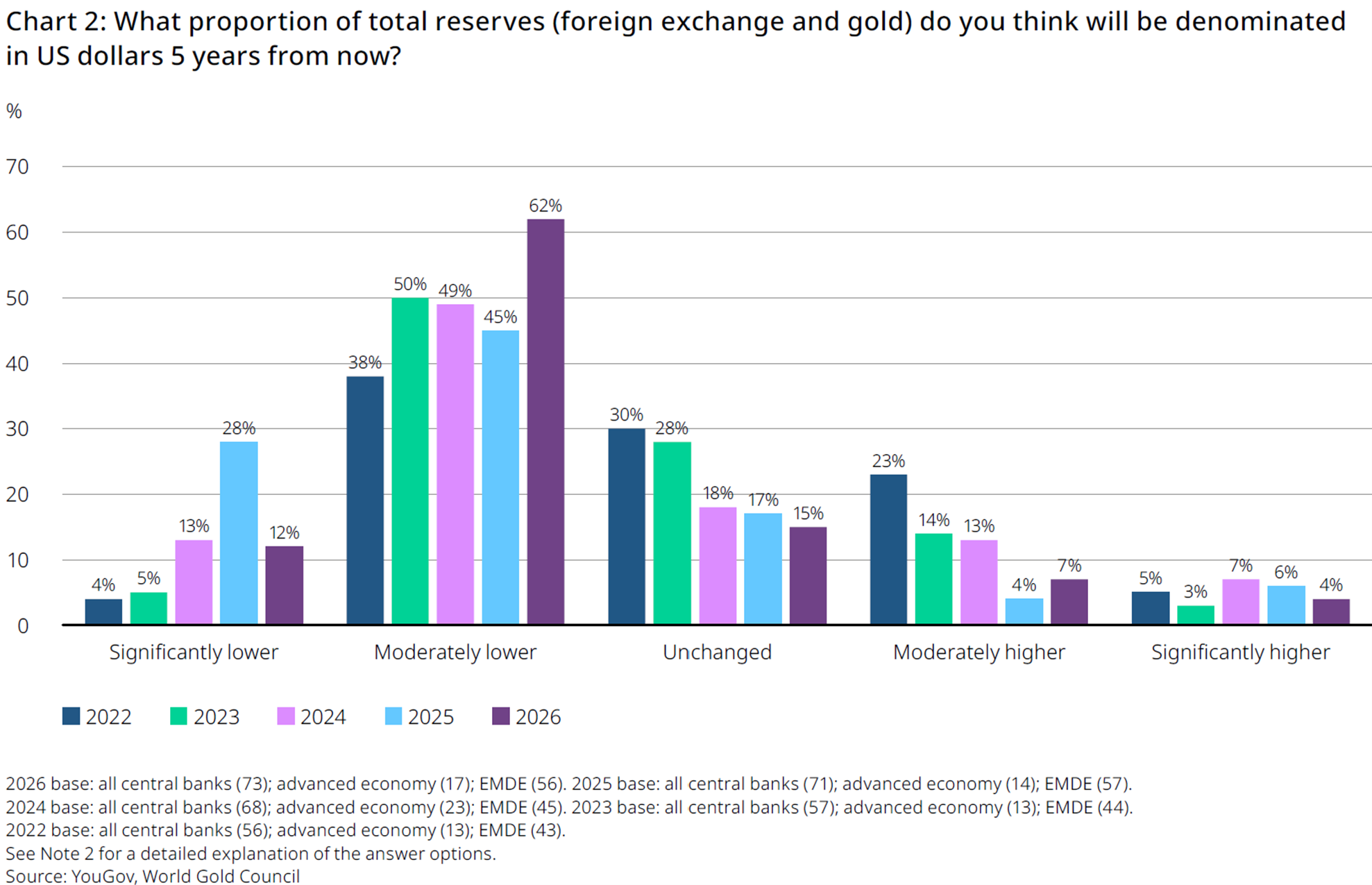
This trend becomes even more interesting when compared directly with the US Dollar. While a clear majority expects gold to account for a larger share of global reserves, 74% of the central banks surveyed expect the US Dollar’s share to be lower over the next 5 years. Of these, 12% expect a significantly lower share and 62% a moderately lower share.
This does not mean that the US Dollar is likely to lose its position as the world’s leading reserve currency in the near term. The survey does, however, point to a clear trend towards greater diversification.
This is precisely where gold has a distinctive advantage: It is not a claim on another sovereign, carries no traditional issuer default risk and is not directly tied to the monetary policy of any single currency.
GOLD DEMAND REMAINS ROBUST DESPITE HIGH PRICES
The overall picture for the gold market also remains remarkably resilient. Global gold demand, including OTC transactions, reached 1,269 tonnes in the second quarter of 2026, virtually unchanged from the same quarter a year earlier. Across the first half of the year, demand totalled 2,522 tonnes, around 2% higher than a year earlier. In value terms, gold demand reached a new record of ~380 billion USD.
This stability is particularly noteworthy because gold continues to trade at substantially higher price levels. The average LBMA gold price stood at 4,506.29 USD per ounce in the second quarter. While this was 8% below the record-setting first quarter, it was still 37% higher than in the second quarter of 2025.
The fact that overall demand remained stable despite prices being significantly higher than a year earlier points to continued strength in the underlying structural demand for gold.
PHYSICAL GOLD REMAINS IN DEMAND
A closer look at the different forms of gold investment also reveals a notable contrast. While gold ETFs recorded moderate outflows of around 45 tonnes in the second quarter, demand for bars and coins remained close to the previous year’s level at ~307 tonnes. The decline compared with the second quarter of 2025 was just 3%.
Physical gold therefore showed considerably greater stability than more short-term financial market flows.
Strong OTC demand provided additional support. This segment reached around 327 tonnes in the second quarter and totalled ~571 tonnes in the first half of the year. According to the World Gold Council, there are indications that a substantial share of this demand originated from Asian markets.
ASIA CONTINUES TO GAIN IMPORTANCE
The World Gold Council expects investment demand to remain an important growth driver for the gold market throughout the remainder of 2026. At the same time, the composition of that demand is likely to continue shifting. OTC activity and Asian investors are expected to play a greater role, while Western ETF flows are likely to remain more sensitive to real interest rates, monetary policy and movements in the US Dollar.
The World Gold Council also continues to see support for physical investment demand in China and India. In China, low domestic interest rates, geopolitical risks and weakness in the property sector are among the factors supporting demand, while Indian investors, according to the report, have used pullbacks in the gold price as buying opportunities.
The gold market is therefore increasingly being supported by a diverse range of buyers: Central banks, Asian investors, buyers of physical bars and coins and institutional market participants are creating a broad and diversified demand base.
WHAT DOES THE CURRENT SITUATION MEAN FOR INVESTORS?
Corrections are a normal part of long-term uptrends. After an exceptionally strong gold rally in 2025 and at the beginning of 2026, a period of consolidation is therefore not unusual in itself. The more important question is whether the fundamental case for gold has changed.
So far, the latest data from the World Gold Council suggest the opposite: Central banks continue to buy, their long-term purchasing intentions remain at record levels and a clear majority expect gold to account for a larger share of global reserves. At the same time, physical investment demand remains comparatively resilient.
The World Gold Council does expect total central bank purchases in 2026 to fall short of the exceptionally strong levels seen in 2025. At the same time, however, it expects demand from this buyer group to remain above its long-term average.
For long-term investors, a correction can therefore have a very different meaning than it does for short-term market participants. Weaker phases in the market can be used to build precious metals positions gradually rather than waiting until the gold price reaches new record highs again.
GOLD AS A STRATEGIC BUILDING BLOCK FOR WEALTH
Current developments clearly show how gold is viewed by long-term reserve holders: Not as a short-term trade, but as a strategic component of their asset and reserve policies.
At Elementum, the focus is therefore not on short-term speculation about the next move in the gold price, but on the long-term accumulation of physical precious metal wealth. Through the national Elementum companies, clients can purchase physical precious metals and subsequently have them stored in Switzerland with Elementum International AG.
Elementum International AG specialises in the storage of precious metals. Client holdings are stored physically and both the inventories and the corresponding insurance coverage are subject to regular independent verification.
In a world where central banks themselves are placing greater emphasis on diversification, preservation of value and protection against economic and geopolitical risks, the question of what role physical gold should play in private wealth remains more relevant than ever.
BOTTOM LINE
The recent correction in the gold price has not broken the long-term gold story. Instead, it shows that some of the market’s most important and long-term buyers are once again using lower price levels to add to their holdings.
For investors who view gold not as a short-term speculation, but as a strategic building block for wealth, that remains a strong signal.

Stephan Bogner
Contact
Rockstone News & Research
Stephan Bogner (Dipl. Kfm., FH)
Müligässli 1, 8598 Bottighofen
Switzerland
Phone: +41-71-5896911
Email: info@rockstone-news.com
Disclaimer: This article reflects the personal opinion of the author. Elementum assumes no responsibility for the accuracy of the content and accepts no liability for its use. This article may contain links to external third-party websites. Elementum is not responsible for the content of these external sites and expressly distances itself from all information provided there. At the time the links were created, no unlawful content was identifiable. This article does not constitute a recommendation to buy or sell. Elementum International AG is a Swiss company that specializes exclusively in the storage of physical precious metals in a high-security vault facility located in the St. Gotthard mountain massif in Central Switzerland. The Board of Directors and Executive Management of Elementum International AG have been selected solely based on their professional expertise and long-standing experience in precious metals markets. As these individuals may also be professionally active outside their roles at Elementum International AG, the company has no influence over their external activities and respects their right to freedom of expression. Therefore, the views expressed by persons working with or for Elementum do not necessarily reflect the opinion of Elementum International AG. Investments in precious metals are subject to risks, including those specific to the structure of this market. Please read our full risk disclosures and consult a licensed financial advisor before making any investment decisions. Neither the author, Elementum International AG, nor Elementum Deutschland GmbH assume any liability for actions taken based on the information provided. Past performance is not indicative of future results. The cover picture has been obtained and licenced from shutterstock.com.