For centuries, the rise of great economies has been closely tied to the mastery of strategic materials and the industries formed around them. Iron built empires and infrastructure. Coal powered the Industrial Revolution. Oil fueled mobility and global commerce. Copper electrified civilization. Each era had its defining material and each material enabled a new wave of human progress. Today, another material sits quietly at the heart of nearly every major technological transformation shaping the 21st century: Silica.
Without silica, there is no solar glass. No semiconductors. No optical fiber networks. No silicon carbide for electric vehicles. No advanced ceramics. No high-performance energy storage systems. From artificial intelligence and data centers to renewable energy and next-generation electronics, modern civilization increasingly depends upon a material that remains largely overlooked by investors.
As these technologies become more advanced, so too do the purity requirements of the materials that enable them. Demand is increasingly shifting toward high-purity silica capable of serving advanced industrial and technological applications, while control over such resources is becoming strategically important as governments and manufacturers seek to build more resilient supply chains beyond traditional centers of production.
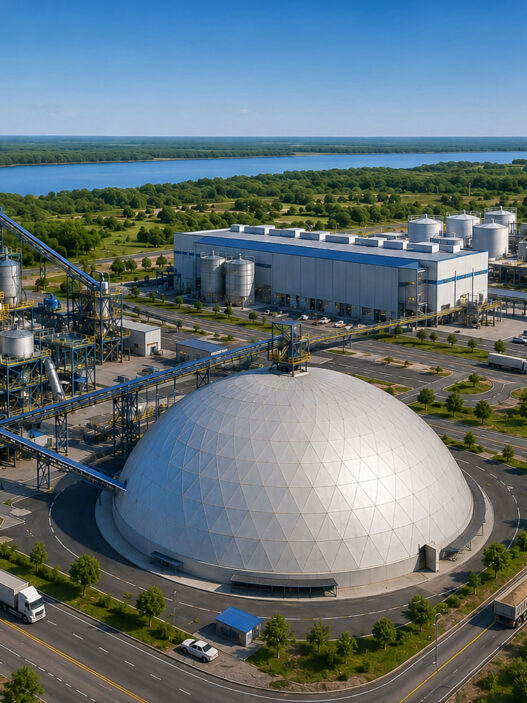
Against this backdrop, Homerun Resources Inc. is on a mission to turn high-purity silica in Brazil into the foundation of a vertically integrated industrial platform. The company’s objective is the creation of what it calls the “Silica Valley” of Bahia: A vertically integrated industrial ecosystem built around one of the world’s most exceptional high-purity silica districts. From silica purification and solar glass manufacturing to advanced materials, energy storage and technology solutions, the strategy seeks to transform a single resource into a platform serving multiple global industries.
The silica is the starting point.
The Silica Valley may be the destination.
The Vision
While the strategic importance of silica is becoming increasingly apparent, very few companies are attempting to build an entire industrial platform around it.
Most silica producers remain focused on extracting and selling raw material. The vast majority of the value chain, from purification and advanced materials to manufacturing and technology applications, typically resides elsewhere. Raw materials are exported. The highest-value products are imported.
Brazil has long sought to change that equation.
As one of the world’s leading resource-rich nations, Brazil increasingly aims to capture more value domestically by encouraging industrial processing, advanced manufacturing and technology development rather than simply exporting raw materials.
Initiatives involving institutions such as BNDES and federal strategic minerals programs reflect a broader ambition to move further up the value chain, strengthen domestic manufacturing and reduce reliance on foreign supply chains for critical energy and technology infrastructure.
Homerun’s strategy is remarkably aligned with that vision.
Rather than exporting high-purity silica into somebody else’s industrial ecosystem, the company is seeking to build one of its own in Bahia.
What began as the consolidation of a high-purity silica district has evolved into a strategy encompassing purification, solar glass manufacturing, advanced materials, energy storage and technology solutions, all anchored around a single strategic resource.
To understand the significance of this strategy, investors must first understand why Homerun increasingly appears less like a traditional mining company and more like the foundation of an emerging industrial platform.
Not Just Another Mining Story
Most mining companies follow a familiar path: A deposit is discovered. A resource is defined. A feasibility study is completed. A mine is built. The commodity is extracted and sold into the market. Value creation is largely determined by the quantity and quality of the resource, production costs and prevailing commodity prices.
Homerun’s strategy is fundamentally different.
While the company’s silica resources provide the foundation, management is increasingly focused on capturing value far beyond the mine gate. Rather than simply extracting and exporting silica, Homerun is pursuing a vertically integrated model that seeks to participate in multiple stages of the value chain, from purification and manufacturing to advanced materials, energy storage and technology solutions.
This distinction is important. The world’s largest and most successful industrial companies rarely generate their greatest value from raw materials alone. Instead, value is often created through processing, manufacturing, intellectual property, technology and value-added products serving end-market applications.
Homerun’s strategy reflects that reality.
What began as a resource development story is increasingly evolving into a platform story. The company’s objective is not merely to sell silica. The objective is to capture value from everything silica can become.
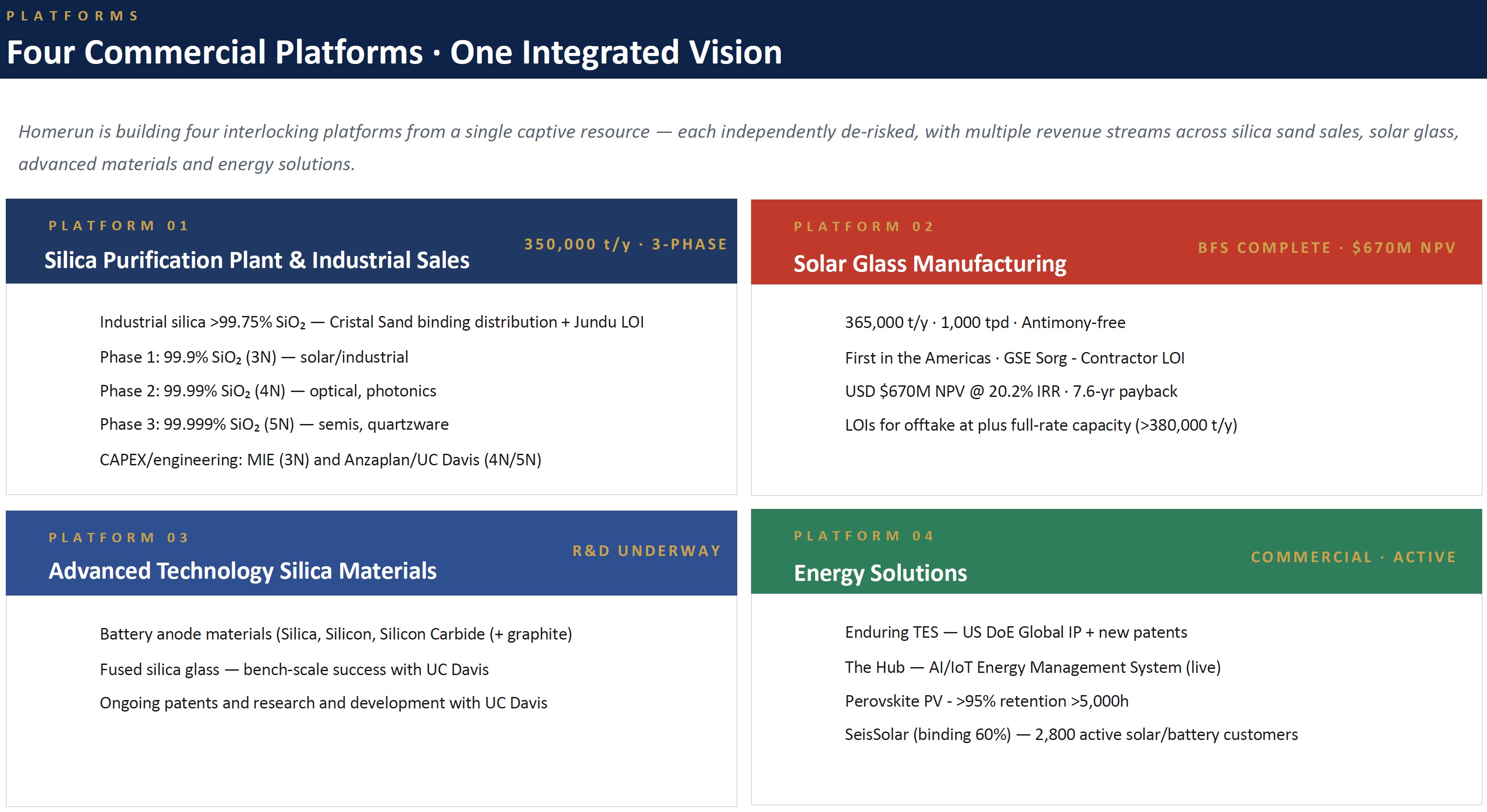
To better understand the scale of that ambition, it is helpful to examine the 4 commercial platforms that now form the foundation of Homerun’s long-term strategy:
Platform 1: Silica Purification
The first platform forms the foundation of the entire strategy.
While high-purity silica is already a valuable industrial material, its value can increase substantially as purity levels improve and additional applications become accessible.
Homerun’s purification roadmap is designed around a 3-phase progression:
- Phase 1 targets ~350,000 tonnes per year (tpy) of 3N silica, or greater than 99.9% SiO₂. This material is intended to serve industrial markets and provide feedstock for the company’s planned solar glass manufacturing facility.
- Phase 2 targets 4N silica, or greater than 99.99% SiO₂, opening opportunities in advanced industrial applications, optical products and specialty materials.
- Phase 3 focuses on 5N silica, or greater than 99.999% SiO₂, a purity level associated with some of the highest-value silica applications in the world, including semiconductor-related products, quartzware and advanced technology markets.
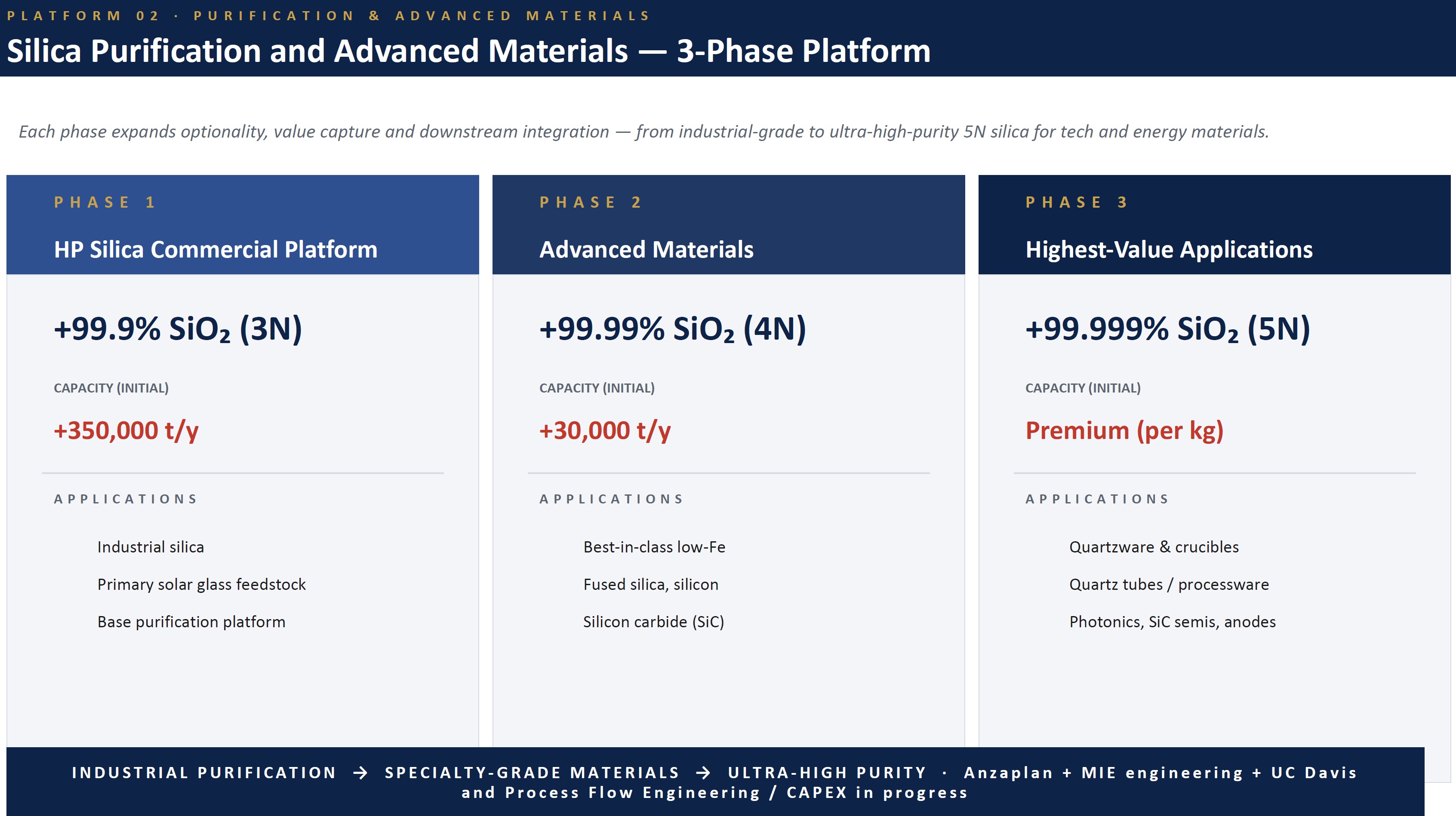
Importantly, Homerun is no longer operating solely at the conceptual stage. The company has recently engaged Minerali Industriali Engineering (MIE) and Dorfner Anzaplan to advance engineering, process route development and future capital cost estimates (CAPEX) for the proposed purification platform.
This marks an important transition. In the past, management focused on validating the quality of the resource and identifying potential purification pathways. The current phase is increasingly focused on industrial implementation. As a result, the purification platform appears to be evolving from a technical concept into a potential commercial business.
More importantly, it provides the critical link between the resource itself and many of the downstream opportunities that follow.
In many respects, purification is where the Silica Valley concept begins. Because once silica can be upgraded into increasingly higher-purity products, entirely new industries become accessible.
The next platform represents perhaps the most visible example of that opportunity:
Platform 2: Solar Glass Manufacturing
If the purification platform provides the foundation, the solar glass platform represents the first large-scale industrial expression of Homerun’s broader vision.
In the past, investors largely viewed the company as a resource development story. The completion of the Bankable Feasibility Study (BFS) for a proposed solar glass manufacturing plant in Bahia may have fundamentally changed that perception.
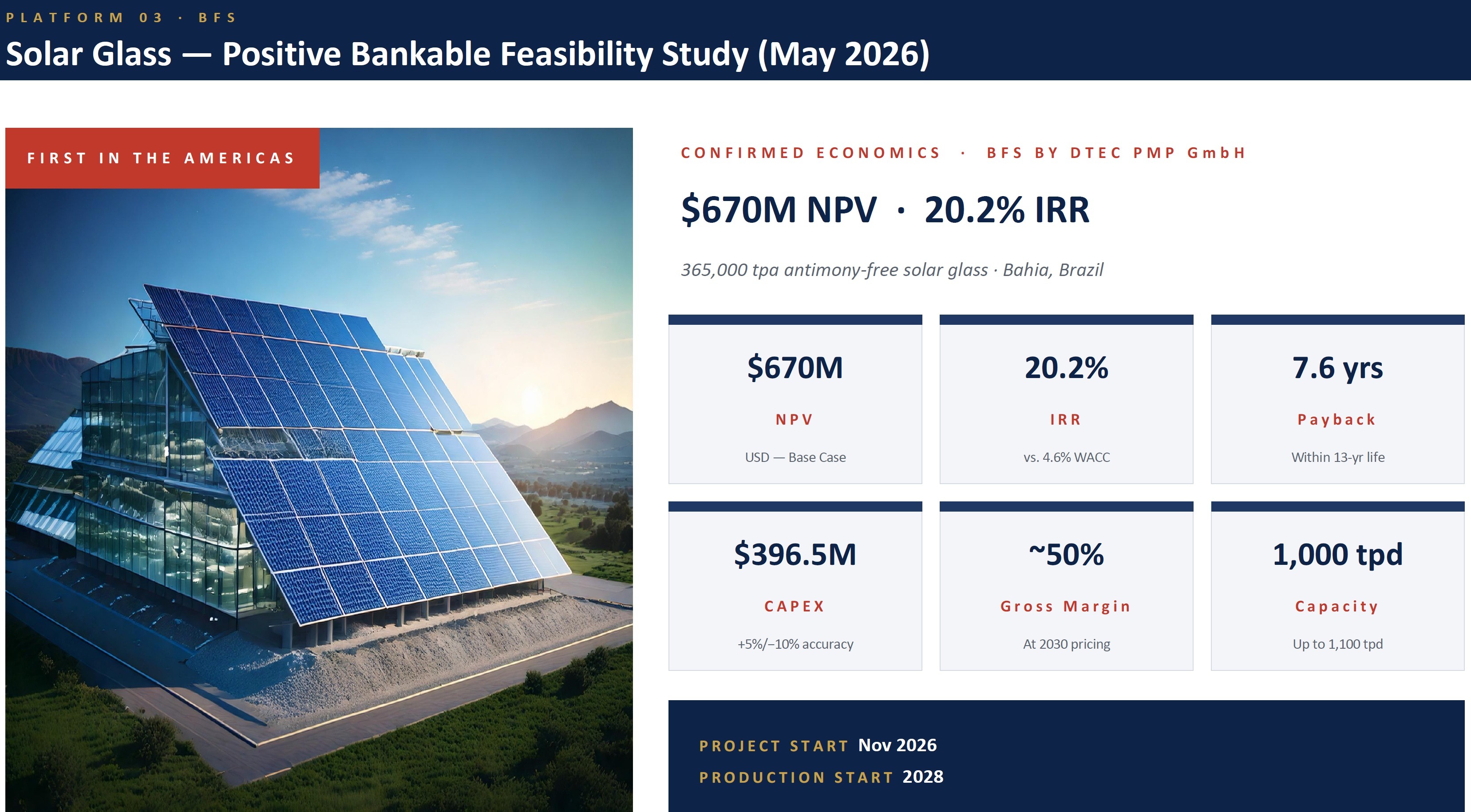
The BFS outlined a project capable of producing ~365,000 tonnes of antimony-free solar glass annually, positioning Homerun to become the first large-scale solar glass manufacturer in the Americas. More importantly, the study provided the first comprehensive engineering and economic framework supporting management’s long-standing objective of building value-added manufacturing capacity directly adjacent to its silica resources.
The reported economics were robust. The BFS outlined an estimated post-tax Net Present Value (NPV) of ~670 million USD, an Internal Rate of Return (IRR) of 20.2% and a payback period of 7.6 years. While future performance will ultimately depend on financing, construction, operating conditions and market demand, the results suggest that the project may possess the economic characteristics necessary to support large-scale industrial development.
However, the significance of the BFS extends beyond the numbers themselves:
- Before the BFS, the solar glass facility existed largely as a strategic concept. After the BFS, it became an engineered industrial project.
- Before the BFS, investors were evaluating a vision. After the BFS, investors could evaluate a blueprint.
This distinction is critical. The solar glass plant is not simply another downstream opportunity. It represents a direct link between Homerun’s silica resources and one of the fastest-growing industrial sectors in the world. Every solar panel requires solar glass. As global electricity demand continues to rise and nations seek greater energy security and domestic manufacturing capacity, demand for solar glass is expected to remain a critical component of future energy infrastructure.
For Homerun, the facility also creates an important strategic advantage: Rather than selling purified silica to third-party manufacturers, the company intends to become the manufacturer itself. In doing so, management seeks to capture additional margins, strengthen supply-chain control and establish a long-term industrial anchor for the broader Silica Valley strategy.
Perhaps most importantly, the currently proposed facility may represent merely the first step in a much larger industrial buildout. According to the BFS presentation, the site layout reserves space for a potential second production line that could eventually double manufacturing capacity. While such expansion remains conceptual at this stage, it illustrates how management appears to view the project – not as a standalone facility, but as the foundation of a much larger industrial platform.
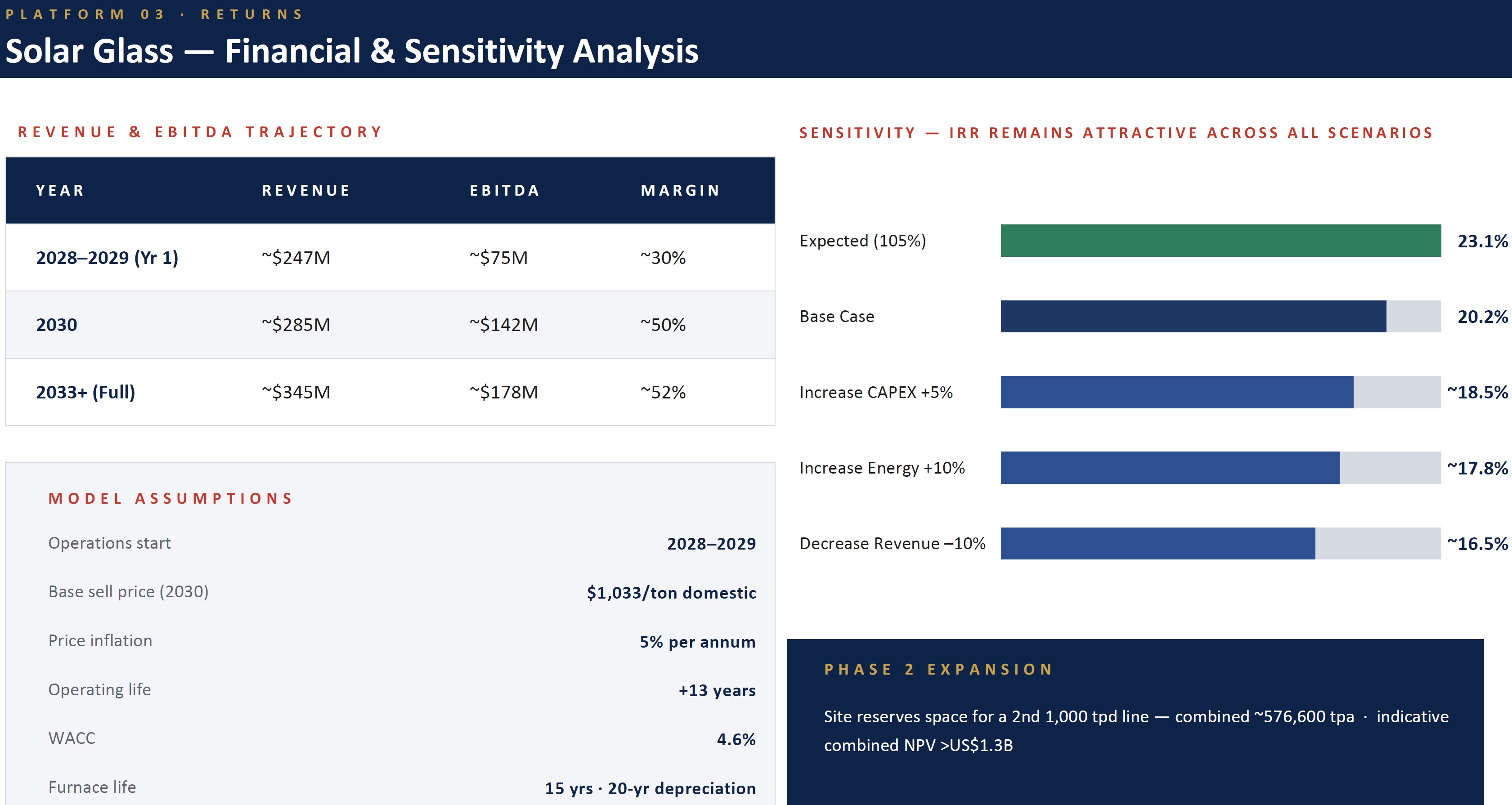
And it is this concept of scalability that begins to separate Homerun from many traditional resource companies. The objective is no longer merely to develop a mine. The objective is to build industries around the mine.
Platform 3: Advanced Materials
While the solar glass platform may currently attract the greatest investor attention, the advanced materials platform could ultimately prove to be one of the most significant long-term opportunities within the Homerun ecosystem.
The reason is simple. Historically, the highest margins in the silica value chain have rarely been generated by the raw material itself. Instead, value tends to increase as silica moves further downstream into increasingly specialized applications.
This is where Homerun’s research and development initiatives become particularly interesting. Working alongside researchers at the University of California, Davis, the company has been exploring pathways to transform its Bahia silica into a range of advanced materials, including fused silica glass, silicon carbide (SiC) and other high-purity silica-derived products.
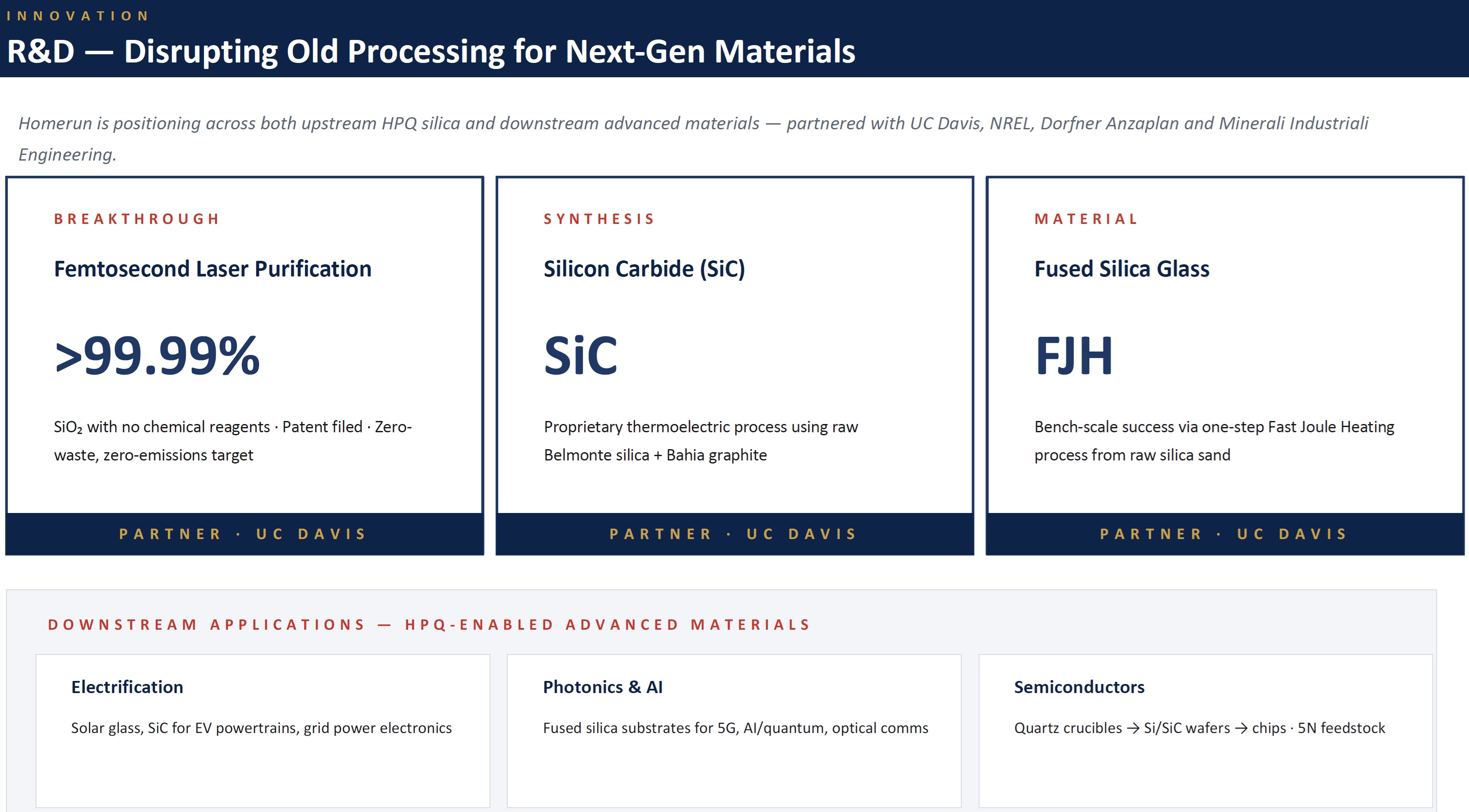
For many investors, these markets may appear unrelated to traditional mining. In reality, they represent some of the most strategically important materials supporting modern industry.
Silicon carbide, for example, has emerged as a critical material for next-generation power electronics. Compared to conventional silicon, SiC can operate at higher temperatures, higher voltages and greater efficiencies, making it increasingly attractive for electric vehicles, renewable energy systems, industrial power applications and data-center infrastructure.
Likewise, fused silica plays an essential role in industries ranging from semiconductors and photonics to telecommunications and advanced manufacturing.
These are not commodity markets. They are technology markets. And technology markets often command substantially higher margins than industrial mineral markets.
What makes Homerun’s position particularly interesting is that management is attempting to develop these opportunities from a resource base that has already demonstrated unusually high purity characteristics. Rather than sourcing feedstock from external suppliers, the company is exploring ways to integrate resource ownership, purification and advanced materials development within a single ecosystem.
This approach is still moving through technical development and commercialization planning. Customer qualification, scale-up work and market adoption will require additional progress. Nevertheless, the direction is noteworthy.
Most resource companies seek to move one step downstream. Homerun is attempting several. The company’s advanced materials initiatives suggest that management is not merely pursuing industrial applications for silica, but also exploring opportunities within some of the most technologically sophisticated segments of the global materials economy.
In doing so, the company is potentially expanding its addressable market far beyond traditional industrial minerals.
Yet even these opportunities may represent only part of the broader picture. Because beyond materials, Homerun is also positioning itself within another rapidly growing sector: Energy infrastructure.
And unlike many energy technologies that depend on scarce or expensive raw materials, this platform begins with something Homerun already possesses in abundance: Silica.
Platform 4: Energy Solutions
At first glance, energy storage, artificial intelligence and energy management software may appear disconnected from a silica development company. Yet within Homerun’s broader strategy, these initiatives represent a logical extension of the company’s effort to move further downstream and participate in higher-value segments of the industrial ecosystem it is building.
The centerpiece of this platform is Enduring, a long-duration thermal energy storage technology originally developed through years of research supported by the U.S. Department of Energy and the National Renewable Energy Laboratory (NREL).
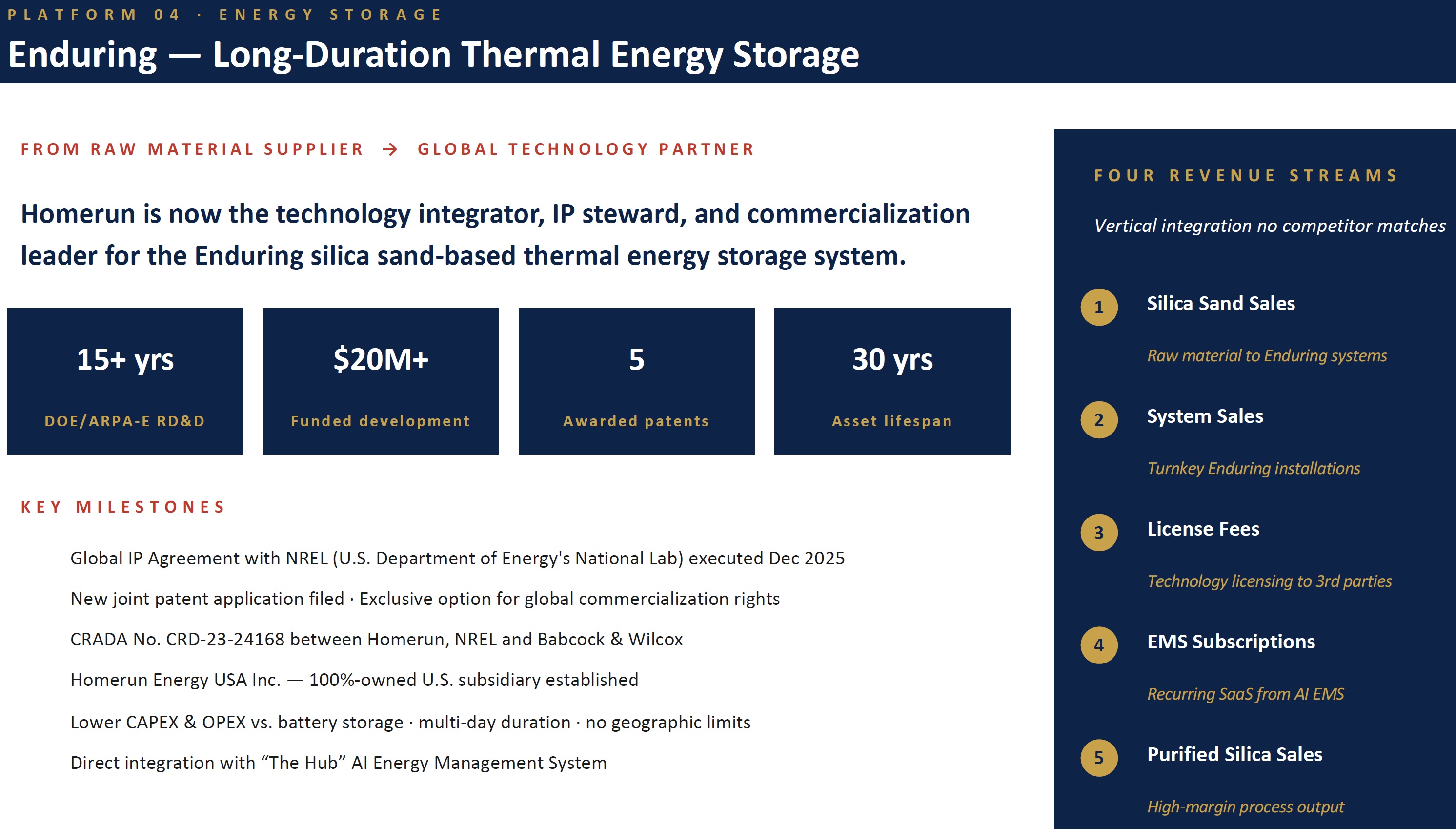
Unlike conventional battery systems that rely on electrochemical storage, Enduring utilizes silica sand as a thermal storage medium, allowing energy to be stored as heat and released when required. The technology is designed to provide long-duration storage solutions for industrial, utility and infrastructure applications while potentially offering lower costs and longer operating lifespans than many alternative storage technologies.
For Homerun, the strategic significance is obvious. The company controls the raw material. The company is pursuing commercialization rights. And the company intends to participate in future deployment opportunities.
Few resource companies possess exposure to both the feedstock and the technology platform itself. This distinction is important because technology businesses are often valued differently than mining or manufacturing companies.
Mining companies typically generate revenue by selling tonnes. Technology platforms can generate revenue through system deployments, licensing agreements, intellectual property and recurring service contracts. Enduring potentially introduces exposure to each of these higher-value revenue pathways.
The platform becomes even more interesting when viewed alongside The Hub, Homerun’s AI-driven energy management system. Designed to optimize distributed energy assets, battery storage systems and microgrids, The Hub aims to provide real-time monitoring, predictive analytics and autonomous energy management capabilities. While still early in its commercial development, the platform reflects management’s broader ambition to participate not only in energy infrastructure, but also in the software and intelligence layers that increasingly control it.
The planned acquisition of a majority interest in SeisSolar Fotovoltaica (a European provider of alternative energy solutions for commercial and industrial customers) further expands this strategy by adding an established customer base, distribution channels and renewable energy deployment experience in Europe.
Another noteworthy component within this platform is Homerun’s Perovskite PV technology portfolio in Europe. According to the latest corporate presentation, the company owns this technology 100%, supported by 15 years of PV technology experience and reported efficiency retention of more than 95% after over 5,000 hours. The presentation also highlights recognition as a Key Innovator by the European Commission Innovation Radar in December 2025, as well as a stability breakthrough in large-area perovskite modules in January 2026.
While still an emerging area, perovskite technology adds another layer of optionality to Homerun’s energy solutions strategy. It also reinforces the broader point that management is not limiting the company to silica extraction or even solar glass manufacturing, but is positioning across multiple parts of the solar and energy infrastructure value chain.
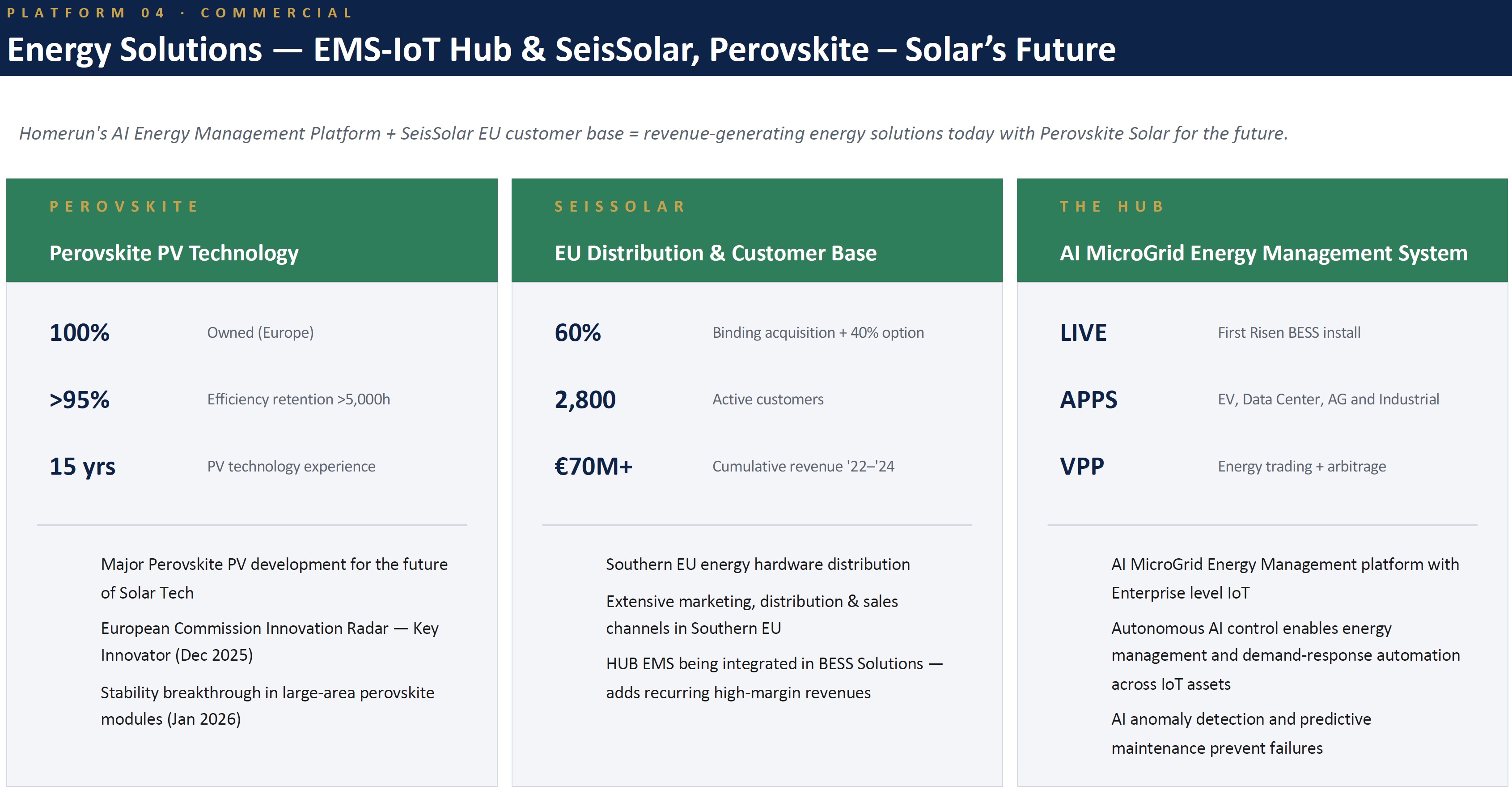
Viewed collectively, Enduring, The Hub, SeisSolar and Perovskite PV represent something uncommon within the resource sector. They introduce exposure to technology, systems integration, software and potentially recurring revenues.
Whether these initiatives ultimately achieve large-scale commercial success remains to be seen. However, they reinforce a recurring theme throughout the Homerun story.
Management is not simply attempting to sell raw materials. Nor is it solely focused on manufacturing products. Increasingly, the company is building an integrated platform that spans materials, manufacturing, infrastructure and technology.
When viewed together, the 4 commercial platforms begin to reveal a much larger picture. The silica resource may be the foundation, but the ultimate objective is the creation of an industrial ecosystem capable of generating value across multiple sectors of the modern economy.
In this sense, Enduring may be less a side project than a signal of how far Homerun’s ambitions now extend.
The company is not only moving downstream into processing and manufacturing, but also outward into technology, software, systems integration and intellectual property. For investors, that makes the energy solutions platform one of the clearest examples of how Homerun is evolving beyond the boundaries of a traditional resource company.
That broader vision is perhaps best illustrated by the concept that has become central to Homerun’s corporate identity: The Silica Valley.
From Silica District to Silica Valley
Viewed individually, Homerun’s 4 commercial platforms may appear to be separate initiatives:
- A purification business
- A solar glass manufacturing project
- An advanced materials platform
- An energy solutions portfolio
Taken together, however, they begin to reveal something much larger: An industrial ecosystem.
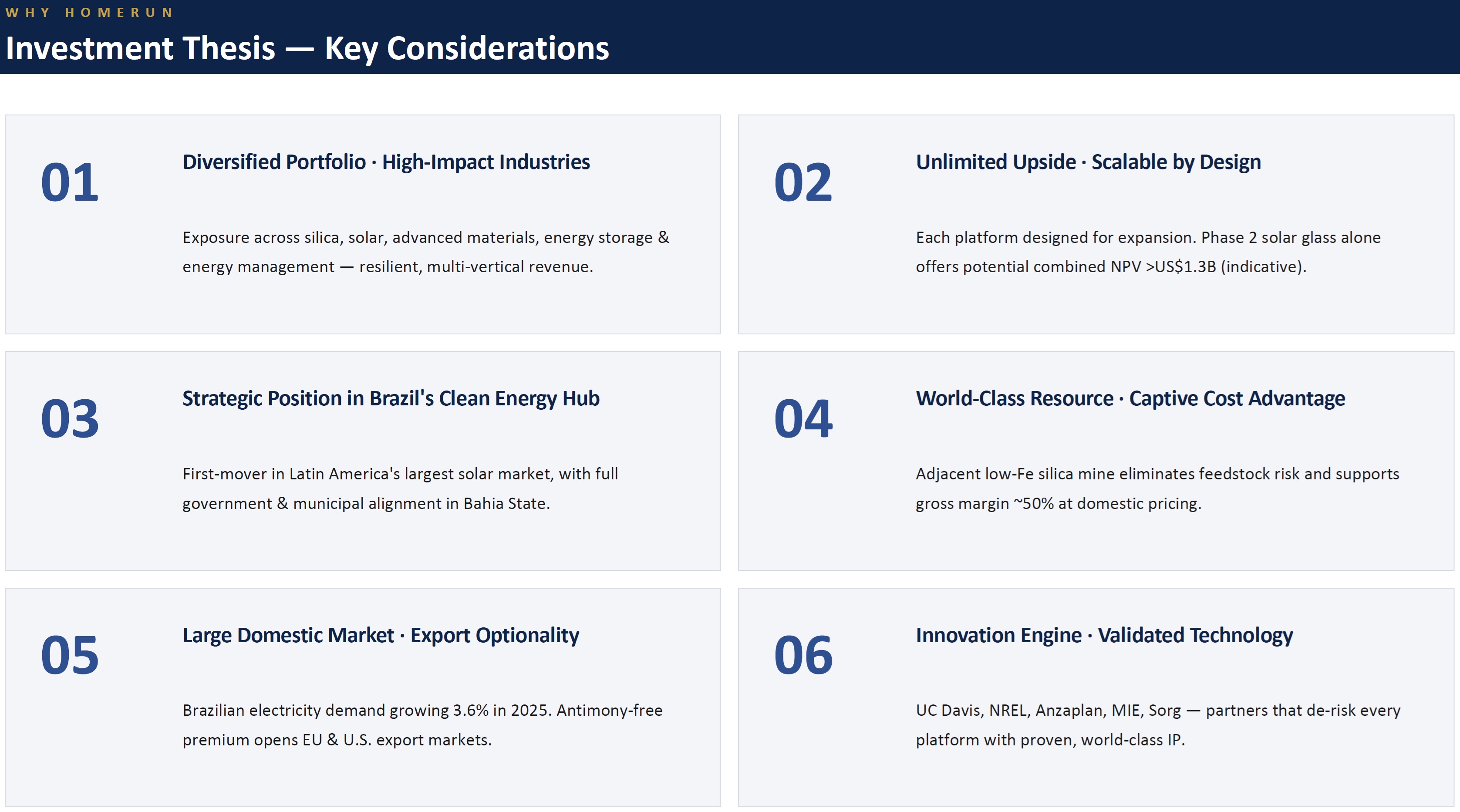
This is the concept management refers to as the “Silica Valley”. At first glance, the term may sound ambitious. Upon closer examination, however, it provides valuable insight into how management views the long-term opportunity in Bahia.
Silicon Valley did not become a global innovation hub because one company discovered a resource. It became a global innovation hub because an ecosystem formed around a strategic technology.
Likewise, major industrial clusters around the world emerged because resources, infrastructure, talent, manufacturing capacity, research institutions and end markets gradually became concentrated in one location.
Management appears to be pursuing a similar concept in Bahia, albeit centered around a very different strategic resource.
Over the past several years, Homerun has systematically assembled many of the key components required to support such an ecosystem. These include:
- High-purity silica resources
- Long-term mining rights
- Industrial land and surface rights
- Government support and institutional engagement
- Infrastructure and natural gas access
- Purification technologies
- Manufacturing pathways
- Research partnerships
- Commercial distribution channels
- Energy technology initiatives
Viewed separately, each milestone may appear incremental. Viewed collectively, they begin to resemble the foundation of a regional industrial cluster built around silica and its downstream applications.
At the center of this strategy lies a simple but powerful idea:
1 Resource. 4 Platforms. Multiple Industries.
Rather than exporting silica into somebody else’s value chain, Homerun is seeking to participate in several of the industries that depend upon it.
Those industries currently include silica purification, solar glass manufacturing, advanced materials and energy solutions. Taken individually, each platform could support a standalone business. Taken together, they begin to reveal the scale of the broader opportunity management is pursuing in Bahia.
The Bahia Advantage
Even the strongest industrial strategy requires the right location. In many respects, Bahia may represent one of the most important and underappreciated components of the Homerun story.
Historically, industrial clusters have emerged where several critical ingredients come together at the same time: Resource availability, infrastructure, energy, transportation access, labor and supportive government policy.
Management believes Bahia offers many of these advantages. The region combines access to high-purity silica resources with established transportation infrastructure, industrial development initiatives, deep-water export routes and growing renewable energy capacity.
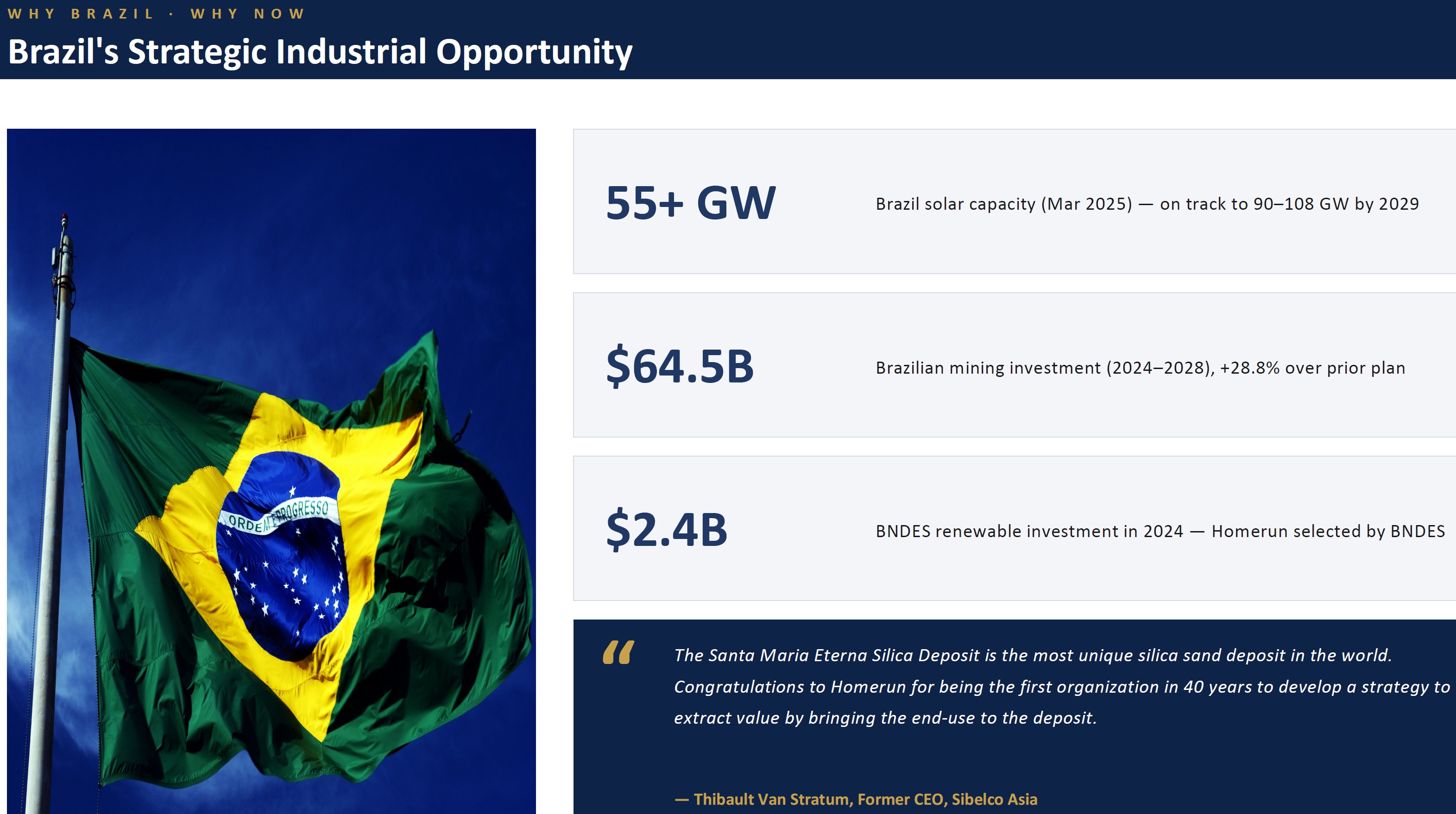
At the same time, Brazil’s broader economic objectives increasingly emphasize domestic value creation, advanced manufacturing and greater participation in strategic industrial supply chains.
This backdrop appears particularly relevant for Homerun’s vertically integrated approach. Rather than shipping silica to overseas processors and manufacturers, the company intends to bring purification, manufacturing and technology development closer to the resource itself. In doing so, management seeks to capture a greater share of the economic value chain while contributing to Brazil’s long-term industrial development objectives.
The timing may also be significant. Around the world, governments and corporations are reassessing supply chain dependencies and seeking greater resilience in critical industries.
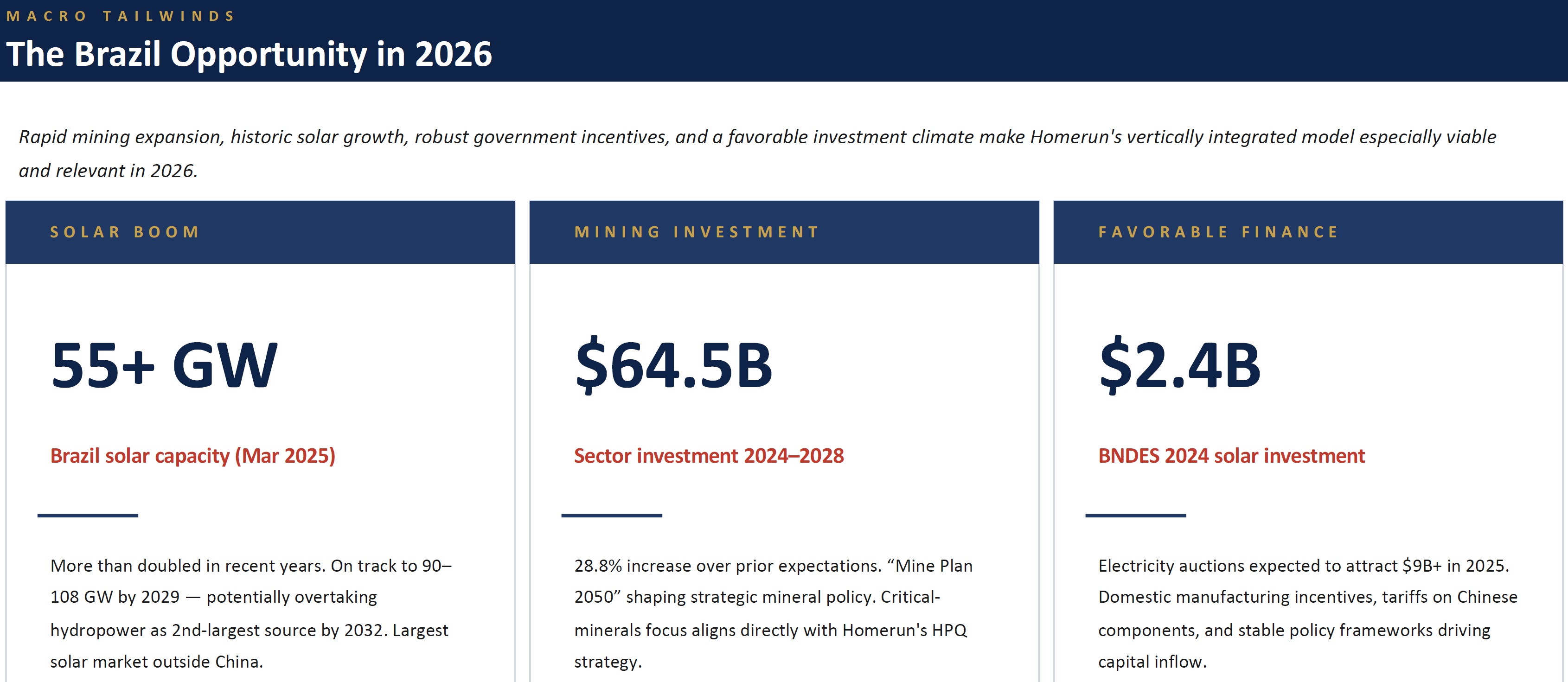
From semiconductors and energy infrastructure to advanced manufacturing and strategic materials, the focus has increasingly shifted from simply securing raw materials to securing complete industrial capabilities. This trend may create opportunities for new regional manufacturing hubs capable of serving growing domestic and international demand.
Homerun’s strategy is designed to capitalize on precisely this shift.
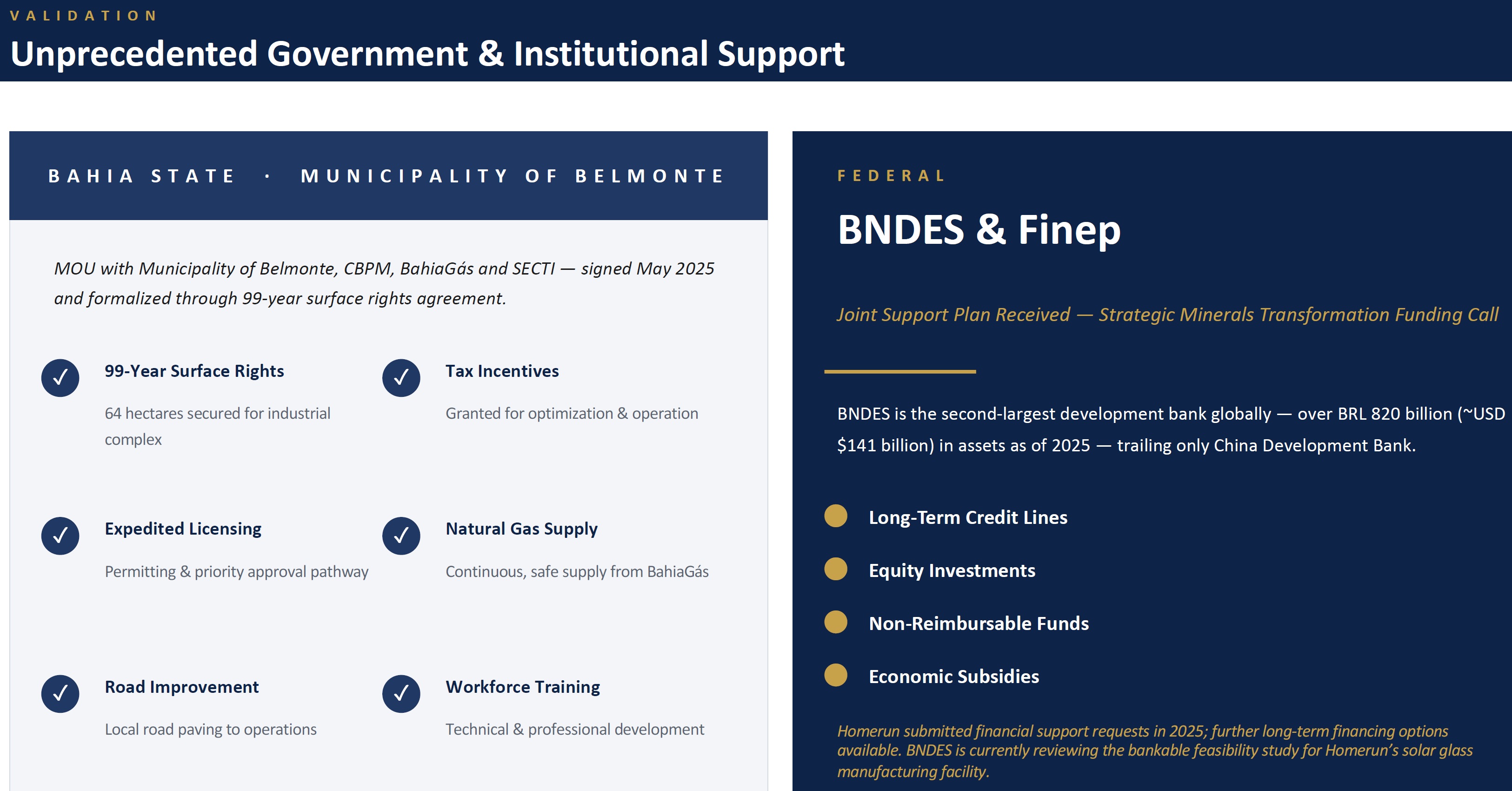
Rather than positioning itself solely as a resource supplier, the company is establishing an industrial platform capable of serving multiple sectors from a single geographic hub. If successful, Bahia may ultimately become more than the location of a silica deposit. It may become the location of an emerging industrial cluster built around one of the most versatile materials in the modern economy.
Timing Is Everything
Even the strongest industrial strategy can fail if the timing is wrong. In Homerun’s case, however, several powerful trends appear to be converging at the same time.
For decades, many industries prioritized efficiency above all else. Manufacturing capacity became concentrated in a limited number of regions, supply chains stretched across continents and critical materials were often sourced wherever costs were lowest.
Today, that landscape is changing. Governments and corporations alike are increasingly focused on supply-chain resilience, domestic manufacturing capacity and industrial self-sufficiency. Rather than relying exclusively on distant suppliers, many countries are seeking to establish more localized and diversified production networks for critical materials, advanced technologies and energy infrastructure.
This shift is creating new opportunities for integrated industrial platforms capable of serving regional markets.
At the same time, global electricity demand is entering a new phase of growth. The rapid expansion of artificial intelligence, cloud computing and hyperscale data centers is driving unprecedented demand for power infrastructure. New data centers require not only electricity, but also transmission networks, energy storage systems and reliable sources of generation capacity.
Solar power continues to play an increasingly important role in meeting that demand. As solar deployment expands around the world, so too does the need for solar glass, high-purity silica products, energy storage technologies and advanced materials used throughout the broader energy and technology sectors.
This trend extends well beyond traditional renewable energy markets. Increasingly, silica-derived materials are finding applications across semiconductors, photonics, power electronics, telecommunications and advanced manufacturing.
In many cases, the same forces driving digitalization are also driving demand for the materials required to support it.
Against this backdrop, Homerun’s strategy appears unusually well aligned with several long-term industrial themes simultaneously:
- The company is pursuing exposure to advanced materials.
- It is pursuing exposure to manufacturing.
- It is pursuing exposure to energy infrastructure.
- And through Enduring and The Hub, it is pursuing exposure to technology platforms and smart energy systems.
Importantly, these opportunities are not being pursued independently. They are being built around a common resource base and within a single geographic region.
That integration may prove increasingly valuable in a world where supply chains, manufacturing capacity and industrial resilience are becoming strategic considerations rather than merely operational ones.
In many respects, the Homerun story is not simply about what the company is building. It is also about when it is attempting to build it.
And the timing may prove to be just as important as the vision itself.
From Resource Company To Industrial Platform
Perhaps the most important question raised by Homerun’s strategy is also the simplest: What exactly is the company becoming?
For many investors, the answer may still appear straightforward: A silica company. A resource developer. A future mining operation in Brazil.
Yet after examining the various components of the business, that description appears increasingly incomplete.
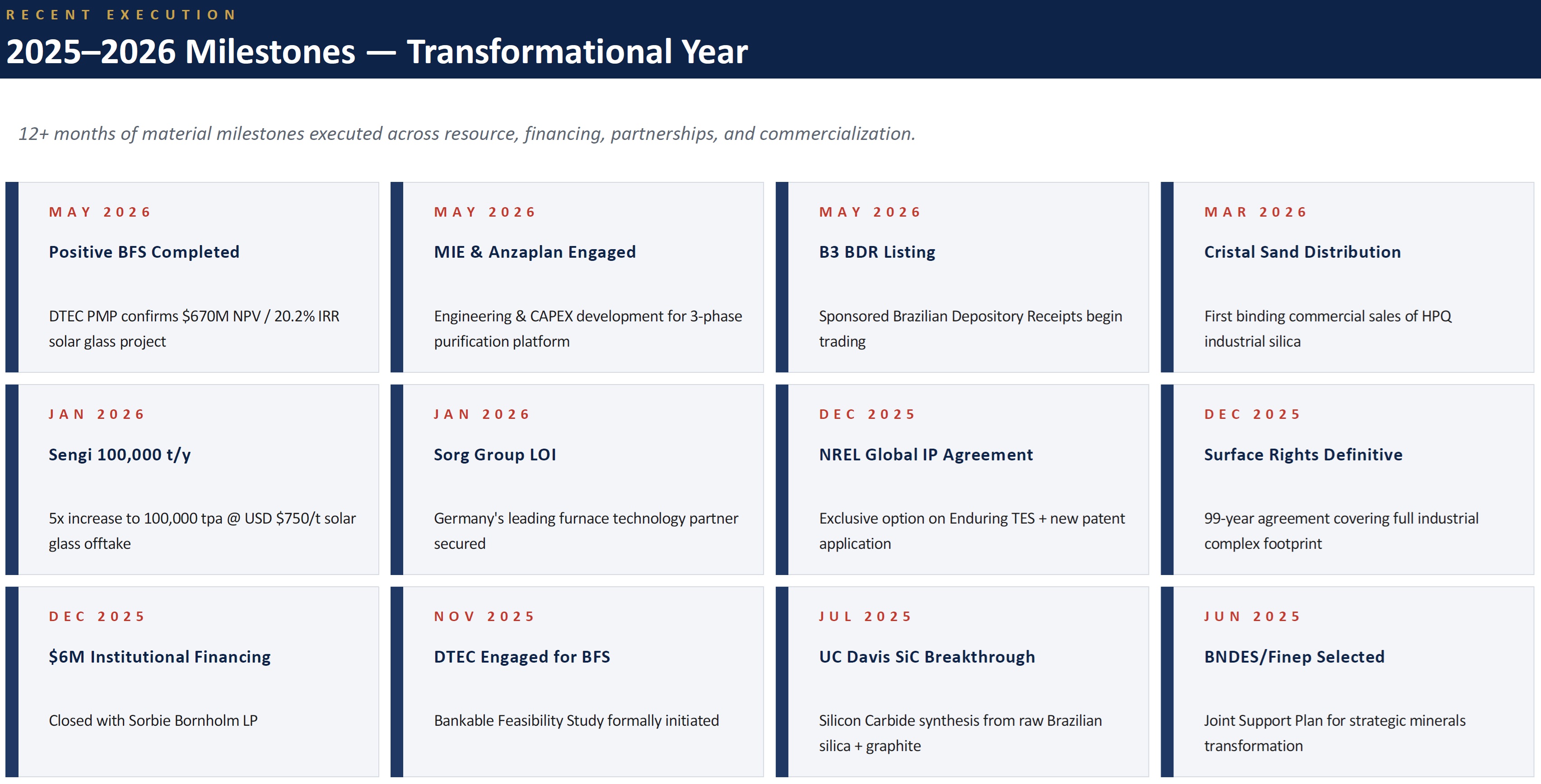
The silica resource remains the foundation, but resources alone do not fully explain the strategy.
The purification platform seeks to transform raw silica into increasingly valuable products. The solar glass platform introduces large-scale manufacturing. The advanced materials platform creates exposure to higher-value technology markets. And the energy solutions platform introduces technology, software, intellectual property and potential recurring revenue streams.
Viewed individually, each initiative is meaningful. Viewed collectively, they begin to resemble something quite different from a traditional mining company: An industrial platform.
This distinction may ultimately prove important because markets often value platforms differently than projects:
- Projects are finite. Platforms can expand.
- Projects generate revenue from a specific asset. Platforms create opportunities across multiple assets, products and industries.
- Projects are measured by what they produce. Platforms are often measured by what they enable.
Increasingly, Homerun appears to be pursuing the latter model. The silica resource may be the foundation, but the platform is the ultimate objective.
Bottom Line
Most junior resource companies spend years attempting to prove that a deposit has economic value and commercial viability.
Homerun is pursuing a far more ambitious objective. The company is attempting to prove that an entire industrial ecosystem can be built around that deposit.
The investment thesis is no longer centered solely on a silica resource in Bahia. It is increasingly centered on the possibility that this resource may serve as the foundation for multiple downstream businesses spanning purification, solar glass manufacturing, advanced materials, energy storage and technology solutions.
The recently completed BFS provided the first large-scale economic validation of that strategy.
The advancement of the purification platform suggests that industrial implementation is beginning to follow technical validation.
Research initiatives with UC Davis continue to explore higher-value applications for the company’s silica.
And Enduring introduces exposure to a technology platform that few resource companies can claim.
Importantly, these initiatives are not being pursued as isolated opportunities. They are increasingly being connected through a common resource base, shared infrastructure, strategic partnerships and a vision centered on capturing more value across the silica supply chain. This integrated approach is what ultimately distinguishes the company from many traditional resource development stories.
Ultimately, execution will determine whether management can transform vision into reality. Yet what makes Homerun increasingly interesting is that management is not attempting to create value from a single project, but from an integrated platform built around a strategic resource.
Whether Bahia ultimately becomes the Silica Valley envisioned by management remains uncertain.
What appears increasingly clear, however, is that Homerun is no longer simply pursuing a mining story.
The silica is the foundation.
The platform is the opportunity.
And the Silica Valley is the vision.
Company Details

Homerun Resources Inc.
#2110 – 650 West Georgia Street
Vancouver, BC, V6B 4N7 Canada
Phone: +1 844 727 5631
Email: info@homerunresources.com
www.homerunresources.com
ISIN: CA43758P1080 / CUSIP: 43758P
Shares Issued & Outstanding: 77,333,285
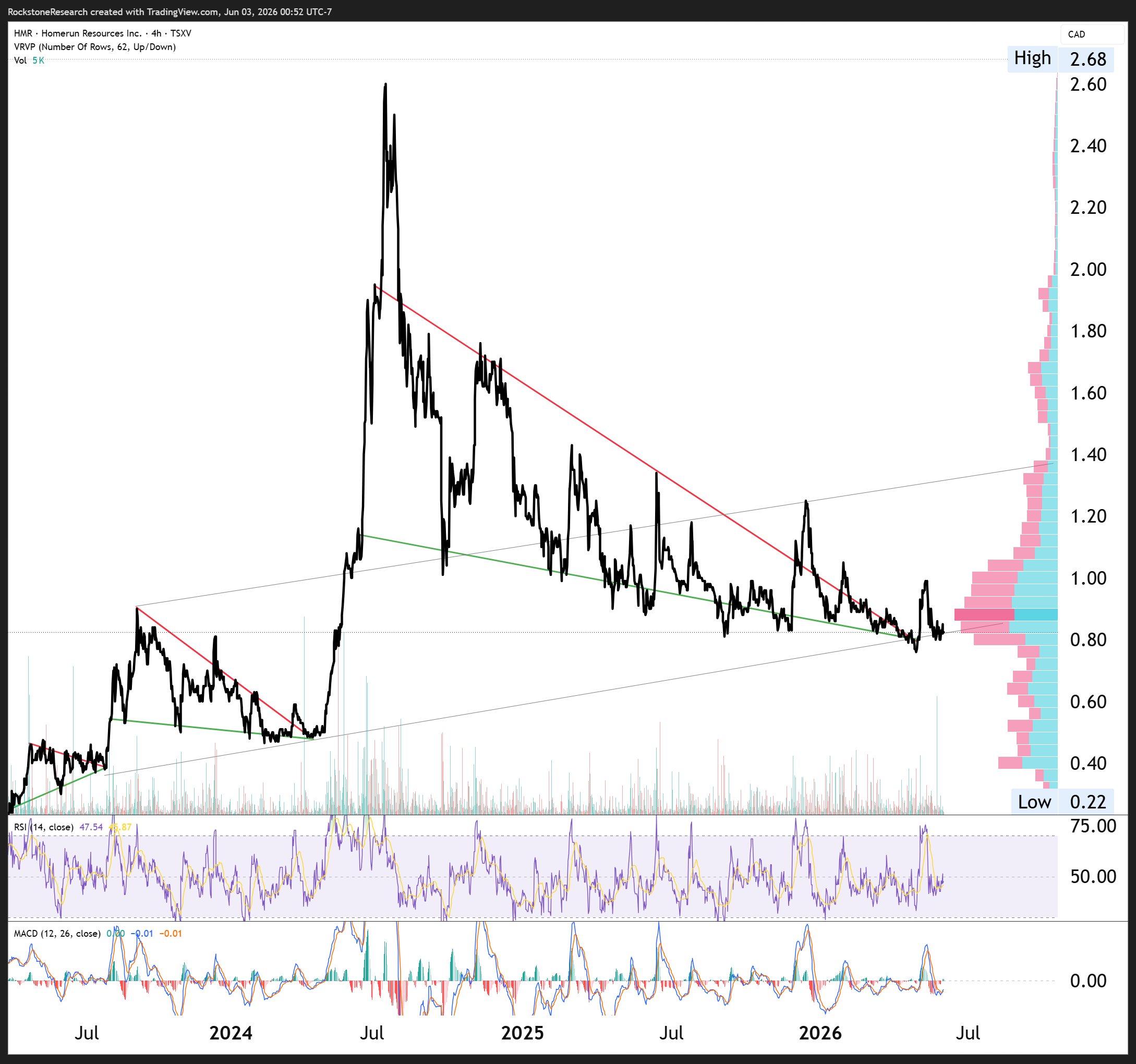
Canada Symbol (TSX.V): HMR
Current Price: 0.825 CAD (06/02/2026)
Market Capitalization: 64 Million CAD
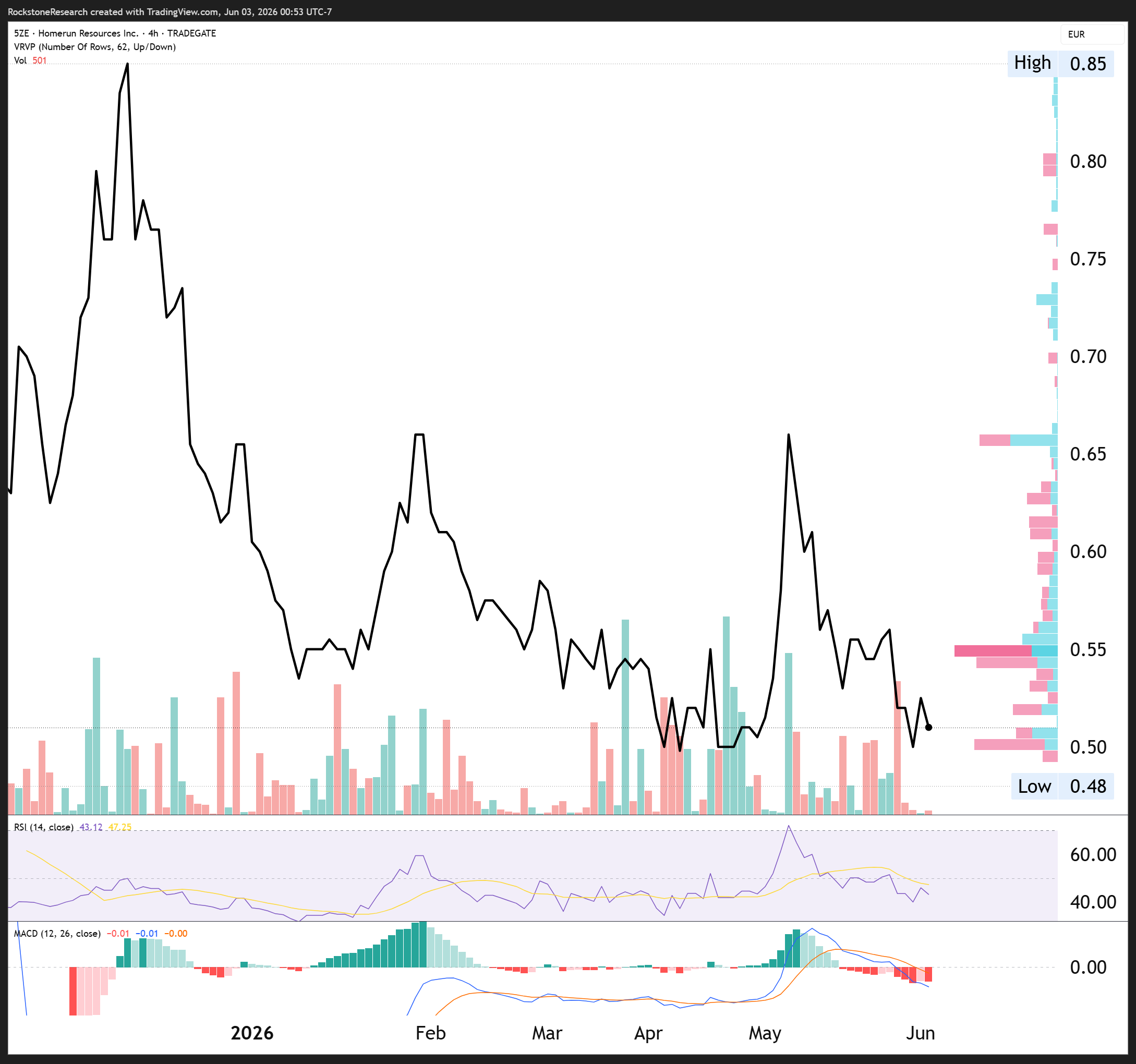
Germany Ticker / WKN: 5ZE / A3CYRW
Current Price: 0.52 EUR (06/03/2026)
Market Capitalization: 40 Million EUR

Stephan Bogner
Contact
Rockstone News & Research
Stephan Bogner (Dipl. Kfm., FH)
Müligässli 1, 8598 Bottighofen
Switzerland
Phone: +41-71-5896911
Email: info@rockstone-news.com
Disclaimer and Information on Forward Looking Statements: Rockstone and Homerun Resources Inc. (“Homerun“) caution investors that any forward-looking information provided herein is not a guarantee of future results or performance, and that actual results may differ materially from those in forward-looking information as a result of various factors. The reader is referred to Homerun’s public filings for a more complete discussion of such risk factors and their potential effects, which may be accessed through its documents filed on SEDAR+ at www.sedarplus.ca. All statements in this report, other than statements of historical fact, should be considered forward-looking statements. Much of this report is comprised of statements of projection, interpretation and strategic analysis. Such statements involve known and unknown risks, uncertainties and other factors that may cause actual results, developments or events to differ materially from those anticipated in these forward-looking statements. There can be no assurance that such statements will prove to be accurate, as actual results and future events could differ materially from those anticipated in such statements. Forward-looking statements in this report include statements, interpretations, conclusions, industrial comparisons, strategic observations and market commentary regarding Homerun Resources Inc.’s proposed vertically integrated silica platform, including statements related to the strategic importance of the Company’s high-purity silica resources in Bahia, Brazil, its planned silica purification platform, proposed solar glass manufacturing facility, advanced materials initiatives, energy solutions platform and broader “Silica Valley” strategy. Forward-looking statements also include expectations regarding the commercial, operational and strategic implications of the Company’s Bankable Feasibility Study (“BFS”) for its proposed solar glass manufacturing facility in Bahia, Brazil, including assumptions that the BFS may support infrastructure planning, financing discussions, engineering development, strategic partnerships, downstream manufacturing integration, domestic value-added production and future commercial advancement. Additional forward-looking statements include expectations regarding Homerun’s 3-phase silica purification roadmap, including assumptions that the Company may successfully advance Phase 1 industrial silica production, future 4N and 5N purification stages, downstream advanced materials initiatives, solar glass feedstock integration and vertically integrated industrial manufacturing operations. Forward-looking statements further include expectations regarding the Company’s proposed solar glass manufacturing facility, including assumptions related to production capacity, antimony-free solar glass production, project economics, NPV, IRR, payback, CAPEX, site layout, potential future expansion, customer demand, domestic and export markets, offtake opportunities, financing, construction, commissioning and the facility’s role as a potential industrial anchor within the Company’s broader Silica Valley strategy. Forward-looking statements also include expectations regarding the Company’s advanced materials initiatives, including assumptions related to fused silica, silicon carbide, high-purity silica-derived products, semiconductor-related applications, photonics, power electronics, quartzware, advanced manufacturing applications and ongoing research and development activities with UC Davis or other technical partners. Forward-looking statements further include expectations regarding the Company’s energy solutions platform, including Enduring thermal energy storage, The Hub AI-driven energy management system, SeisSolar Fotovoltaica, perovskite PV technology and related commercialization pathways, including assumptions related to system deployments, licensing, intellectual property, recurring service revenues, technology adoption, customer growth, energy infrastructure markets and broader integration with Homerun’s silica-based industrial platform. Forward-looking statements also include statements regarding financing engagement and financing discussions, including assumptions that interest from finance parties, strategic investors, infrastructure partners, lenders, development institutions or other counterparties may progress into structured financing arrangements, strategic partnerships, commercial agreements or project funding. Forward-looking statements are based on current expectations, estimates and assumptions that are inherently subject to uncertainty and may differ materially from actual outcomes. Industrial Platform Execution Risks: Statements regarding Homerun’s potential evolution into a vertically integrated silica purification, solar glass, advanced materials and energy solutions platform are subject to substantial execution risk. The Company remains in a development-stage phase and may face significant challenges associated with engineering, financing, permitting, construction, commissioning, commercialization, manufacturing ramp-up, supply-chain integration, customer qualification, technology deployment, downstream product acceptance and operational scaling. There can be no assurance that Homerun will successfully transition into a sustainable industrial platform or that anticipated integration benefits, operating efficiencies or commercial advantages will materialize. Silica Valley Strategy Risks: Statements regarding the development of a “Silica Valley” in Bahia, Brazil are forward-looking and conceptual in nature. There can be no assurance that Homerun will successfully establish an integrated industrial ecosystem, attract sufficient partners, secure necessary financing, develop required infrastructure, achieve commercial scale or create the regional industrial cluster described or implied in this report. Industrial ecosystem development is complex and may be affected by financing constraints, infrastructure limitations, permitting delays, market adoption, political conditions, partner performance and broader economic factors. Purification Platform Risks: Statements regarding Homerun’s planned silica purification platform, including Phase 1, 4N and 5N purification stages, are forward-looking and subject to technical, operational and commercial uncertainty. There can be no assurance that engineering studies, process routes, CAPEX estimates, equipment procurement, infrastructure access, operating assumptions, commissioning timelines or construction schedules will proceed as anticipated. Development of industrial purification infrastructure may involve cost overruns, technical modifications, permitting delays, contractor performance issues, procurement constraints or operational challenges that could materially impact the project. Solar Glass Development Risks: Statements regarding the proposed solar glass manufacturing facility are forward-looking and subject to significant uncertainty. There can be no assurance that the facility will be financed, constructed, commissioned or operated according to current expectations, or that the project will achieve anticipated production capacity, product quality, operating costs, margins, customer acceptance, offtake volumes or economic returns. Actual project performance may differ materially from BFS assumptions due to financing conditions, construction costs, energy costs, market pricing, operating performance, regulatory developments, supply-chain constraints or changes in demand. BFS and Economic Assumption Risks: Statements regarding the BFS, including NPV, IRR, payback, CAPEX, margins, production capacity, operating life, pricing assumptions or sensitivity scenarios, are forward-looking and based on assumptions that may not materialize. Feasibility studies are not guarantees of future performance. Actual project costs, revenues, timelines, operating conditions, financing terms and market outcomes may differ materially from those assumed in the BFS. Expansion and Scalability Risks: Statements regarding potential future expansion, including a second solar glass production line, broader industrial buildout or increased manufacturing capacity, are conceptual and forward-looking. There can be no assurance that any expansion will be pursued, financed, permitted, constructed or commercially justified. Future expansion may depend on market conditions, financing availability, operating success of initial facilities, customer demand, infrastructure capacity and regulatory approvals. Purification and Product Quality Risks: Statements regarding silica purity, processing performance, impurity reduction, product consistency and suitability for industrial, solar glass or advanced materials applications are subject to technical and operational risks. Silica purification performance may vary due to geology, metallurgy, process conditions, scaling challenges, quality-control requirements or customer-specific technical specifications. There can be no assurance that future production will consistently achieve anticipated purity levels, customer acceptance standards or downstream application requirements. Advanced Materials Risks: Statements regarding fused silica, silicon carbide, 4N or 5N products, semiconductor-related materials, photonics, quartzware, power electronics, advanced manufacturing applications or other high-purity silica-derived products are inherently speculative and subject to substantial technical and commercial uncertainty. There can be no assurance that laboratory or pilot-scale results will translate into commercial production, customer qualification, economic viability or market acceptance. Technology and Intellectual Property Risks: Statements regarding Enduring, The Hub, perovskite PV technology, UC Davis research, NREL-related technology, intellectual property, patents, licensing, system deployments or recurring revenue opportunities are forward-looking and subject to technology development, commercialization, adoption and intellectual property risks. There can be no assurance that such technologies will be successfully commercialized, protected, licensed, deployed or adopted by customers, or that they will generate anticipated revenues or competitive advantages. Energy Solutions Commercialization Risks: Statements regarding Enduring thermal energy storage, The Hub AI energy management system, SeisSolar, perovskite PV technology or broader energy solutions opportunities are subject to commercialization risk. Technology deployment may be affected by customer adoption, regulatory requirements, competing technologies, project economics, system performance, financing availability, market acceptance, integration challenges, software performance, hardware availability and partner execution. Customer Qualification and End-Market Acceptance Risks: Statements regarding potential applications in solar glass, fused silica, silicon carbide, semiconductors, photonics, AI infrastructure, quartz crucibles, power electronics, energy storage, perovskite PV or other high-purity silica markets are forward-looking. There can be no assurance that Homerun’s future products, systems or technologies will meet customer-specific qualification requirements, pricing expectations, performance standards or commercial acceptance criteria in any target market. Infrastructure and Shared Development Risks: Statements regarding shared infrastructure, utility leverage, site synergies, natural gas access, road improvements, export routes, surface rights, operational efficiencies or accelerated engineering timelines are forward-looking and subject to risk. There can be no assurance that infrastructure development, utilities, logistics access, energy availability, water supply or broader site-development assumptions will proceed according to expectations or generate the anticipated benefits. Brazil and Jurisdictional Risks: Statements regarding Brazil’s domestic manufacturing objectives, BNDES or other institutional engagement, federal strategic minerals programs, Bahia state support, permitting pathways, infrastructure development or regional industrial policy are forward-looking and subject to political, regulatory, administrative and economic uncertainty. Government priorities, financing programs, incentives, permitting processes, tax treatment, infrastructure commitments or policy frameworks may change and may not result in the benefits currently anticipated. Financing Risks: Statements regarding financing engagement, financing discussions or strategic interest from counterparties are inherently forward-looking. There can be no assurance that discussions with finance parties, lenders, strategic investors, infrastructure funds, development institutions or commercial counterparties will result in binding agreements, financing commitments or funding arrangements on acceptable terms or at all. Failure to secure adequate financing could delay, scale back or prevent development of the Company’s projects and platforms. Market Demand and Commercialization Risks: Statements regarding industrial silica demand, solar glass demand, downstream customer sales, advanced materials applications, energy storage opportunities, energy infrastructure markets or broader technology-related demand are subject to market uncertainty. Demand for silica products, solar materials, advanced purification products, energy storage systems or technology platforms may be impacted by changes in market conditions, pricing pressure, competing technologies, regional overcapacity, import competition, regulatory developments, customer preferences or broader economic conditions. Construction and Operational Risks: Development of industrial processing, purification, manufacturing and technology deployment facilities involves substantial construction and operational risks, including engineering challenges, contractor performance issues, permitting delays, cost escalation, commissioning challenges, workforce limitations, equipment failures, infrastructure dependencies, supply-chain constraints and operational ramp-up risks. There can be no assurance that the Company’s projects will be constructed or operated according to current expectations, budgets or timelines. Comparative Industrial Analogy Risks: References in this report to vertically integrated industrial platforms, industrial ecosystems, specialty materials companies, advanced manufacturing businesses, technology platforms or industrial-scale operating models are provided for conceptual and strategic discussion purposes only. Such comparisons may not accurately reflect Homerun’s future operating profile, financial performance, scalability, market positioning or valuation outcomes. Readers should not assume that Homerun will achieve comparable economics, operating performance, market relevance or commercial success merely because industrial comparisons or strategic analogies are discussed in this report. Macroeconomic and External Risks: Homerun’s business and development plans may be affected by broader macroeconomic, geopolitical, regulatory, energy-market, supply-chain, inflationary, currency, commodity-price or capital-market developments. External events including political instability, changes in trade policy, permitting delays, infrastructure disruptions, labor shortages, energy-price volatility, financing constraints or broader economic conditions may materially impact the Company’s development plans, financing prospects, construction timelines or commercial opportunities. Accordingly, readers should not place undue reliance on forward-looking information. Actual results may differ materially from those expressed or implied in the forward-looking statements contained in this report. Rockstone and the author of this report do not undertake any obligation to update any statements made in this report except as required by law. Past performance, comparisons to other companies, projects, commodities, technologies, jurisdictions, feasibility studies, capital-market events or industry trends are provided for illustrative purposes only and should not be considered indicative of future results.
Disclosure of Interest and Advisory Cautions: Nothing in this report should be construed as a solicitation to buy or sell any securities mentioned. Rockstone, its owners and the author of this report are not registered broker-dealers or financial advisors. Before investing in any securities, you should consult with your financial advisor and a registered broker-dealer. Never make an investment based solely on what you read in an online or printed report, including Rockstone’s report, especially if the investment involves a small, thinly-traded company that isn’t well known. The author of this report, Stephan Bogner, is paid by Homerun Resources Inc. On September 8, 2025, Homerun announced that the company “entered into an agreement with Rockstone Research to provide marketing services to the company”, and that “Rockstone Research is an arm’s-length marketing firm and has been engaged for an initial three-month term for total consideration of $25,000, which is payable up front. The company does not propose to issue any securities to Rockstone in consideration for the services to be provided to the company.” The author owns equity of Homerun and thus will profit from volume and price appreciation of the stock. This also represents a significant conflict of interest that may affect the objectivity of this reporting. The author may buy or sell securities of Homerun (or comparable companies) at any time without notice, which may give rise to additional conflicts of interest. Overall, multiple conflicts of interests exist. Therefore, the information provided in this report should not be construed as a financial analysis or recommendation but as an advertisement. This report should be understood as a promotional publication and does not replace individual investment advice. Rockstone’s and the author’s views and opinions regarding the companies that are featured in the reports are the author‘s own views and are based on information that was received or found in the public domain, which is assumed to be reliable. Rockstone and the author have not undertaken independent due diligence of the information received or found in the public domain. Rockstone and the author of this report do not guarantee the accuracy, completeness, or usefulness of any content of this report, nor its fitness for any particular purpose. Lastly, Rockstone and the author do not guarantee that any of the companies mentioned in the reports will perform as expected, and any comparisons that were made to other companies may not be valid or come into effect. For the avoidance of doubt, this report is not intended for distribution to, or use by, any person or entity in any jurisdiction where such distribution, publication or use would be contrary to local law or regulation. Readers are solely responsible for ensuring that their review and use of this report is lawful in their jurisdiction. Neither Rockstone nor the author accepts liability for any direct or indirect loss arising from the use of this report or from any investment decision made in reliance on it. Please read the entire Disclaimer carefully. If you do not agree to all of the Disclaimer, do not access this website or any of its pages including this report in form of a PDF. By using this website and/or report, and whether or not you actually read the Disclaimer, you are deemed to have accepted it. Information provided is educational and general in nature and should not be interpreted as personalized investment, financial, legal, tax or professional advice. Data, tables, figures and pictures, if not labeled or hyperlinked otherwise, have been obtained from Stockwatch.com, Tradingview.com, Homerun Resources Inc. and the public domain. The cover picture has been obtained and licenced from 123rf.com.