
Everyone is talking about the silver price. Will it continue to rise? Is a correction coming? Is now the right time to enter? These are understandable questions. But they fall short.
Because the truly decisive question is: Do I actually own silver or do I only hold a financial product that tracks the silver price? This question is becoming increasingly important right now.
The new World Silver Survey 2026 by the renowned Silver Institute clearly shows that the silver market is changing in the background – not in the short term, but structurally.
The market is consuming more silver than it produces
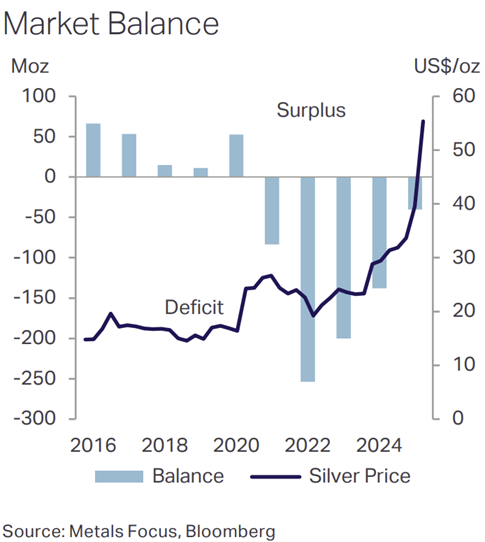
The silver market has been in deficit for years. This means that globally, more silver is being consumed than is newly produced and recycled. For 2025, the report shows a deficit of around 40 million ounces. For 2026, the sixth consecutive year of deficit is expected.
The following chart illustrates this development very clearly:
Scarcity develops quietly, not overnight
What may initially sound technical is actually quite simple: If more silver is consumed than supplied over many years, existing reserves become increasingly important. Physical silver becomes scarcer.
Silver has long become a resource of the future
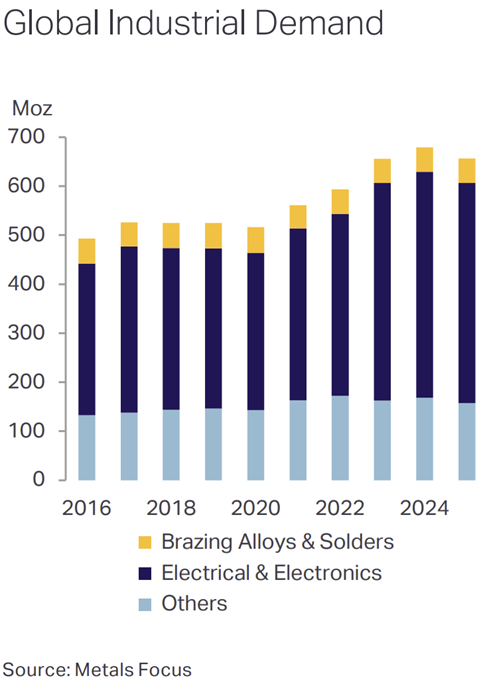
At the same time, the role of silver is changing. It is no longer just a traditional precious metal but a key raw material for many future technologies. Silver is needed in photovoltaics, electronics, electromobility, data centers and applications related to artificial intelligence.
The new report from the Silver Institute shows that industrial demand has increased significantly in recent years. This is turning silver into a strategic resource rather than just a traditional investment product.
Supply cannot simply be increased
While demand remains structurally high, the situation on the supply side looks different. Many investors assume that rising prices automatically lead to increased production. However, this is only partially true for silver.
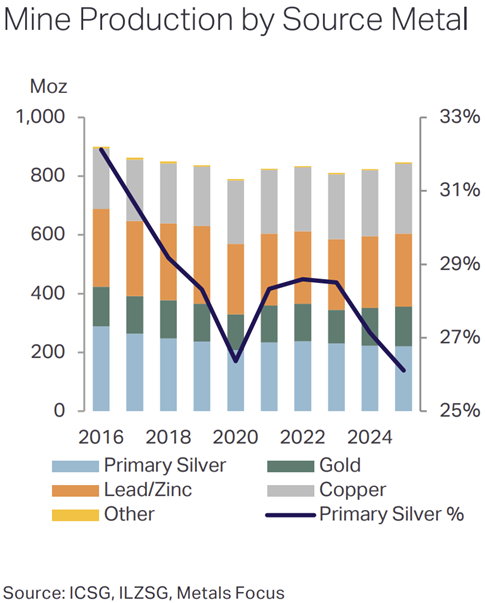
A large portion of silver does not come from primary silver mines but is produced as a by-product of mining other metals such as copper, lead or zinc. As a result, production cannot be increased flexibly, even when prices rise. This means that even rising prices do not solve the problem immediately.
Less buffer means more tension in the market
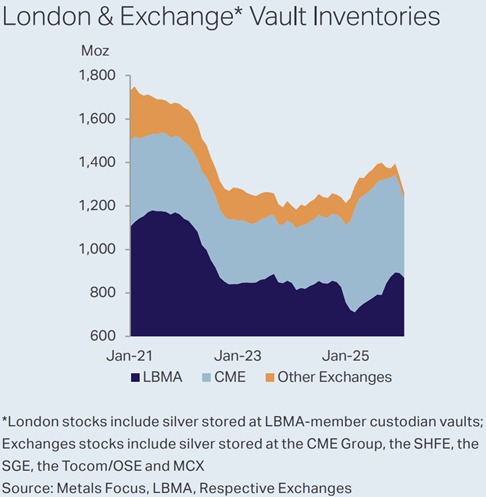
Another point that is often overlooked is the development of inventories and market liquidity. The report describes that freely available silver inventories have declined in recent years. At the same time, the market is becoming more susceptible to bottlenecks and stronger price fluctuations.
Paper silver is not the same as real silver
At this point, a crucial difference emerges that many investors underestimate.
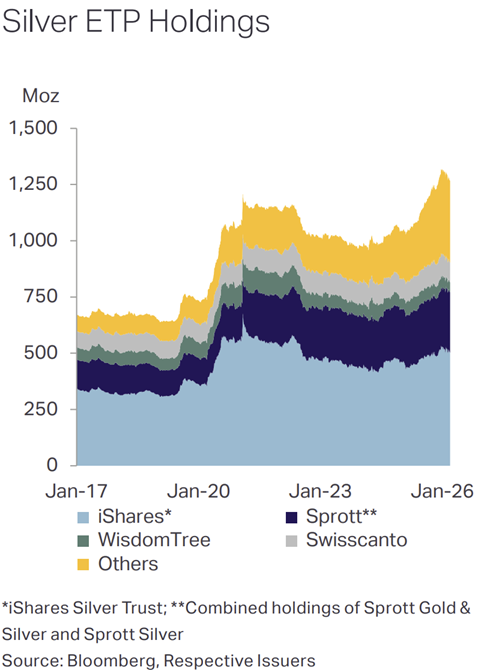
Today, many invest in silver through ETFs, ETCs or other financial products. These track price movements and are easy to trade. However, in most cases, the investor does not hold physical metal but merely a claim within a financial structure. In extreme situations, access always depends on that structure, not on the investor.
You often own the price, but not the metal
In other words, you often own the silver price, but not necessarily the silver itself.
As long as markets are calm, this difference is hardly noticeable. But in a tightening market, this changes. When physical metal becomes scarcer, the question of real ownership becomes more important.
Then it is no longer just about the price at which you bought. It is about whether you actually have access to physical metal.
Elementum focuses on real ownership instead of financial promises
This is exactly where the Elementum concept comes in.
At Elementum, customers acquire real silver that is held entirely in their own name. It is not a financial product but physical ownership. The storage takes place in a Swiss bonded warehouse, in highly secure vault facilities.
While financial products focus on price movements, Elementum focuses on physical ownership. The silver is physically present, clearly allocated and stored independently of issuers.
Why many German investors are buying less and why this is misleading
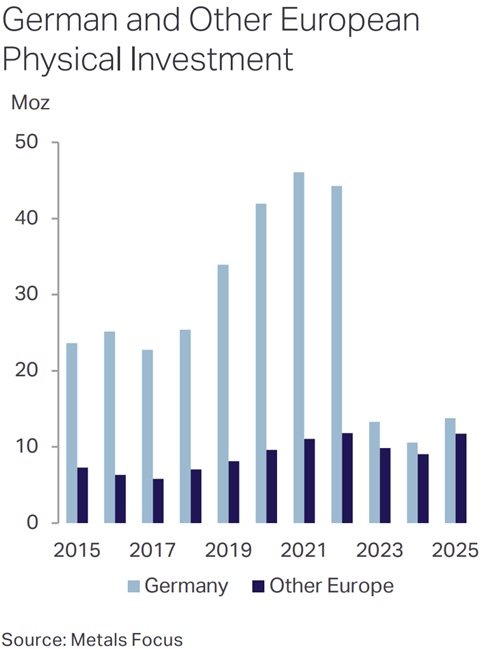
In recent years, physical silver demand in Germany has declined significantly.
At first glance, this seems contradictory. If silver is becoming scarcer, why are fewer people buying? The reason lies not in the attractiveness of silver, but in regulation.
At the end of 2022, the so-called differential taxation for many silver products in Germany was effectively abolished. This fundamentally changed the tax treatment. Previously, only the dealer’s margin was taxed. Suddenly, the full VAT of 19% applied to the entire purchase price.
For investors, this had noticeable consequences: Silver became significantly more expensive almost overnight. Premiums rose in some cases to 30-40% above the actual metal value. For many retail investors, this made entry unattractive.
The decline in demand is therefore not a sign of a weak market environment, but a direct consequence of political and tax changes.
Elementum offers a decisive advantage here
This is where the structural difference becomes clear.
While traditional silver purchases in Germany are burdened by VAT and high premiums, Elementum uses a different model:
Elementum customers acquire physical silver directly in a Swiss bonded warehouse, a high-security vaulting facility. The legal transfer of ownership from Elementum Deutschland GmbH to the customer takes place within this bonded warehouse. The purchased silver is stored by Elementum International AG in Switzerland in the name of the customer. Since both the acquisition and storage take place within the bonded warehouse, no VAT is incurred upon purchase or during storage. Especially in a market where physical silver is becoming increasingly scarce over the long term, this form of direct, VAT-free storage represents a decisive advantage.
Real ownership becomes the decisive advantage
This is the key difference: At Elementum, silver does not exist merely on paper, but as a real asset.
The new silver report therefore shows more than just numbers. It shows a market in transition. Demand remains high, supply is limited and available inventories are becoming increasingly important.
Bottom Line: Those who own physical silver can look to the future with confidence
The most important question for investors is therefore not only: Where is the silver price heading in the short term?
The much more important question is: Do I actually own my silver?
Those who hold physical silver own a real asset. And this is of great importance in a tightening market. The new silver report clearly shows: Silver is needed industrially, supply is limited and available inventories are becoming more important over the long term.
Short-term price fluctuations are part of the silver market. This should not unsettle anyone. What matters is not the price today or tomorrow, but the long-term development.
Those who own silver hold something that is needed worldwide, cannot be increased at will and is likely to become more valuable in the coming years because it is becoming scarcer.
That is why a calm, strategic approach is worthwhile. Regular purchasing can help smooth out price fluctuations and build a solid position over time. Combined with secure, VAT-free storage in a Swiss bonded warehouse, this results in a stable long-term wealth structure.
Those who already own physical silver today can therefore look to the future with confidence. Not because the price must rise every day, but because they own something of substance: A resource that is becoming scarcer, is needed industrially and can create real value over time.
And this is exactly where Elementum provides a clear answer: Those who invest in a structured way today benefit not only from potential price increases, but above all from ownership itself.
How can you buy precious metals cheaply and store them safely?
Elementum Deutschland GmbH, based in Sindelfingen (Germany), specializes in trading physical precious metals. Customers who purchase precious metals from Elementum Deutschland (or one of the other national Elementum companies in five European countries) can store them in the renowned high-security vaulting facilities in the St. Gotthard Massif in Switzerland at Elementum International AG.
Of course, you also have the option of purchasing gold and silver directly and having it delivered to your desired address. However, storing silver in the so-called open duty-free warehouse (“offenes Zollfreilager”) at St. Gotthard offers decisive tax advantages:
- The 19% value added tax customary in Germany is completely waived on purchases and sales – a considerable price advantage that effectively secures you 19% more silver for your money.
- If you store your silver in this high-security vault, you can sell it back to Elementum Deutschland GmbH at any time – without any bureaucratic hassle and also without VAT, as the trade takes place within the duty-free warehouse. You will receive the funds via bank wire.
- VAT is only payable when you physically remove the stored silver – either by picking it up in person (after prior notification) or by having it shipped to your address.
More silver, more return
Thanks to duty-free storage, you receive 19% more physical silver when you buy. This additional amount also participates in the performance of the silver price if it rises – a leverage effect that significantly improves your return opportunities.
About Elementum
Elementum is a second-generation, owner-managed family business. Trust, consistency, and long-term thinking are at the heart of our philosophy. The Board of Directors of Elementum International AG is composed of internationally renowned experts in the money and precious metals markets, including economists, analysts, university professors, and precious metals specialists. This in-depth expertise forms the backbone of our actions – for your security, your assets, and your future.
About the Author
Stephan Bogner
CEO of Elementum International AG
Stephan Bogner, who holds a degree in business administration, studied economics at ISM Dortmund (Germany) and wrote the university’s first thesis on precious metals as a hedge against inflation. After studying in the UK and Australia and gaining professional experience in Dubai, he took over as CEO of Elementum International AG in Switzerland in 2012. His expertise in precious metals has had a significant impact on the company’s development.
Contact
Rockstone News & Research
Stephan Bogner (Dipl. Kfm., FH)
Müligässli 1, 8598 Bottighofen
Switzerland
Phone: +41-71-5896911
Email: info@rockstone-news.com
Disclaimer: This article reflects the personal opinion of the author. Elementum assumes no responsibility for the accuracy of the content and accepts no liability for its use. This article may contain links to external third-party websites. Elementum is not responsible for the content of these external sites and expressly distances itself from all information provided there. At the time the links were created, no unlawful content was identifiable. This article does not constitute a recommendation to buy or sell. Elementum International AG is a Swiss company that specializes exclusively in the storage of physical precious metals in a high-security vault facility located in the St. Gotthard mountain massif in Central Switzerland. The Board of Directors and Executive Management of Elementum International AG have been selected solely based on their professional expertise and long-standing experience in precious metals markets. As these individuals may also be professionally active outside their roles at Elementum International AG, the company has no influence over their external activities and respects their right to freedom of expression. Therefore, the views expressed by persons working with or for Elementum do not necessarily reflect the opinion of Elementum International AG. Investments in precious metals are subject to risks, including those specific to the structure of this market. Please read our full risk disclosures and consult a licensed financial advisor before making any investment decisions. Neither the author, Elementum International AG, nor Elementum Deutschland GmbH assume any liability for actions taken based on the information provided. Past performance is not indicative of future results. The cover picture has been obtained and licenced from Shutterstock.com.